
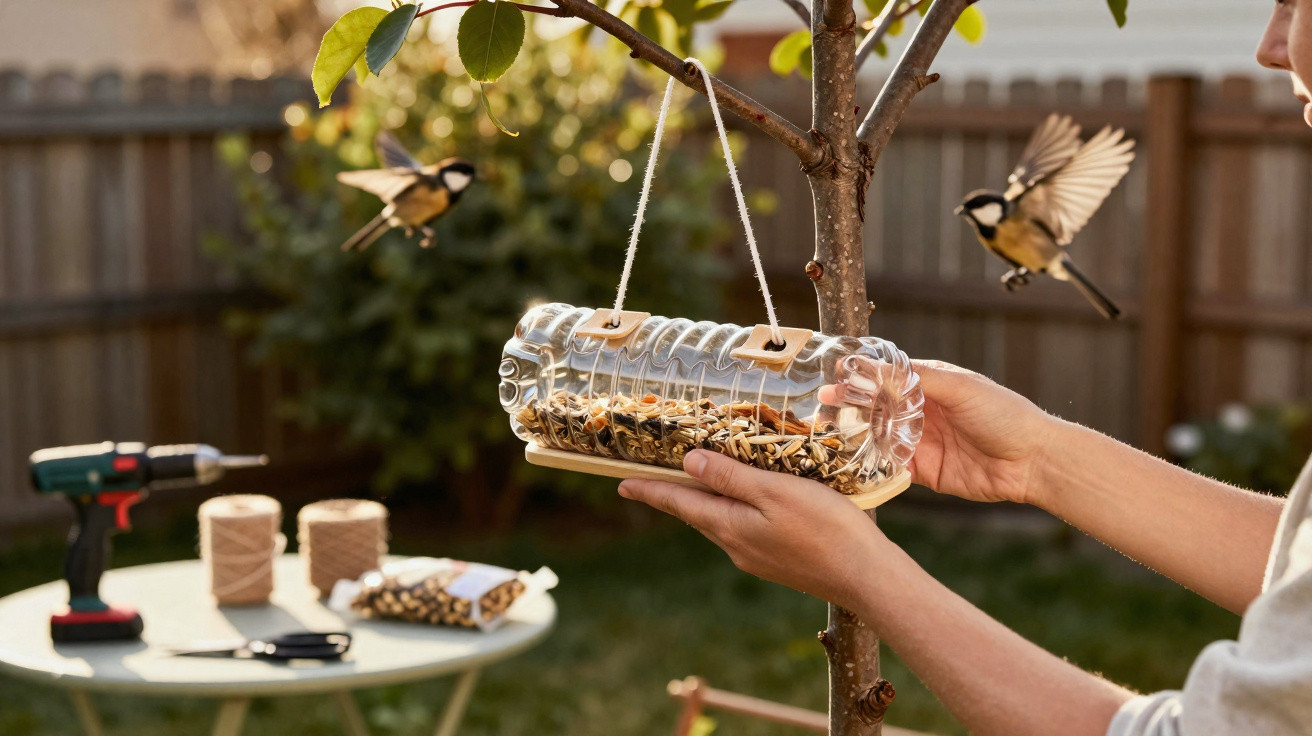
The plastic bottle was cloudy and dented, destined for the recycling bin. Two sparrows touched down on the balcony rail, cocked their heads, then flew away again, unimpressed by the bare concrete. Pale winter light covered the buildings, while the city felt oddly silent without birdsong.
Then an idea appeared: what if that useless bottle could become their little café in the sky?
All it took was a pair of scissors, some string and a handful of seeds. Hardly impressive in theory. But 20 minutes later, a slightly wonky homemade feeder was hanging by the window, turning gently in the breeze. The same sparrows returned, hovered nearby, inspected it and eventually perched. One bird pecked first, followed by the other.
A small, wonderfully silly triumph.
Seen from the kitchen sink, the scene had an almost film-like quality. Everyday life seemed to slow around those two busy, fearless visitors. The bottle creaked in the wind, and seed husks scattered across the sill.
Something completely ordinary had become full of life.
The best thing is that this modest, clumsy-looking idea works much better than you might expect.
The next empty bottle you hold may never seem quite the same.
Why a plastic bottle bird feeder works better than it seems
The appeal of this idea begins with something nearly everyone has: a used plastic bottle. Usually, it is dropped into the recycling without a second thought. Turning it into a feeder gives it a new role that you can see unfolding in front of you.
It becomes a transparent little stage where birds arrive, feed, squabble and return.
For a bird, your garden or balcony is simply one potential stop during a long hunt for food. A hanging plastic bottle bird feeder is easy to notice, particularly when it catches the light and moves softly in the breeze. Birds can spot the seed inside, learn where to reach it and remember the location.
There is nothing sentimental about it for them. They are hungry, practical and efficient.
There is a human element too. A shop-bought feeder may feel like a piece of “equipment”, whereas a homemade version feels like a small agreement with nature. You spend ten minutes cutting two holes, pushing through a stick and adding seed, and suddenly your home becomes part of a local survival network.
For such an uncomplicated idea, the effect on urban wildlife can be surprisingly meaningful.
How to make a plastic bottle bird feeder in under 20 minutes
Begin with a clean plastic bottle, preferably one holding 1 to 1.5 litres, with a cap that still screws on securely. Rinse it out and dry it thoroughly so that traces of juice or sugar do not attract wasps.
Hold the bottle horizontally and consider where a small bird could stand and feed without losing its footing.
Using a marker, draw two small feeding windows on opposite sides, around 8–10 cm from the base. Make each opening approximately the height of a coin and slightly wider: large enough for a beak, but not for an entire bird. Cut them carefully with sturdy scissors or a craft knife to prevent the plastic from splitting.
Smooth the cut edges as much as possible so tiny feet are not injured.
Then make two small holes directly below each window. Thread a wooden spoon, narrow dowel or straight twig through the bottle so that it projects equally on both sides. This creates the perch. Pour birdseed through the top until the bottle is two-thirds full, then replace the cap.
Lastly, pierce two holes close to the neck, thread through strong string or wire, and suspend the feeder somewhere visible to birds but out of reach of cats.
Once it is hanging, the small details matter. Position it at least 1.5–2 metres above ground level, with an open view so birds can see predators approaching. Do not place it where it will thrash about in strong wind; a slight movement is fine, but not a storm-time pendulum.
If possible, hang it close to a tree or shrub where birds can wait safely.
Your choice of seed affects which birds visit. A simple combination of sunflower hearts, millet and cracked corn attracts a varied group. Sunflower hearts alone often appeal to more finches and tits. Steer clear of inexpensive mixes packed with coloured pieces and wheat, as many birds will simply throw those aside.
Let’s be honest: nobody studies birdseed labels for three hours, but a quick look can save both money and mess.
There is one further consideration: plastic deteriorates outdoors. Every week or two, inspect your feeder for cracks, sharp edges or mouldy seed. A quick wash with warm water and a small brush will keep the feeding openings clear. If the contents look damp and soggy, stop refilling it for a few days.
Birds may tolerate an “out of service” sign, but they will not tolerate spoiled food.
“It was the cheapest entertainment we had.”
These small emotional moments are what make the idea memorable in everyday life. On a dull Tuesday, watching a blue tit awkwardly reverse on to the bottle perch can improve your mood in a way no app can.
When the day has been difficult, that brief flash of life beyond the window can feel unexpectedly grounding.
Before you start cutting, use this short checklist:
- Pick a strong bottle (1–1.5 L), rather than one that is flimsy or badly crushed.
- Make coin-sized feeding holes 8–10 cm above the base.
- Push a wooden spoon or stick through the bottle to form a stable perch.
- Choose good-quality birdseed, avoiding coloured mixes or those heavily bulked out with wheat.
- Hang it high, away from cats, with a clear surrounding view.
Simple changes that make a bottle feeder a bird magnet
Bottle feeders do not all perform equally well. A minor adjustment to their position can double the number of visits. Birds want both safety and a clear view: they need to spot danger early, while having a nearby branch to retreat to.
Hanging the bottle within 1–3 metres of a tree or dense shrub often provides exactly that balance.
Light is more important than many people realise. If you can, choose a spot with morning sunshine and afternoon shade. Early daylight makes the seeds and plastic glimmer enough to draw the attention of passing birds. Shade later in the day prevents the seed from overheating and limits condensation inside the bottle.
You will probably see more activity at dawn and shortly before dusk.
A quieter setting also makes a difference. A plastic bottle bird feeder beside a banging door or a busy barbecue area may remain noticeably empty. Shift it a couple of metres into a more peaceful corner, and the very same birds may become more relaxed. On a balcony, even moving it away from the rail where you usually stand can encourage bolder visits.
We all recognise that feeling of arriving somewhere and immediately knowing whether it is “for us” or not. Birds do as well.
| Key point | Details | Why it matters to readers |
|---|---|---|
| Best bottle size and type | Choose a clear 1–1.5 L plastic bottle with a screw cap and reasonably rigid sides. Do not use extremely thin bottles that crumple when cut. | Stronger bottles survive longer outside, are safer for birds’ beaks and feet, and will not buckle beneath the seed’s weight. |
| Ideal hanging location | Suspend it 1.5–2 m above the ground, within a few metres of a tree or shrub, and away from the base of dense hedges where cats can hide. | This combination of height and nearby shelter helps small birds feel secure enough to return often. |
| Cleaning and refill rhythm | In dry weather, empty and lightly rinse the feeder every 2–3 weeks; during damp periods, do this weekly. Allow it to dry before adding fresh seed. | Regular cleaning limits mould and disease, ensuring the feeder remains a healthy stop rather than a hazardous one. |
Once the feeder has become part of the setting, you begin to notice its miniature dramas: the dominant great tit chasing every other bird away; the timid dunnock approaching only when the area is completely clear; the robin that appears convinced the whole garden legally belongs to it.
On a day when bad news is constantly buzzing from your phone, that tiny soap opera can be strangely reassuring.
Something else gradually changes too. The empty bottle in your hand no longer looks like rubbish. It becomes possibility: a future meal stop for a migrating finch, a patient blackbird or a winter-fat squirrel that will shamelessly steal the seed. On a street where everything appears planned and controlled, it is one small act of generosity with nothing expected in return.
The same simple idea works on a balcony, in a courtyard or outside an office window.
We have all caught ourselves gazing through the window, lost in thought, before a bird lands nearby and brings us back to the moment. A plastic bottle feeder simply gives that moment more chances to happen.
Perhaps your first attempt will be slightly crooked, with holes that are too large and a perch that is off-centre.
It truly does not matter. Birds do not read DIY blogs. They investigate, adjust and return when something suits them. If they do not visit, move the feeder, alter the seed blend or raise it a little higher.
The experimenting is part of the story you create with a piece of discarded plastic and a handful of seed.
The next time you hold an empty bottle above the bin, you may hesitate for a moment. A quiet “what if” may appear at the back of your mind. Perhaps you will recycle it. Or perhaps you will pick up a marker, cut two small windows and hang it where the sky feels close.
After that, the choice belongs to the birds.
FAQ
- What kind of birdseed works best in a plastic bottle feeder? For most gardens, a mixture of sunflower hearts, millet and small grains is effective. Avoid blends containing lots of large whole corn or wheat, as many small birds toss these out, leaving waste beneath the feeder.
- How long does a plastic bottle feeder usually last outdoors? A good-quality, thicker bottle may last for one to two seasons before the plastic becomes brittle. If you notice cracks, sharp edges or a hanger beginning to tear, retire it and make another from a new bottle.
- Isn’t plastic dangerous for birds? When used carefully, a smooth bottle with neatly cut openings is safe enough for garden use. Jagged edges and long, loose strings create the real danger, so keep cuts tidy, knots short and replace the bottle once it begins to deteriorate.
- Why aren’t any birds coming to my feeder? Birds often need one to two weeks to discover a new food source. Try shifting the feeder by a couple of metres, selecting a quieter or slightly higher position, and using a seed mixture with more sunflower hearts to make it more appealing.
- How often should I clean the inside of the bottle? In cool, dry conditions, rinsing every few weeks is usually sufficient. During wet spells or heatwaves, clean it weekly, discard clumped seed and allow the bottle to dry completely before refilling it.

Comments
No comments yet. Be the first to comment!
Leave a Comment