
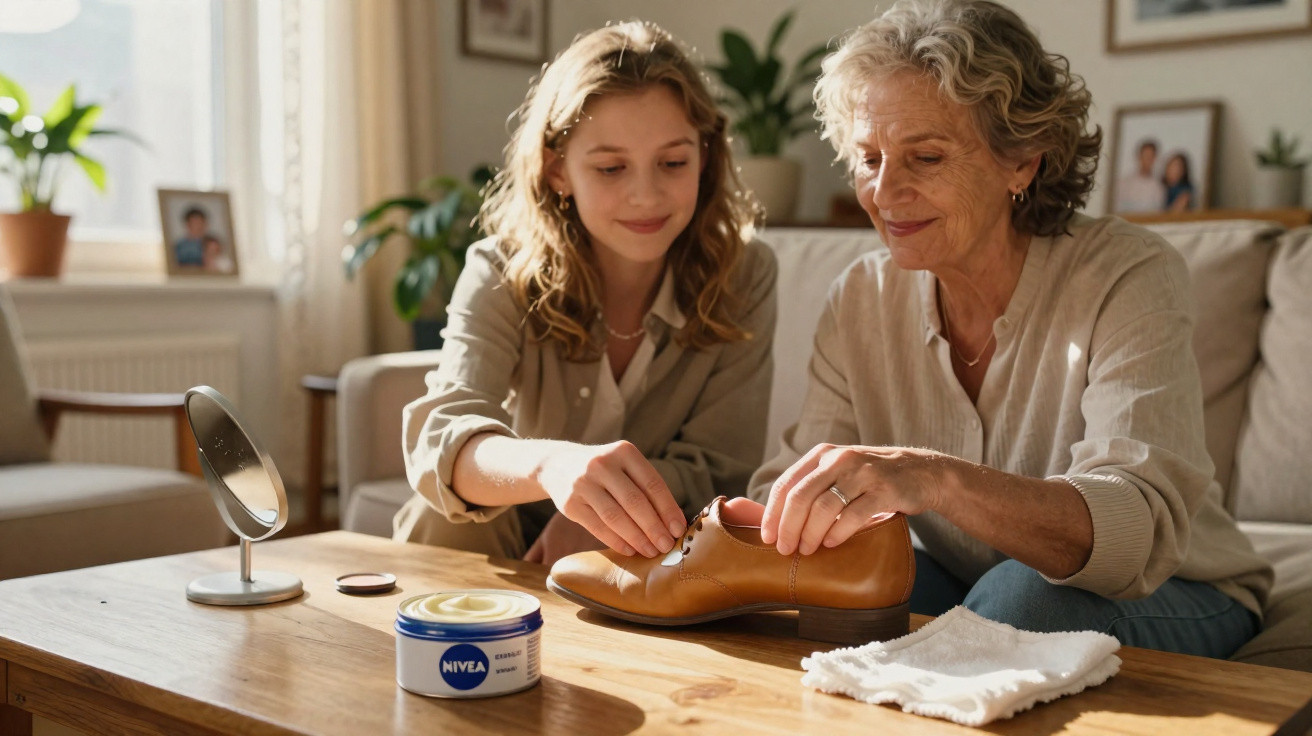
An old kitchen trick is currently taking off online: an everyday item from the bathroom cabinet is said to tackle a stubborn stain in minutes.
Amid cleaning influencers, grandmotherly wisdom and product advertising, one piece of advice keeps appearing and surprises many people: an ordinary pot of Nivea Creme, usually used on dry hands, is said to remove a particular type of stain faster than some specialist cleaners – without harsh-smelling chemicals or expensive products from the chemist.
How a pot of cream became a household secret weapon
The story starts in a completely ordinary home: a discoloured mark, an old piece of furniture, a frustrated glance – and the memory of something Gran once said: “Just use a little Nivea, rub it in and let it work for a moment.” Many people are now sharing similar anecdotes, particularly on social media.
There is no magic behind it, only chemistry on a small scale. Nivea Creme contains fats, waxes, water and emulsifiers. Depending on the type of mark, this blend can loosen particular dirt particles or discolouration, or conceal them.
What once seemed like an improvised emergency solution is now being presented as a clever household hack: Nivea Creme as a gentle mini-cleaner for particular problem areas.
Which stains Nivea Creme can really tackle
In many accounts, the tip relates to stains with a greasy or pigmented element – in other words, marks sitting on smooth surfaces that are difficult to remove with water alone. These commonly include:
- marks on leather shoes or handbags, such as scuffs or dull patches
- light discolouration on faux leather and smooth plastic
- dried-on make-up marks on smooth surfaces, including tables and mirror frames
- light water marks or limescale rings on bathroom metal fittings, where these are only superficial
The cream does not work like a conventional all-purpose cleaner; it is more of a combination of care product and mild solvent. It will not lift red-wine stains embedded deep in carpet fibres, nor does it replace a thorough bathroom deep clean. Used correctly, however, it can be surprising how quickly the appearance of a troublesome mark improves.
The 2-minute trick: how it is meant to work
Step-by-step guide
Many users describe a similar method, which can be completed in just a few minutes:
- Use a dry cloth to remove surface dust and loose dirt.
- Apply a small amount of Nivea Creme – genuinely only a pea- to hazelnut-sized dab – to the stain.
- Gently work it in with a soft cotton cloth or cotton pad, using circular motions.
- Leave it for around 1–2 minutes, watching to see whether the mark begins to lift or “smear”.
- Thoroughly remove the remaining cream with a clean cloth, then polish again with a second dry cloth if needed.
The effect often comes from the cream loosening or dispersing pigments while conditioning and smoothing the surface at the same time – making the stain look noticeably less pronounced.
Where the trick makes sense – and where it does not
Anyone expecting too much will soon be disappointed. Nivea Creme is mainly suitable for stains on:
- smooth leather, such as black or brown leather shoes
- faux-leather surfaces
- smooth plastic surfaces
- varnished wood with a hard-wearing coating
It is considerably riskier on delicate fabrics, unfinished wood or pale, open-pored materials such as untreated stone. On these, the fat in the cream may leave new marks of its own.
Why Nivea Creme in particular? A look at the ingredients
At its core, the best-known blue pot contains:
| Ingredient | Role in the cream | Effect on stains |
|---|---|---|
| Fats & waxes, such as paraffins | Protective film, conditioning and suppleness | Loosen grease-soluble dirt and smooth surfaces |
| Water | Moisture carrier and emulsion base | Helps with light water-soluble residues |
| Emulsifiers | Combine water and fat | Blend different types of dirt, making them easier to wipe away |
| Fragrances & additives | Scent, texture and shelf life | No direct cleaning action; mainly cosmetic |
This composition explains why the cream can act as a mild cleaning and conditioning product – particularly where standard cleaning products would be too aggressive, such as on leather shoes, handbags or certain surfaces inside a car.
Grandmother’s logic: cleaning without harsh-smelling chemicals
Anyone who listens to older generations quickly notices that many dislike strongly scented cleaners and sprays that irritate the throat. In the past, people were more likely to reach for soap, oil, Vaseline or a multipurpose cream instead.
The idea is simple: first check whether a mild, familiar substance will do the job. Only if it does not work should the “heavy-duty” cleaner be used.
Nivea Creme fits this approach. It is far less irritating to the mucous membranes than some bathroom cleaners, can be applied in controlled amounts and is already in many cupboards. For some, it becomes a kind of “first aid” for stains before more aggressive products are considered.
Risks and limits of the trick
When care is needed
Useful as the tip may sound, it is not entirely risk-free. Applying too much cream can lead to:
- grease stains on fabrics or carpets
- smeary residue on plastic and glass
- uneven sheen on sensitive leather surfaces
Testing it first in an inconspicuous area remains sensible, particularly on:
- high-quality leather furniture
- antique wood
- car interiors with delicate coatings
- coloured plastics that can be easily affected
Anyone allergic to fragrances or preservatives should also remember that rubbing a surface involves skin contact. Gloves may help in these situations.
Practical everyday uses for Nivea Creme
The leather-shoe example
A classic use case is a pair of black leather shoes with dull, slightly grey patches caused by road dust. Many people report that a dab of Nivea and a soft cloth restores an even shine within two minutes. The mark does not disappear in a chemical sense; instead, it is blended in, conditioned and visually disguised.
Make-up on a mirror frame
Another example is foundation or lipstick ending up on the varnished frame of a bathroom mirror while applying make-up. Water alone often barely shifts the mark. A small dab of cream, rubbed in briefly and wiped away, can noticeably reduce the coloured edge without damaging the varnish.
How the trick can be combined with other household remedies
People who prefer to spend carefully and keep specialist products to a minimum often rely on a small set of staples: bicarbonate of soda, vinegar, household soap and sometimes oil. The cream belongs on that list, although with a particular function: it is most useful as a finishing touch.
- After cleaning with soap: If a surface is clean but looks dull and lifeless, a light coating of cream can add shine and protection.
- Together with a microfibre cloth: The fibres pick up loosened dirt more effectively and leave fewer streaks behind.
- As a “rescue” after an overly strong cleaner: Where a surface looks slightly dried out, the cream can make it feel more supple again.
What lies behind the hype – psychology and everyday life
The appeal of hacks like this also has an emotional side. A product familiar to many since childhood creates a sense of reassurance. Add a grandmother’s story, and the result is a blend of nostalgia and practicality. At a time of rising prices, the prospect of using one product for skincare and small cleaning tasks is especially appealing.
Anyone trying this trick should view it for what it is: an everyday tool with limited effectiveness, but one that can sometimes be very useful. It is not a miracle cure, yet it can be the practical middle ground between throwing something away and buying an expensive specialist cleaner. It may also be a small reason to pay closer attention to the seemingly simple advice of older generations.





Comments
No comments yet. Be the first to comment!
Leave a Comment