
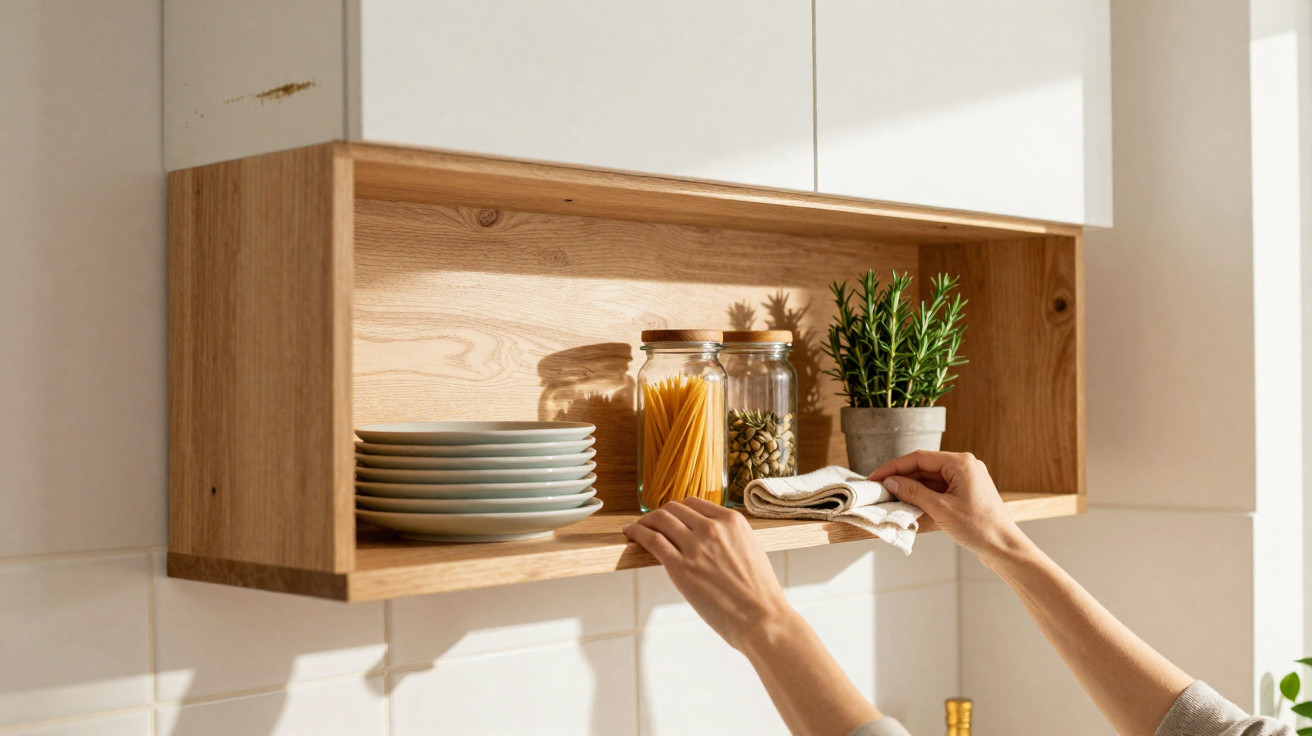
The smell is what hits you first.
It is a faintly sweet blend of bloated chipboard, stale coffee and something… humid. You open a base cupboard to take out a pan and find the rear panel swollen like yesterday’s croissant. What was once a sharp white surface is now a weary beige, while the hinges groan whenever you pull the door. This kitchen was supposedly “new” five years ago. Already, it looks as though it has surrendered.
As you silently blame steam, splashes and unexplained leaks, Instagram serves up kitchens that appear untouched by time. They are open and light-filled, with crisp lines, shelving rather than bulky units, and strikingly simple frames that hold everything together. There is no puffed-up MDF or mouldy plinth concealing clumps of dust. Only order. And light.
A few of these kitchens are secretly eye-wateringly expensive. Increasingly, though, they are not. They rely on a less costly approach that is quietly pushing traditional cabinets aside. Once you notice it, those large box-like units look very different.
Why people are quietly ditching traditional kitchen cabinets
Spend ten minutes in a bustling family kitchen and it is obvious why conventional cabinets are losing favour. Doors bang, children lean against them, dogs investigate the kickboards, and pans are constantly pulled out and put away. Then there is steam from kettles and pasta water, plus dishwashers releasing hot air into every gap. It is an unforgiving setting for compressed wood dust covered in a thin veneer.
For that reason, more designers are guiding homeowners towards open storage on metal frames rather than enclosed boxes. Picture robust shelving, powder-coated steel structures and aluminium rails built to handle humidity. There are no concealed spaces for water to penetrate and no laminated edges lifting like worn stickers. Instead, the storage is visible and ventilated, without pretending to be immaculate furniture. It is straightforward. And it lasts.
Helena, 32, discovered this in the hard way at her small terraced home in Manchester. Her budget kitchen, installed before she bought the property, began warping around the sink within 18 months. Behind the plinths she found faint black mould spots, along with soft areas around the pipe openings. “I hadn’t spilled a bucket of water,” she said. “I just cooked like a normal person.” Replacing the most damaged units would have cost almost as much as a basic new kitchen.
A friend instead proposed another solution: remove the base cabinets along the dampest wall and fit a heavy-duty galvanised shelving frame with deep metal drawers. On the first day, it had an almost industrial appearance, like something found in a fashionable coffee shop. Two years of regular pasta dinners and relentless washing-up later, nothing has swollen, peeled or developed fuzzy patches. She wipes it down, she cleans it, and it remains unchanged. The cost? Roughly half the estimate she had been given for replacement base units from a well-known brand.
The logic behind the trend is harshly simple. Conventional cabinets are typically built around MDF or particleboard, both formed from fine wood fibres, glue and pressure. Neither copes well with water. A minor leak, or prolonged gentle condensation, eventually enters the board, making it expand and weakening its structure. The surface splits, doors lose alignment, and a “10-year kitchen” suddenly resembles a worn-out rental. Open metal systems cannot absorb moisture. Nor do they depend on concealed joints remaining watertight. Air moves around the shelving, quickly drying splashes and depriving mould of the persistent dampness it needs. At a time when renovation bills can be enormous, a cheaper option that does not simply rot is beginning to seem sensible.
The cheaper, tougher alternative: metal frames and open storage
This new approach begins with one uncomplicated change: replace bulky boxes with skeletal frames. Rather than using complete carcasses with tops, sides, backs and plinths, structural metal uprights and horizontal rails do the work. Shelves, drawer modules, baskets and even worktop supports can then be clipped or bolted onto those rails. The principle is much like warehouse racking, only slimmer, more attractive and intended for plates rather than pallets.
Nor is this look reserved for ultra-modern lofts. Plenty of homeowners retain their wall cabinets but swap the bottom row for open metal modules in black, white or stainless steel. The worktop appears to float above the frames, with tidy arrangements of pots, appliances and baskets underneath. There are no false base panels for water to hide behind, nor tightly enclosed corners where stale air lingers. Should a pipe leak, you see it immediately. You deal with the cause rather than the damage left behind.
Naturally, clutter is the main concern. Few people want cereal boxes and chipped mugs on permanent display. This is where thoughtful planning matters. People who enjoy these kitchens almost always divide storage into two types: “show” and “stow”. Frequently used plates, attractive pantry jars and cast-iron pans sit on open shelves or in wire drawers. The disorderly items – plastic containers, children’s snacks and the ancient blender you promise yourself you will use again – are tucked away in one durable enclosed cabinet or a tall pantry cupboard with doors.
In practical terms, this arrangement can reduce costs in unexpected ways. Metal frames are commonly modular, allowing you to purchase only what you require and add shelves later. You are not tied to an inflexible row of boxes designed around a single wall. If one shelf becomes scratched or worn, you replace that component rather than the entire unit. It is closer to building with Lego than commissioning a permanent kitchen sculpture. Anyone who has endured a complete rip-out renovation will appreciate something adaptable – and resistant to soaking.
How to make the “no cabinets” trend actually work at home
If you are considering leaving traditional cabinets behind, begin on a small scale. The simplest place to start is the kitchen’s wettest and hardest-used area: the space around the sink and dishwasher. Take out the lowest units nearest to splashes and potential leaks, replacing only that run with a metal frame or open shelving arrangement. Where possible, retain your existing worktop and have it cut to rest on the new structure.
Then select shelves and drawers that suit the way you genuinely live. For daily cooks, deep pull-out metal drawers for pans and lids are invaluable. If you mainly reheat food and snack, wide open shelves for appliances may be more practical. Do not copy a Pinterest image and assume it will match your routine. Mentally walk through a typical evening: where do you chop, boil, serve, wash and dry? Those spots need the strongest and easiest-to-reach storage, even if they do not create the most photogenic view.
There is an emotional element too. On a difficult day, open storage can make a kitchen feel as if it is judging you. Build in some kindness instead. Keep a “catch-all” drawer or basket close to the main preparation area, so items have somewhere to land without guilt. Position your loveliest, most calming possessions at eye level – the good bowls, the peaceful-looking jars and the wooden board that makes you feel vaguely capable.
Let’s be honest: nobody genuinely does this every day. Nobody folds every tea towel perfectly or arranges spice labels with military precision. The useful system is one that quickly forgives you. That could be a rail of mug hooks, a line of matching baskets that conceal mismatched packaging, or simply a closed cupboard to take the mess when friends arrive.
People who have used this arrangement for some time often make the same observation:
“Once the lower cabinets were gone, I could finally see what was going on in my own kitchen – the leaks, the dust, the clutter – and deal with it before it became a disaster.”
To maintain that feeling of control, several straightforward rules make a real difference:
- Keep open shelves for items used weekly, rather than things used once a year.
- Organise belongings by purpose: one shelf for baking, another for everyday plates and another for pans.
- Pick finishes that wipe clean without special treatment – matt metal, sealed wood or stainless steel.
- Place a removable tray beneath the sink to protect anything there if leaks return.
- Maintain one “secret” storage area with doors, so the kitchen does not feel like a showroom.
The quiet revolution under your worktop
Move from a kitchen packed with weighty cabinet blocks into one centred on slim metal frames and the contrast is not purely visual. Usually, the second kitchen sounds different as well. There is less creaking and fewer doors slamming, replaced by the clink of plates and the quiet hum of activity. It feels more like a workshop than a showroom, which many people find unexpectedly reassuring.
The change reveals much about the direction of home design. Rather than pursuing an immaculate kitchen that never appears used, people are recognising that these rooms are busy, demanding and messy. They want materials that reflect that truth: surfaces that can be wiped, knocked and splashed while still looking good. They are also less willing to spend vast sums on something that must stay perfectly dry in the one room where that is rarely possible.
A more fundamental shift sits behind the steel and open shelves. Visible storage subtly influences daily habits. You buy fewer duplicate gadgets because you can see what you already own. If a pasta bag looks untidy on the shelf, you are more inclined to transfer it into a jar. And you notice a tiny drip from the trap below the sink before it can turn a £50 leak into a £1,500 cabinet replacement.
At a human level, it is about being honest too. We have all experienced the moment when someone peers through the kitchen doorway and says, “Oh, it’s super at your place”, while you know perfectly well that a particular cupboard must never be opened. The “goodbye cabinets” trend does not magically organise your life. It merely makes hiding harder and looking after your space easier. Somewhere between those two things, a more relaxed kitchen begins to emerge.
| Key point | Detail | Benefit for the reader |
|---|---|---|
| Metal frames vs. cabinets | Use steel or aluminium structures instead of full carcasses | Cheaper upfront, far more resistant to warping and mould |
| Open + closed mix | Combine visible shelves with at least one closed pantry zone | Allows practicality and privacy, without feeling on display |
| Start with the wet zone | Replace units around sink and dishwasher first | Targets the area most likely to rot and saves money on a full refit |
FAQ:
- Isn’t an open-frame kitchen going to look cluttered? It can, if you try to display everything. The key is to show daily essentials while moving rarely used or unattractive items into one tall closed cupboard or a nearby utility area.
- Are metal frames really cheaper than full cabinets? In many situations, yes, particularly when you reuse your worktop and retain existing wall units. Modular frames and shelves often cost less than made-to-measure carcasses, and you can extend them later.
- Will an open system affect my home’s resale value? Buyers are becoming increasingly familiar with mixed arrangements. Provided the kitchen feels solid, clean and functional, most people place more importance on condition than having doors everywhere.
- What about noise – won’t everything rattle? Well-made frames and thicker shelves remain surprisingly quiet. Soft baskets and lined drawers for loose items prevent rattling while protecting plates and glasses.
- Can I install a frame-based system myself? If you are confident with basic DIY, many modular systems are intended for home installation. However, it remains worthwhile to call in a professional for stone worktop cutting or plumbing changes.




Comments
No comments yet. Be the first to comment!
Leave a Comment