

You drop your phone face-down on the bathroom counter. You are half-dressed, with hair stuck to your head like wet spaghetti.
The clock is playing its cruel trick: five minutes suddenly feels like 30 seconds. Meanwhile, the mirror is reflecting “deflated balloon”, not “effortless volume”. There is no time for a round brush, mousse, or another YouTube tutorial that opens with “so first you section your hair into twelve parts…”.
Your hairdryer is staring at you, and you stare straight back. Somewhere between towel-dried and genuinely presentable, there must be a shortcut: one that is faster than a complete blow-dry, gentler than daily heat styling and less tacky than layering styling products.
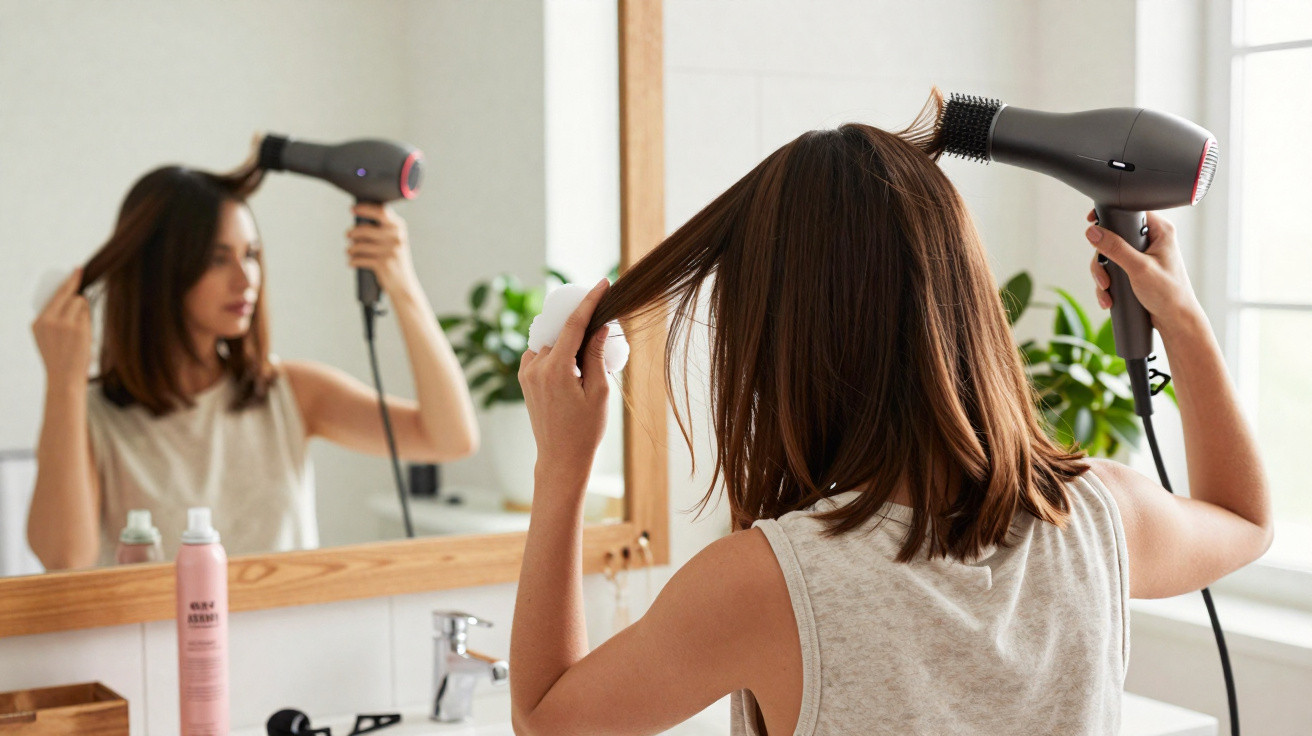
Almost automatically, you pick up the dryer. This time, without much thought, you tip your head forwards. You change the direction of the air. Your roots rise. At last, your hair looks fuller, softer and more alive.
You have not changed your shampoo. You have simply changed the angle.
Why your hair keeps falling flat
When hair will not hold volume, most people blame their products. They change shampoos, buy “root lifters” that smell as though a perfume counter has exploded, or blame genetics, humidity and bad luck. Yet the unexciting answer is often in how we use a hairdryer.
We tend to direct hot air straight down the hair shaft, copying the salon technique we have seen: nozzle aimed downwards, smoothing every strand flat. Initially, it looks glossy, but the roots are already being taught to sit close to the scalp. Once the hair is dry, that shape is fixed in place: flat at the roots and fuller at the ends. It is not volume; it is triangle hair developing in slow motion.
Hair has a memory. How it dries is how it tends to remain.
Think of clothes drying on a washing line. If you hang them while crumpled, they stay creased; if you smooth them first, they hang more neatly. Hair works in a similar, but upside-down, way. When it dries pressed against your scalp, it retains that “collapsed” memory. When it dries lifted away from the head, the root retains a small curve, rather like a tiny spring.
Styling products may help that shape last, but they are not where it begins. The real starting point is the airflow direction while hair is in its most responsive state: neither dripping wet nor dry, but damp enough to be shaped.
Volume is not really found in a bottle. It is a decision made while drying.
This may sound theoretical, but it appears in real life on those random days when your hair looks brilliant and you cannot work out why. Perhaps you left it to air-dry pushed to the “wrong” side, or slept with it thrown over the pillow. Those accidental movements created room at the roots.
The aim is to turn that happy accident into an easy, repeatable ritual.
The flip-and-freeze technique: volume without heat or products
The basic method is the small change that can quietly transform everything: dry your hair upside down on the coolest setting you can manage, then allow the roots to “set” in their raised position before lifting your head again.
Begin with towel-dried hair that is no longer dripping. Bend forwards so your hair falls clear of your scalp. Gently separate it with your fingers to expose the roots to the air. Set your dryer to cool or low-warm, then move it in small circles around the scalp rather than directing it down the lengths.
You are not trying to dry every strand completely. Instead, dry the roots until they feel light rather than wet while they are lifted away from your head. Leave the mid-lengths and ends slightly damp. Flip your head back with one swift movement, then leave your hair alone for a few seconds.
That brief pause allows the “new shape” to settle.
A young London stylist monitored the results with her regular clients. She asked 15 clients with fine, limp hair to alter just one part of their routine for a month: no new products, no hot tools, only this upside-down cool-root drying ritual three times weekly.
After two weeks, almost all of them described the same result: hair that was previously “flat by noon” was still holding up beyond lunchtime. Several stopped using weighty volumising sprays that left a residue by the third day. One woman with straight, shoulder-length hair found that, even on days between washes, her roots did not cling to her scalp as tightly as they had before.
There was no magical change to their hair type. What changed was the usual position in which their roots dried. Picture it as a gentle, repeated stretch for the hair: it encourages the base to sit away from the scalp rather than being stuck against it.
Across social media, the method goes by several names, including “Upside-down cool set”, “gravity lift” and “flip drying”. The wording changes, but the principle does not: dry the roots where you want them to live.
There is a straightforward reason it can work without strong heat or styling products. Hair consists of keratin, and every strand contains bonds that shift temporarily when wet before resetting as it dries. Hot tools use this process aggressively, applying intense heat for a pronounced but potentially damaging change. Cool or low heat works through the same process more gently, although more slowly.
Drying upside down turns gravity into an invisible round brush. The roots naturally lift away from the scalp, allowing those bonds to reset in a raised position. You are not trying to force a curl; you are simply creating a soft arch. That arch is what the eye reads as “volume”.
It also explains why heat-free volume feels lighter. There is no crunchy mousse, sticky spray or rigid crown. Instead of being weighed down by product, hair is supported by its own internal structure. It is like the difference between wearing a helmet and wearing nothing while still holding your shape.
Once you recognise this, you may notice just how often your usual drying routine works against the effect you want.
Making the flip-and-freeze technique a ritual
This sequence generally works best, particularly for anyone who is not a “hair person” and wants something close to idiot-proof.
After washing, lightly squeeze your hair with a towel or an old cotton T-shirt. Do not rub or twist it. Leave it for three to five minutes, then shake it loose and create a parting on the opposite side to where you normally wear it. That alone encourages lift along your eventual parting line.
Bend your head forwards. Place your fingers into the roots and lightly “comb” them away from the scalp, as if making small tents. Direct the dryer at the roots on cool or low heat, keeping it moving. Stop once the roots feel around 80% dry. Lift your head, guide your hair into its usual parting using only your fingertips, and walk away.
The important thing is not precision. It is consistency.
Many people attempt this once, then abandon it because they expect an instant shampoo-advert transformation. Hair is not quite so obedient. It often responds gradually, then seemingly all at once.
The usual mistakes are simple to correct. Some people over-dry the lengths while overlooking the crown, leaving the ends puffy and the top flat. Others return with a brush and high heat, effectively pressing out the lift they have just created. Some apply products “just in case”, adding weight exactly where it matters most: at the roots.
Time is another consideration. On a hurried weekday morning, bending upside down and waiting for those extra minutes can seem indulgent. Let’s be honest: nobody truly does it every day. Choose your moments instead: use the full ritual before work events, evenings out or on days when you want your hair to cooperate on day two. On other days, even a 60-second upside-down blast can make a difference.
Behind the practical advice sits something more subtle: control. For many people, hair is closely tied to body image, age and energy. Flat hair can make a face appear more tired, more serious or more “over it” than it really is.
“When my hair has lift at the roots, people ask if I’ve slept well or changed my skincare,” laughs Ana, 39. “Nothing else is different. Just my hair not giving ‘I’m exhausted’ energy.”
You do not need a bathroom filled with gadgets to create that understated lift. You need a handful of small habits that become automatic. To simplify it, think in terms of triggers: each time you pick up your towel, you are already shaping how your volume will look two hours later.
Keep this short cheat sheet in mind:
- Dry the roots before the lengths, every time.
- Let gravity help: bend forwards, then “freeze” the shape.
- Keep products lightweight, or avoid them unless you genuinely need extra hold.
- Let hair cool while lifted before you touch it.
- Practise on low-stakes days until the process feels natural.
A new normal for “good hair days”
There is something quietly radical about achieving more volume without more damage, spending or products. We have been taught that bouncy hair requires commitment: blow-dry bars, multi-step routines and viral products promising miracles in 30 seconds. Compared with that, low-heat, product-free volume can feel almost suspiciously straightforward.
In practical terms, the flip-and-freeze technique delivers in the small moments you notice afterwards. You glimpse yourself in a shop window. Your hair is not flawless, but it looks alive. The top of your head no longer appears as a flat line above your forehead. You feel slightly more awake than you did five minutes earlier.
At a deeper level, it can alter how you think about “fixing” things. Some of the effects you have been pursuing in jars and with tools are already present in your body and surroundings: gravity, airflow and the way bonds reset while hair dries. The more you work with those forces instead of against them, the less you have to battle your reflection.
On a busy Tuesday, when there is no time for a full routine, this stops being merely a trick and becomes a safety net. You can skip styling creams, curling irons and the urge to start again because it looks “meh” at first. Flip your hair forwards, dry the roots in minutes and let the shape do the rest.
We have all entered a room and immediately felt underdressed. Hair cannot change everything, but it is one of those small levers that can affect how you stand, speak and meet someone’s eyes. Root volume lifts more than strands: it changes how you take up space.
The next time your hair is clinging to your head and you instinctively blame the shampoo, stop for a moment. Look at the dryer and consider the direction in which you have always aimed it. Ask what might happen if you allowed gravity to become your stylist for just one week. The worst outcome is a few odd hair days.
The best outcome is that “good hair days” no longer feel unusual and instead become your new average.
| Key point | Detail | Why it matters to the reader |
|---|---|---|
| Drying direction | Dry roots upside down so they set in a “lifted” position | Creates volume from the base without relying on volumising products |
| Moderate temperature | Use cool or warm air rather than intense heat | Protects the hair fibre while making use of hair “memory” |
| Simple ritual | Repeat a few brief movements after every wash | Builds long-lasting, lighter and more natural volume without spending hours on it |
FAQ:
Does this technique work on very fine, straight hair? Yes. Fine hair often responds even better because it is lighter at the root, making the lifted “memory” easier to maintain, particularly if you avoid heavy conditioners on the scalp.
Can I still use my usual styling products with this method? You can, but begin with less. Try the complete flip-and-freeze routine once on clean hair, then use a very small amount of lightweight spray only if you need additional hold afterwards.
How often should I use the flip-and-freeze technique? Using it whenever you wash your hair is ideal, although even two or three times per week can start to “train” roots to lift rather than lie flat.
Will this damage my hair or dry out my scalp? Cool or low heat is gentler than conventional blow-drying. Provided you keep the dryer moving and do not concentrate it on one area for too long, your scalp and hair are much safer than they would be with high heat.
What if I usually let my hair air-dry? You can still use the central idea: tip your hair forwards for a few minutes while it is damp, gently raise the roots with your fingers, then loosely clip it in that lifted position until it is mostly dry.



Comments
No comments yet. Be the first to comment!
Leave a Comment