
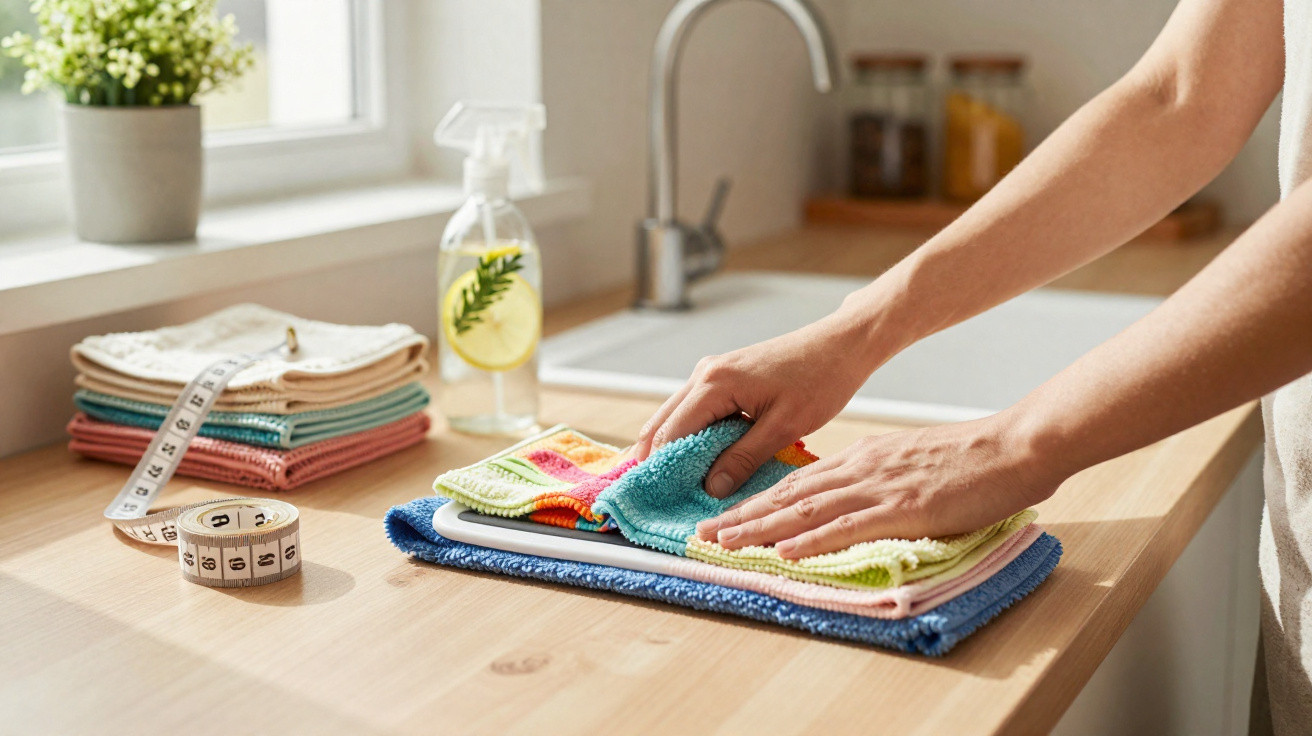
In countless bathrooms, worn-out towels sit in cupboards because they have become stiff, grey or simply no longer feel pleasant. Rather than throwing them into general waste or wearing them out as rags, you can turn them into a genuinely useful cleaning hack: a reusable floor mop cover that replaces costly disposable cloths while also reducing household waste.
Why old bath towels make ideal floor mop covers
The key benefit lies in the fabric itself. Traditional terry towels are made from cotton with numerous small loops, a texture that works almost like a professional cleaning tool around the home.
“The loops of a terry towel catch dust, hair and crumbs – while reliably absorbing liquids.”
Cotton terry has several useful qualities:
- Looped texture: The tiny loops catch on to dust and pet hair.
- Excellent absorbency: Cotton absorbs water effectively and holds dirt within the fibres.
- Durability: Towels can withstand frequent washing at 60°C.
- Pleasant mopping action: The fabric moves smoothly across hard floors without squeaking or leaving smears.
Even old bath towels therefore work in a similar way to professional floor-cleaning systems used by commercial cleaners, including mops, string mops and flat mop heads. They lift dirt away instead of merely pushing it across the floor.
How much disposable floor cloths really cost
Anyone who has bought a large pack of floor-cleaning cloths for a flat mop knows that they are not inexpensive in the long run. Over the course of a year, the cost soon adds up.
Example calculation for an average household:
| Parameter | Value |
|---|---|
| Cleaning frequency | Twice a week |
| Number of disposable cloths per cleaning session | 2 cloths |
| Annual use | Approx. 208 cloths |
| Price per cloth | Around €0.30 to €0.40 |
| Annual cost | Around €60 to €80 |
This amount is spent solely on single-use products that are thrown away after only a few minutes of use. At the same time, household waste increases, particularly when other disposable items such as kitchen roll, wet wipes or cleaning cloths are also used.
By contrast, one large bath towel measuring roughly 70 x 140 centimetres can provide several reusable covers or numerous smaller cleaning cloths. After use, they simply go into the washing machine and are ready to use again afterwards - with no trip to the supermarket and no additional packaging.
Step-by-step guide: turning a towel into a mop cover
You need no more than scissors and a tape measure for this conversion. There is no sewing involved, and the adaptation takes only a few minutes.
1. Measure and mark the size
Place the flat mop head in the centre of the towel to quickly see how much fabric is required. Leave a little extra around the edges so that the cover will stay securely in place later.
- Position the mop plate in the middle of the towel.
- Mark out a rectangle around the plate, allowing an extra 5 to 7 centimetres on every side.
- Check the edges with a tape measure, especially if you want to cut several covers at once.
The cut piece should be neither too small nor unnecessarily oversized. Too little excess fabric will not hold properly, while too much gets in the way when mopping.
2. Cut the fabric and snip the corners
Carefully cut out the marked rectangle using sharp scissors. A neat cut is particularly worthwhile with thick terry fabric, as it will then sit tidily around the mop plate.
Then make four small cuts:
- Cut a slit around 2 centimetres deep into each corner of the rectangle.
- Make the cuts diagonally towards the centre, but keep them short.
These slits make it easier to push the thicker fabric into the holders where disposable cloths would normally be secured.
3. Fit and secure the towel piece
Now for the practical part:
- Put the mop plate back in the centre of the cut piece.
- Fold the edges over the plate one at a time.
- Push the fabric into the existing rubber grips or clips at the sides.
The corner cuts prevent the fabric from pulling tight and allow it to sit evenly around the plate. The cover remains secure and can be removed just as quickly as a disposable cloth. Once cleaning is finished, simply put it in the laundry basket.
How to use the towel mop cover day to day
Depending on the type of flooring and the level of dirt, the towel mop can be used dry or slightly damp. The important thing is to use the right method.
- Dry: Ideal for dust, hair and crumbs. Particularly suitable for hallways, bedrooms and living areas.
- Damp: Effective for marks and trodden-in dirt in kitchens and bathrooms.
Different floor types call for different basic rules:
- Tiles, laminate, vinyl: Dampen the cover lightly and wring it out well. Too much water can leave puddles behind.
- Parquet: Mop only with minimal moisture to prevent the wood from swelling.
- Homes with pets: Mop dry first to collect hair, then go over the surface a second time with a damp cover.
If you normally clean with a bucket or a mop with a wringing mechanism, you can continue doing so. The towel cover can be rinsed and wrung out in a cleaning bucket just like a conventional string mop.
Simple cleaning solution for ready-prepared damp cloths
If you prefer to have cloths ready to use at any time, you can store several covers in a mild cleaning solution. A screw-top jar or another tightly sealed container is all that is needed.
One possible mixing ratio is:
- 1/3 clear vinegar cleaner or household vinegar
- 2/3 softened or demineralised water
- a few drops of lemon essential oil (optional, for fragrance)
Place the cut towel covers in the jar, allow them to soak up the solution, and lightly wring them out when needed before mopping. After use, put them straight in with the rest of the household laundry.
Washing at 60°C generally ensures that bacteria and germs do not stand a chance. Avoid fabric conditioner, as it coats the fibres and significantly reduces their absorbency.
Benefits for the environment and household
Each homemade floor mop cover reduces the need for disposable products. This cuts packaging waste, saves plastic and reduces transport associated with continually buying replacement packs. The difference becomes noticeable particularly quickly in households with children or pets, where floors are mopped often.
Old towels also gain further uses almost effortlessly:
- small squares for washing-up cloths or dusters
- larger pieces for window frames, radiators or cleaning car interiors
- thick doubled-over layers as mats for wet shoes in the hallway
It is also practical to assign different colours or towel offcuts to particular tasks - one colour for the bathroom, for example, and another for the kitchen. This makes it easier to maintain good hygiene throughout the home.
Many people underestimate how long an old towel can last in the cleaning cupboard. Even when its fibres have become somewhat thinner, it still works extremely well for dust and light dirt. Only once the fabric starts to tear or develops holes is it worth putting it into general waste; until then, it can continue working hard around the home many times over while quietly making the cleaning budget noticeably smaller.




Comments
No comments yet. Be the first to comment!
Leave a Comment