
There is a very specific sort of embarrassment that comes with answering the door to an unexpected guest and watching their eyes briefly sweep across the hallway. Shoes are strewn about, the skirting board is dusty, and there is a stack of post you have intended to “deal with” since Easter. You grin, they grin, and both of you act as though nothing is there. Once they leave, you shut the door and think: right, enough. My home is a state, I am a state, and I will sort it all out this weekend. Spoiler: the weekend passes, and the only thing that rises is your guilt level.
Many of us live with the constant low hum of physical mess and mental clutter, believing that one thorough clean will turn us into the kind of people who keep linen sprays and neatly labelled baskets. Yet that enormous deep clean hardly ever takes place. Everyday life - emails, after-school clubs and “shall we just watch one more episode?” - wins every time. There is, however, a calmer way to take back control of your home, and it needs only 20 minutes each day.
The lie we have been sold about a “clean house”
Television programmes and glossy magazines taught us that a home is either immaculate or shameful, with no middle ground. You spot a shining kitchen on Instagram and instantly measure it against your own: toast crumbs, a sticky patch near the bin and a saucepan that has been “soaking” since Tuesday. The difference seems so vast that you never begin. What is the point, you wonder, if you cannot reach that standard?
That is the first trap: seeing cleaning as an occasion rather than a regular rhythm. We wait for the imaginary free Saturday when we will clean the oven, organise every drawer and finally confront whatever is lurking beneath the bed. Honestly, hardly anyone does that every day - or even every month. Life is not an upbeat montage in which you suddenly summon the energy to repair everything in one magnificent effort.
The second trap is linking your worth to the state of your skirting boards. A messy home can make you feel as though you are failing at adulthood, parenting or simply functioning as a human being. You look at the laundry pile and turn it into a judgement about who you are, rather than recognising what your timetable looks like. The 20-minute routine begins by undoing that story: you are not lazy; you are simply working with the wrong system.
The day it all clicked - with a kitchen timer
My own turning point arrived on a Wednesday evening that carried a faint smell of burnt toast and leftover curry. I had just stepped on a stray bit of Lego, the washing-up was piled in the sink like Jenga, and the living room looked as if a charity shop had burst open. That was the evening I stopped saying, “I’ll sort it at the weekend,” and did something tiny and unremarkable instead: I set a 20-minute timer on my phone.
I decided I was not required to complete anything; I only had to keep moving for 20 minutes. There would be no huge declutter, no alphabetised spice rack and no flawless before-and-after images. I chose a podcast, hit start and picked up whatever was nearest. A mug. A sock. A crumpled receipt attached to the table by something that might once have been jam.
After 20 minutes, the flat was not “done”, but it looked remarkably different. Surfaces were visible again. The floor had returned. I could see genuine progress without feeling that bleach and bin bags had swallowed the entire evening. That was when I understood that the answer was not to work harder. It was to do less, more frequently.
What the 20-minute routine is - and is not
The 20-minute routine is neither a military-style cleaning plan nor a colour-coded spreadsheet. It is one straightforward daily commitment: for 20 minutes, I will gently move my home in the right direction. On some days, you will be energetic and race through it; on others, you will shuffle about half-awake and put things roughly where they belong. Both still count.
Treat it as you would brushing your teeth, but for your home. You do not wait until your teeth are covered in moss before brushing them for six hours in one go. You do a small amount twice daily and trust the habit more than a heroic effort. That is how you move from “crisis cleaning” to calm upkeep.
It is not a competition in perfection, a weapon to use against yourself or a promise that your home will permanently resemble a show home. There will still be untidy days and frantic mornings. There will still be a particular chair that pulls in clothes as though it has a magnetic field. The aim is not to erase every sign of real life; it is to prevent mess from reaching the “this is unmanageable” point.
The simple structure: one room, one focus, one week
The weekly rotation that keeps you sane
To prevent those 20 minutes becoming aimless pottering, assign each week a main area. Focus on the kitchen one week, then the living room the next. After that, move on to the bedroom, bathroom, hallway or even a “digital clutter” week for tackling your inbox and the mysterious files on your desktop. You will still complete basic daily resets throughout the home, but direct the additional effort towards one place only.
This rotation means you do not fixate on one room while the others gradually slide into disorder. It also creates a feeling of having finished something. On Sunday evening, you can say that the bathroom is better than it was on Monday, even when it is not faultless. That modest sense of completion will do more for motivation than any inspirational quote.
There is also a quiet psychological benefit. When you tell yourself, “This week, it’s the bedroom,” your mind can relax about everything else. Instead of looking at the whole home and wondering where to begin, you have already decided. Begin here. Begin now. Begin with the bedside table if that is all you can manage.
Your 20-minute flow
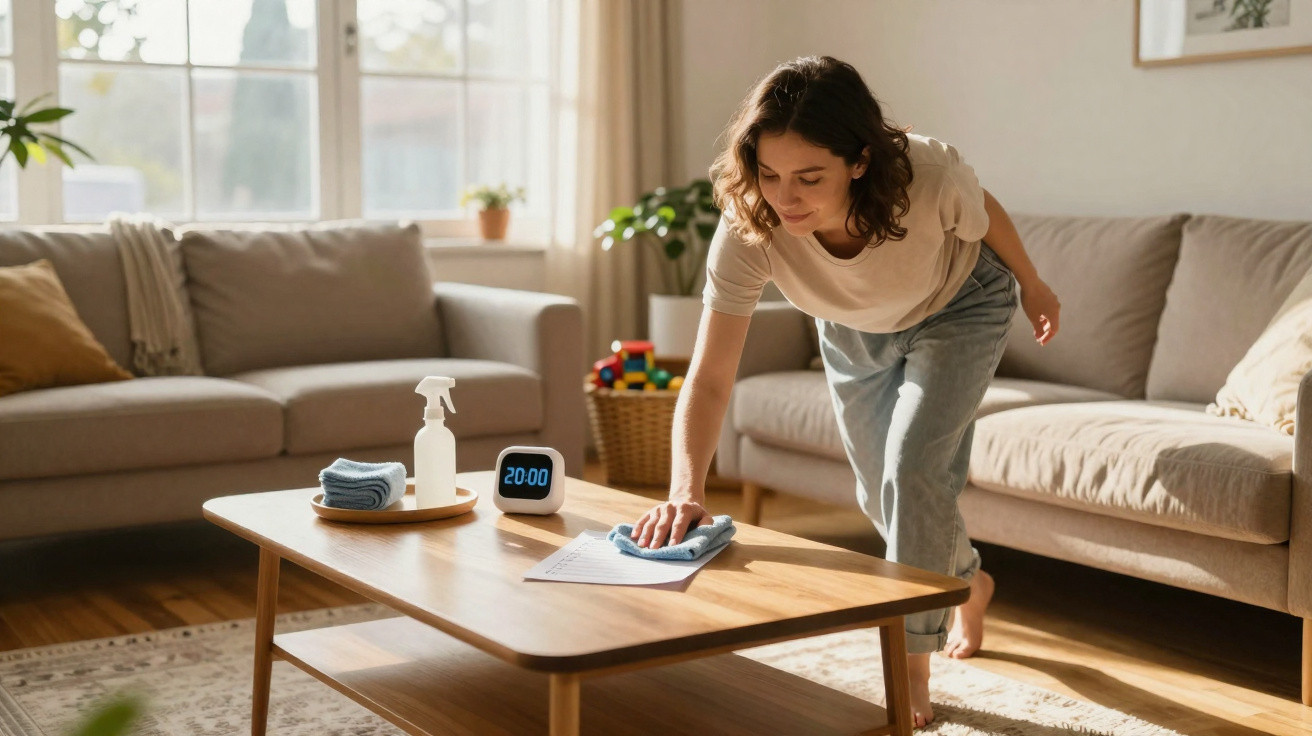
In your selected room, follow a loose sequence for the 20 minutes. Start with a two-minute reset of the space you use most, usually the kitchen or living room. Remove the worst clutter from the surfaces, bin obvious rubbish and open a window if the air feels stale. This is the step that makes the day feel a little less stressful.
Then spend roughly 15 minutes on your weekly zone. Choose one small spot: the sofa, fridge door, bedside table or bathroom shelf. Do not take on the whole room or entire wardrobe. Pick one manageable mini-battle. Play music, or enjoy the stillness as its own form of company, and work at a steady pace rather than in a panic.
Use the final minutes as a present for “tomorrow me”. Put out clean tea towels. Set shoes by the door. Fold the blanket on the sofa rather than leaving it in a forlorn pile. You are showing yourself that you deserve a small act of care, even on evenings when you feel ready to collapse face-first onto the pillow.
The four tiny rules that make it actually work
Rule 1: Never clean in silence if you are already stressed
When your thoughts are noisy, silence can make the clutter seem noisier too. A favourite playlist, an audiobook or even the familiar background chatter of a programme you have watched ten times can turn cleaning from a punishment into something that happens in the background. You are not “doing chores”; you are catching up on your series while your hands happen to deal with the washing-up.
We have all experienced the moment when a song starts playing and suddenly we are wiping the kitchen worktops with much more passion than the task warrants. Use that feeling. Allow the beat to carry you along. Turn your 20 minutes into something you can almost look forward to, not dread.
Rule 2: Always stop when the timer goes off
This may sound like the oddest rule, but it is the one that safeguards the habit. Once the timer rings, stop - even when you are “in the zone”. You are showing your brain that the routine is easy, manageable and will not take over the whole evening. If it begins to feel never-ending, you will avoid it, much like the gym membership you claimed you would use.
Naturally, there will be occasional days when you truly want to continue. That is fine: carry on for another ten minutes if it makes you happy. Just do not allow it to become the standard. Consistency is the success, not intensity.
Rule 3: Visible first, invisible later
Begin with what is in plain sight. Clear the coffee table before alphabetising the spice drawer. Make the bed before reorganising the space beneath it. People respond to changes they can see. When a transformation is visible, however modest it may be, it strengthens the feeling of “I can do this.”
Once the obvious disorder is under control, your 20 minutes can gradually shift towards concealed chaos: the drawer full of tangled chargers, the unknown cupboard under the stairs or the box labelled “misc” that has travelled with you through four house moves. Those tasks become slightly less daunting when the rest of the room already feels calmer.
Rule 4: Everyone who lives there, helps there
When you share your home, the 20-minute routine should not be a one-person show. It is a group production. Children can put toys into baskets, partners can wipe down surfaces and housemates can take responsibility for music and the bins. You are not operating a hotel; you are looking after a home.
There is a little magic in announcing, “Right, 20-minute reset, go!” and seeing everyone start at the same time. You hear bin bags rustling, shoes softly thudding into a neat line and cutlery clinking as it returns to the drawer. Cleaning changes from a lonely, faintly resentful job into a quick shared sprint in which nobody has enough time to sulk.
Why a 20-minute cleaning routine changes more than your floors
Something subtle changes when your home is never perfect but is seldom overwhelming. You stop avoiding invitations because you feel ashamed of the mess. You answer the door to the postie without frantically kicking shoes out of view. Mornings become a little easier and evenings a little gentler. The home may not sparkle, but it no longer feels as though it is shouting at you.
There is a deeper mental effect as well. Our minds carry what psychologists call “open loops” - unfinished tasks that quietly consume our attention. A cluttered home is essentially one enormous open loop with walls. Every 20-minute session closes several of those loops. You go to bed thinking, I did something, rather than I failed again.
You may also find that your tolerance for clutter begins to shift. Once the usual baseline is calmer, fresh mess becomes noticeable sooner. You may automatically wipe the hob while the kettle is boiling or put away three items as you pass through a room. The 20-minute routine starts to filter into the gaps in your day without needing any formal effort.
When you miss days and everything goes wrong
Here is the untidy reality: you will definitely fall off the wagon. There will be weeks of illness, deadlines, break-ups, school plays or plain exhaustion when the 20 minutes simply does not happen. Dust will build up, dishes will pile high and you will look around and think, brilliant, we’re back at square one.
But you are not. You now have a route back. Previously, “getting on top of the house” meant facing a vast and uncertain task without any plan. Now you know precisely what to do: choose a room, set the timer and move for 20 minutes. That is all. No drama, no monologue of self-loathing and no emotional sense of beginning from scratch.
When you restart the routine after a messy period, you will discover something reassuring: your home forgives you fast. Two or three days of 20 minutes can reverse weeks of slowly accumulating chaos. It will not be perfect, but it will be liveable. And liveable is enough.
The quiet revolution of “enough”
We do not speak often enough about homes that are not picture-perfect but still feel kind. A hallway with reasonably clean floors and a dependable hook for the keys. A bathroom where the mirror is not immaculate, but you can see your own face. A kitchen where you can make toast without first pushing six things aside. That is what the 20-minute routine can provide, day after day.
You may find that, as your surroundings become gentler, you do as well. You are slightly less irritated by shoes left out. You are more willing to invite a friend in for a quick cuppa without first launching into a 30-minute panic tidy. The house stops seeming like proof of your shortcomings and begins to feel like a scruffy, changing companion in your life.
The real transformation isn’t that your home becomes perfect. It is that the home no longer dictates your mood. You take those small moments once spent quietly fuming over sofa crumbs and turn them into something softer, smaller and unexpectedly powerful. Twenty minutes each day will not create a magazine spread. It may, though, give you a home that feels as if it is on your side - and a version of yourself that understands “good enough” is not a consolation prize but a quiet form of freedom.

Comments
No comments yet. Be the first to comment!
Leave a Comment