
In hard-water areas, steam irons can gradually become clogged with limescale long before they stop working altogether. The encouraging part is that an inexpensive, straightforward routine can restore many irons and prevent the marks that can spoil clothing.
Early signs of limescale in your steam iron
Limescale in a steam iron does not usually appear suddenly. Instead, it accumulates unnoticed in the reservoir, steam chamber and slim internal channels. Well before the appliance fails entirely, it will start showing signs of trouble.
Limescale rarely kills an iron instantly; it weakens performance for months first, leaving a trail of clues on your laundry.
Reduced steam output is generally the earliest clue. When you use the steam-boost button, you may get a weak burst rather than the full cloud of steam it once produced. Steam may also come out unevenly, while crackling or whistling noises occur as water struggles through restricted passages.
Light-coloured flecks appearing on dark clothes are another warning sign. These white particles are mineral deposits coming loose from within the iron. Their presence indicates that hardened scale has already coated the steam chamber.
If you leave it at that point, the issue can worsen. Mineral deposits may combine with tiny fibres that have scorched onto the soleplate. This mixture can then come out as brown or rust-coloured drops on blouses and shirts. Such stains can be particularly difficult to lift from white cotton or silk.
Brown drips usually mean oxidised limescale and residue have built up to a point where they’re contaminating the steam.
An iron affected by limescale can also catch as it moves across material. Rather than gliding freely, the soleplate may require you to apply more pressure, increasing the chance of shiny areas on synthetic fabrics or stubborn pressed-in creases.
How hard water damages steam irons over time
Tap water in much of the UK, as well as in large areas of the US, contains dissolved minerals including calcium and magnesium. Each time that water is heated inside an iron, these minerals can crystallise into limescale.
The resulting deposits attach themselves to the heating element and the internal surfaces. Because scale behaves like an insulating layer, the iron must use additional energy to achieve the same temperature. This added load can put strain on its pump, seals and thermostat.
When blockages are not dealt with, pressure can build against the pump and internal connections. The result may be leaks near the base, unexpected shut-downs or lasting electronic faults. At this stage, many owners believe their iron is “finished” and throw it away, although the underlying issue often began with ordinary scaling months before.
The vinegar and water method for descaling without scrubbing
Most build-up can be removed without buying specialist products. Ordinary white vinegar and a little time are often enough to do the job.
A 50/50 mix of white vinegar and water can dissolve stubborn limescale inside the tank and steam channels, no dismantling required.
Descaling an iron with vinegar: step by step
- Disconnect the iron from the mains and allow it to cool fully.
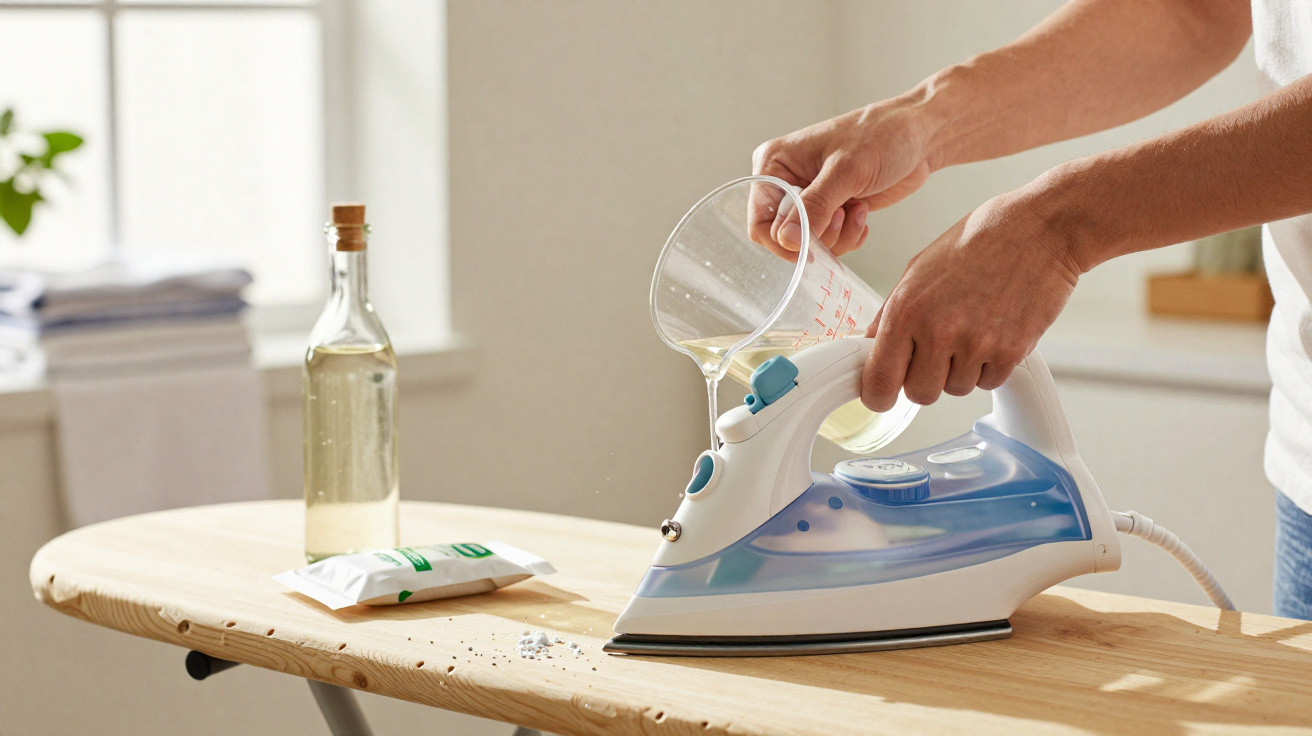
- Combine equal amounts of white vinegar and clean water in a measuring jug.
- Fill the iron’s water reservoir with the mixture, stopping at its normal maximum line.
- Keep the iron switched off for roughly 30 minutes, allowing the acid to work at room temperature.
Do not be tempted to heat vinegar in the iron. Acidic vapour when warm can irritate the eyes and throat, while frequent hot treatments are tougher on rubber seals.
Once the soaking time is over, drain the tank completely. Rinse it several times using fresh water and gently shake the appliance to help release deposits that have loosened. This part is important: failing to rinse properly could leave a vinegar odour on the next batch of ironing.
After rinsing, fill the reservoir with clean water and set the iron to its highest temperature. Hold it over a sink or an old towel, turn on the steam setting and repeatedly press the steam-boost control.
During this “steam purge”, you’ll often see flakes and cloudy droplets spurting out. That mess is exactly what you want to eject now, not onto your favourite shirt.
Citric acid: an odour-free option
Citric acid is a less pungent alternative if you do not like the smell of vinegar. Available as a food-grade powder, it comes from natural fermentation and works very effectively on mineral deposits.
Using citric acid safely
For most household irons, use the following mixture:
- 1 tablespoon citric acid powder for about 250 ml of warm (not boiling) water
- Mix until all the crystals have fully dissolved
- Add it to the cold iron, leave it for 30 minutes, then rinse several times
Following the soak, use the same approach as with vinegar: rinse thoroughly, then carry out a steam purge using plain water. As citric acid has no smell, many people favour it in shared homes or small flats.
A maintenance routine to keep your iron working for years
In hard-water locations, one thorough annual clean is not enough. Shorter, more frequent maintenance is both more effective and gentler on the iron.
Think of descaling as routine maintenance, not an emergency repair. Little and often keeps steam powerful and clothes stain-free.
As a general guide, households that iron several times weekly using hard tap water should descale their iron every one to two months. Where water is exceptionally hard, do it more often. In soft-water areas, or when the iron is only used occasionally, every three months may be sufficient.
| Water hardness | Iron usage | Recommended descaling |
|---|---|---|
| Very hard | Daily or near daily | Every 4–6 weeks |
| Medium | A few times a week | Every 2 months |
| Soft | Occasional | Every 3–4 months |
It is useful to keep a small set of supplies beside the ironing board. With a measuring jug, white vinegar or citric acid, and an old cotton cloth for purging, you can complete the procedure while getting on with other household tasks. Only a few minutes require your attention, as the soaking stage takes care of itself.
Everyday habits that reduce limescale formation
Alongside deep cleaning, several simple practices can greatly slow the rate at which limescale develops.
- Empty the reservoir after every ironing session to prevent water sitting inside and crystallising.
- In areas with very hard water, use a blend of tap water and demineralised water.
- Do not pour fragrance or fabric conditioner straight into the tank, as both can create sticky deposits.
- Once the soleplate has cooled, wipe it with a damp cloth, particularly after ironing synthetic materials.
Many newer irons include self-clean programmes or “anti-calc” cartridges. Although helpful, these do not eliminate the need for proper descaling. Cartridges may become blocked, and automatic cycles still rely on manual rinsing and purging to operate properly.
What descaling does inside a steam iron
If you are concerned about using acids in an appliance, it is useful to know how the process works. Limescale consists largely of calcium carbonate. Gentle household acids, such as the acetic acid in vinegar and citric acid powder, react with it, turning it into soluble compounds and carbon dioxide gas.
Used in low concentrations and at room temperature, household acids target mineral deposits rather than metal parts or plastic housing.
Moderation is essential. Strong acid or aggressively heating it can damage seals and metal coatings. A mild, cool soak concentrates the reaction on the chalky mineral build-up that needs removing.
When a clean iron can save the day
Imagine the morning of a job interview. You pick up the iron to give your shirt one final press, hit the steam-boost button and brown liquid runs down the front. This is often when people first look into descaling, but it is already too late for that item of clothing.
Routine care changes the outcome. When steam openings are clear, the iron gets to its selected temperature more quickly and operates more efficiently. Clothing is pressed evenly, without unexpected stains or wet patches, and you are less likely to raise the heat out of frustration and scorch delicate materials.
There is a wider advantage too: fewer supposedly “dead” irons end up in household rubbish. When limescale is kept under control, the electrical components and moving parts can often last much longer than expected. For many households, that means using one dependable iron for years instead of replacing it every couple of seasons.



Comments
No comments yet. Be the first to comment!
Leave a Comment