
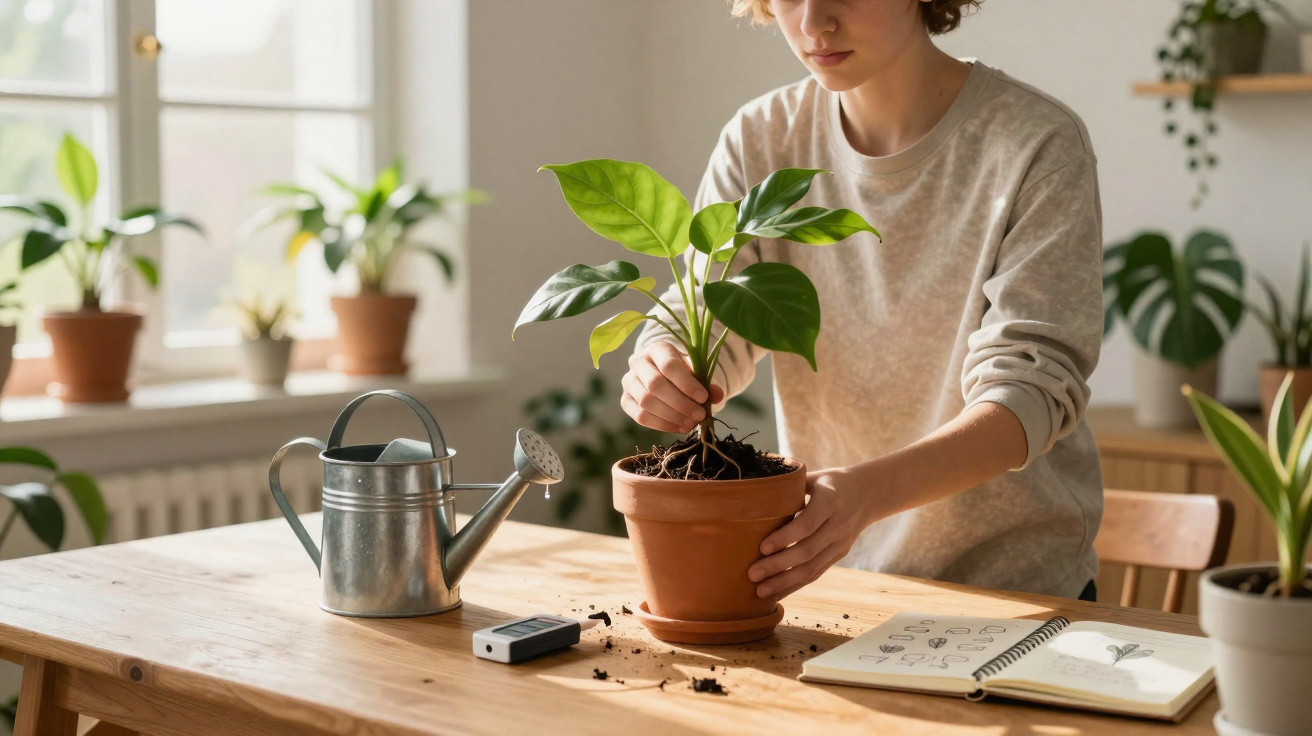
Glossy foliage, a lively arch and no sign of trouble. By Friday, however, the tips had turned crisp and brown, with the whole plant sagging like soggy confetti.
Its owner insisted she had done everything “by the book”. She watered on the same day each week, used the same measuring cup and kept it in the same snug corner. She had even watched three tutorials and followed a plant-care app that sent reminders like an anxious friend.
Yet the plant was plainly putting out an SOS. Quietly. Persistently. Until there was no time left.
Speak to enough people and the same line keeps coming up: “But I watered it right.” The issue is usually elsewhere in the pot, below the surface and out of sight beneath the attractive ceramic container and Instagram-ready pictures.
Why some houseplants die often has far less to do with the watering can than with the conditions surrounding it. That is where the real story begins.
Why “correct watering” still kills plants
In a bright London flat, a fiddle-leaf fig can stand looking like a miserable Christmas tree in June. Its owner has stuck to the same watering timetable from the day it came home, but is now searching “why is my plant suddenly dropping leaves” at midnight with a growing sense of dread.
The compost is moist rather than drenched. The pot is fashionable rather than flimsy. Still, the plant is dying. On a nearby shelf, an inexpensive pothos in an unattractive plastic nursery pot is producing masses of fresh growth, despite receiving only a small splash whenever somebody happens to remember.
That difference reveals more about houseplants than many care guides ever do.
Plants do not survive on water alone. Their wellbeing depends on light, air, temperature, microbes, roots and, of course, human routines. When someone says, “I’m watering correctly”, they frequently mean they are following a rule they once read.
Actual plants do not follow rules. They respond to the precise room, the particular pot and even that week’s weather. An amount that is correct on paper may therefore be entirely unsuitable for your windowsill.
Usually, the problem is not a shortage of affection. It is care given automatically, without paying attention to what the plant is showing you each day.
The hidden killers: roots, light and human routines
A plant specialist in Paris once described a client who brought in a nearly dead peace lily in a designer pot. The owner kept a spreadsheet for every watering: exact dates, millilitres and notes. It was the sort of detailed record that would impress a doctor.
But when the plant was eased out of its pot, the reality was unpleasant. Its roots were black, soft and curled around the base like overcooked noodles. There was no drainage hole. Water had collected beneath a layer of decorative stones, turning the bottom of the container into a swamp.
The owner had watered with religious discipline. For months, the plant had been silently drowning.
Plant physiologists focus heavily on roots and oxygen, not moisture alone. Roots require air pockets within the compost in order to breathe. Those pockets vanish in a dense, compacted mix or a pot without drainage.
As a result, roots may suffocate even when you are “watering correctly”. The top growth can appear healthy for a time, before the leaves suddenly collapse and never properly recover. It may seem random, but it is not: it is simply the point at which the roots finally fail.
Light can create the same misleading effect. A “medium-light plant” in a gloomy hallway uses much less water than an identical plant on a sunny windowsill. Water both in the same way and one will drink, while the other remains in a cold, saturated sponge. The same person performs the same action, with the opposite outcome.
How to water houseplants like someone who actually watches them
Growers who maintain whole greenhouses do not rely on rigid calendar routines. They feel the compost, lift the pots and inspect the leaves with calm suspicion.
The easiest approach is to push a finger into the potting mix as far as the first knuckle. Dry compost indicates a real need for water. If it feels cool and faintly damp, leave it alone. This small, almost old-fashioned habit outperforms most apps.
Some people take this further by getting to know a pot’s “weight”. Lift it immediately after watering thoroughly; that is your reference point. Lift it again a few days later. When it feels unexpectedly light, the roots have used what they need. Water at that point, rather than earlier.
In practical terms, routine rather than cruelty is what harms many plants. People like schedules: “Every Sunday I water all my plants.” On paper, that appears sensible.
In reality, it is more complicated. After a cloudy week, a plant may still be wet on Sunday. Nevertheless, it gets watered because the calendar demands it. Over time, this puts the roots under continual stress.
On a busy Tuesday evening, hardly anyone completes a full plant-inspection round unless they are especially dedicated. Let’s be honest: nobody really does that every day.
This is how overwatering takes hold: not through enormous deluges, but through frequent little drinks given to plants that were not thirsty to begin with.
One horticulturist put it this way:
“Plants don’t need you to be perfect. They just need you to look before you pour.”
Applying that principle in everyday life means approaching plant care differently: less autopilot, more quick checks.
- Water when at least the top 2–3 cm of compost is dry, rather than when the calendar prompts you.
- Choose a pot with a drainage hole and saucer, even if it sits inside a decorative outer pot.
- Tip out water left in saucers after 20–30 minutes, so roots are not left in a puddle.
- Keep thirstier plants, such as ferns, separate from succulents, rather than treating every plant alike.
- Reduce watering in winter: lower light generally means slower water use and fewer watering days.
Learning to spot stress before it’s “too late”
There is a point shortly before a plant declines completely when it is still quietly asking for help. Its leaves may droop late in the day and lift again overnight. Fresh growth may emerge smaller, while the colour shifts from deep green to a faded, weary shade.
We often ignore these clues, putting them down to “winter blues” or claiming “this species is just dramatic”. In fact, these subtle shifts are an early-warning system. Notice them in time and you can still reverse the problem.
Treat your home as a collection of mini-climates. A shelf near a radiator is warm and dry. The bathroom is humid and more forgiving. A north-facing desk is cool and low-lit. The same plant will use water very differently in every one of these locations.
Once you recognise these areas, your watering decisions begin to change almost by themselves. Instead of asking, “How often should I water a monstera?”, you ask, “How is this monstera, in this room, doing right now?”
That small mental shift often separates a home full of browning pots and guilt from one that quietly feels alive. It is also the part people ultimately want to share.
| Key point | Details | Why it matters to readers |
|---|---|---|
| Drainage is non-negotiable | Select pots with at least one drainage hole and use a loose, airy compost mix; add perlite or bark for tropical plants. Decorative containers can serve as covers, but the plant itself should remain in a plastic inner pot that drains freely. | This prevents the silent root rot that kills plants even when you “follow the rules”, and stops watering errors from becoming lasting damage. |
| Match watering to light, not the calendar | Plants in bright windows can need water twice as often as the same species in a dim corner. Monitor how quickly the compost dries in each position over a couple of weeks, then tailor your routine to each room. | It avoids giving identical amounts of water to plants with completely different requirements, the classic reason one shelf of plants dies while another flourishes. |
| Read the soil, not just the leaves | Test the top 2–3 cm of compost with a finger or wooden skewer. Combine this with the pot’s weight, and water only once both indicate dryness. Wilting in wet compost signals trouble; wilting in dry compost indicates ordinary thirst. | This lets you distinguish overwatering from underwatering, so you do not “treat” a drowning plant with more water and can address the true cause instead. |
FAQ
- How do I know if I’m overwatering or underwatering? Check the compost before anything else. When a drooping plant has soggy compost that smells slightly sour, its roots are probably dealing with excessive moisture. If the leaves are limp but the compost is dry, crumbly and shrinking from the pot edges, the plant simply needs a drink.
- Why did my plant die even though the top of the soil was dry? The surface may dry out while the lower half of the pot remains wet, particularly in tall or tightly packed containers. Where drainage is absent, water settles and stagnates around the roots, which then rot unnoticed while the surface appears harmless.
- Is tap water killing my houseplants? In most cities, tap water is suitable for common houseplants. Certain sensitive plants, including calatheas, may gradually develop brown edges in response to hard water. Leaving the water overnight or using a simple filter will usually resolve this.
- How often should I water in winter? Most indoor plants grow more slowly as days shorten and radiators dry the air. Many plants that need water weekly in summer require it only every two to three weeks in winter, though you should still inspect the compost instead of relying on fixed dates.
- Can a plant recover from root rot? Yes, if it is caught early enough. Remove black, mushy roots, repot the plant in fresh, airy compost and a draining pot, then water sparingly and provide bright, indirect light. If every root has gone and the stem feels soft, there is often too little remaining to rescue.



Comments
No comments yet. Be the first to comment!
Leave a Comment