
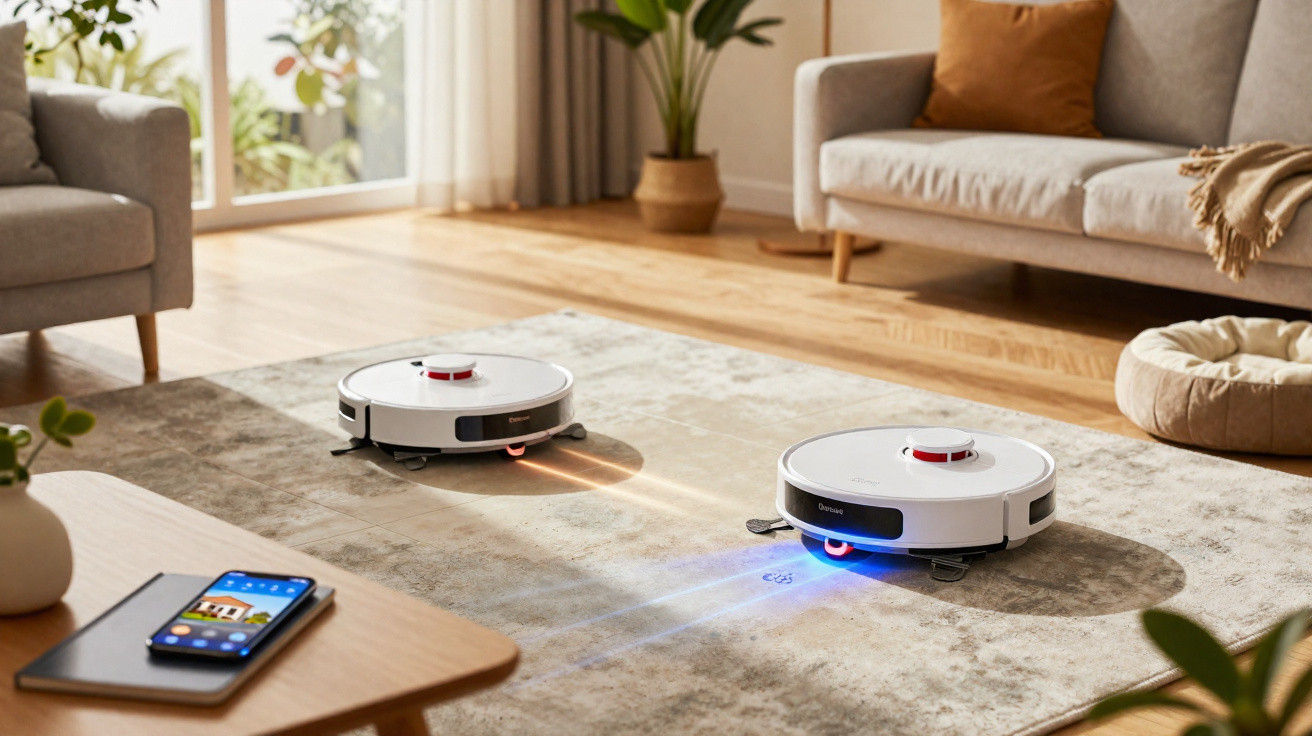
The logos may look alike on a shop shelf and their adverts make near-identical claims, but these robots do not clean a home in quite the same way.
I once watched a toddler scatter raisins across the hallway like confetti as a golden retriever’s tail swept beneath the bench. One robot approached, spotted a sock and quietly went around it; the other prodded the sock, paused as if considering it, then followed the skirting board with the precision of a miniature road sweeper. Apart from the warm fan sound coming from the dock, the house was silent. I can still recall the small chime carrying down the hall. The distinction was not simply suction power or mapping. It was the way each brand deals with the everyday disorder of a lived-in home.
Power, mapping and mopping: how Roborock and Dreame differ today
By 2025, both brands are quick, clever and determined not to leave dirt behind. Roborock prioritises refinement: fluid maps, dependable obstacle awareness and mops that rise over carpet without fuss. Dreame focuses on reach, with arms that work close to edges, forceful scrubbing and base stations resembling compact laundries. You can notice the difference beneath bare feet.
Consider edge cleaning. Dreame’s latest flagship robots use a retractable mop system that moves towards the skirting board and works along the strip where dust generally collects. Roborock’s premium models counter with powerful agitation and, on selected units, dual rollers, while lifting their pads over rugs as carefully as a butler crossing carpet. In rooms full of pet hair and dropped snacks, Dreame will often produce cleaner corners, whereas Roborock commonly handles carpet transitions more cleanly. Choose according to your main cleaning challenge.
The dock is another point of difference. Roborock’s Ultra stations are neat, well insulated and relatively kind to the ears while hot air dries the mops. Dreame favours more intensive cleaning in the base, regular pad washing and more assertive drying programmes. One is understated enough for a living room; the other is industrial in the most positive sense, like a pit stop. Both dispose of dust, rinse pads and dry them, but their approaches to mop care differ, affecting odours, streaks and the weekly maintenance needed at home.
Choosing the right brand for your floors and routine
Begin by identifying the nature of your mess: edges, carpets and available time. If the narrow grey line along the skirting board bothers you most, Dreame’s edge reach can be genuinely satisfying. If your home has plenty of carpet and you want mops to lift without carefully managing zones, Roborock’s pad-lift behaviour is reliably unfussy. A quieter dock can matter in a small flat, while a dock that vigorously washes pads can save effort later in a large house.
Most of us know the feeling when a robot discovers a shoelace and you hold your breath. This is where each brand’s character becomes apparent. Roborock’s obstacle avoidance is generally more cautious, leaving extra room around cables; Dreame’s newer models identify a wider range of objects while still venturing close to the edges. Neither approach is flawless. A tidy floor remains the best solution. Realistically, though, nobody tidies every day. Instead, use routines that automatically wash pads after mopping particular areas, and arrange a weekly “deep edge” run where your chosen brand provides one.
By the third month, the running cost and day-to-day inconvenience are also noticeable.
“I tell customers the same thing: buy the robot whose station you won’t dread hearing,” says a repair tech who sees both brands weekly. “Noise, smell, and little clogs decide whether you love it in six months.”
- Edge cleaning: If skirting boards constantly bother you, put Dreame models with an extending mop arm on your shortlist.
- Self-wash base stations: Choose heated drying to help prevent musty mop pads during damp weeks.
- App reliability: Roborock’s app feels more relaxed; Dreame’s is busier, but gives more detailed control over pad-wash timing.
- Consumables: Bags, filters and pads soon add up, so review bundle prices before being tempted by a sale price.
- Space and sound: Certain docks are tall and noisy during self-cleaning; measure the available recess and consider your noise tolerance.
Who is really ahead in 2025?
There is no single crown here; leadership depends on suitability. Roborock is ahead for buyers who want consistency: reliable maps, assured carpet handling and docks that blend into the room. Dreame comes out in front when the priority is “clean to the edges, every time”, thanks to energetic pad care and smart reach that can make skirting boards appear new. Both companies continue to increase suction and AI capabilities, but their real differences lie in their rhythm: how regularly pads are washed, how corners are reached and how the app guides you through the week.
In homes, people rarely discuss Pascals of suction after the first month. Instead, they mention smells, streaks by the fridge, and whether the robot tangled itself up or smoothly passed through the chaos. That is why the stronger brand for your home may not be the one that looks “best” on paper. Select the one that fixes your most irritating problem, rather than the one with the longest specifications list. That is how a gadget becomes invisible, in the best possible sense.
| Key point | Detail | Why it matters to the reader |
|---|---|---|
| Dock behaviour | Roborock is quieter and tidier; Dreame washes pads more vigorously and reaches edges | Helps you decide according to odour control, noise and corner cleanliness |
| Floor types | Roborock’s pad lift excels with mixed carpet; Dreame performs particularly well on hard floors with skirting boards | Matches the brand to your real rooms rather than generic specifications |
| App experience | Roborock: stable and straightforward; Dreame: detailed controls and frequent pad-wash options | Determines everyday convenience and how much you will adjust settings or simply leave them alone |
FAQ:
- Which brand works best for pet hair? Both perform strongly, but Roborock’s dual-roller arrangements on some models can limit tangles on rugs, while Dreame’s edge reach draws hair out of skirting-board lines that you would otherwise sweep yourself.
- Do I still need a manual mop? Yes, for sticky spills or scrubbing grout. Robots preserve the shine, but they cannot replace an occasional deliberate deep clean.
- Will the robot avoid toys and cables? Premium models from both manufacturers can identify common obstacles using onboard cameras and AI. Help them out by picking up loose wires before major cleaning runs.
- How much room does the dock require? Allow roughly the footprint of a shoebox plus some clearance above it. Docks are taller than they appear in photographs, and airflow aids drying.
- What are the long-term costs? Include dust bags, filters and mop pads in your calculation. Dreame often has the advantage on initial price, while Roborock often benefits from better parts availability and consistent firmware support.




Comments
No comments yet. Be the first to comment!
Leave a Comment