
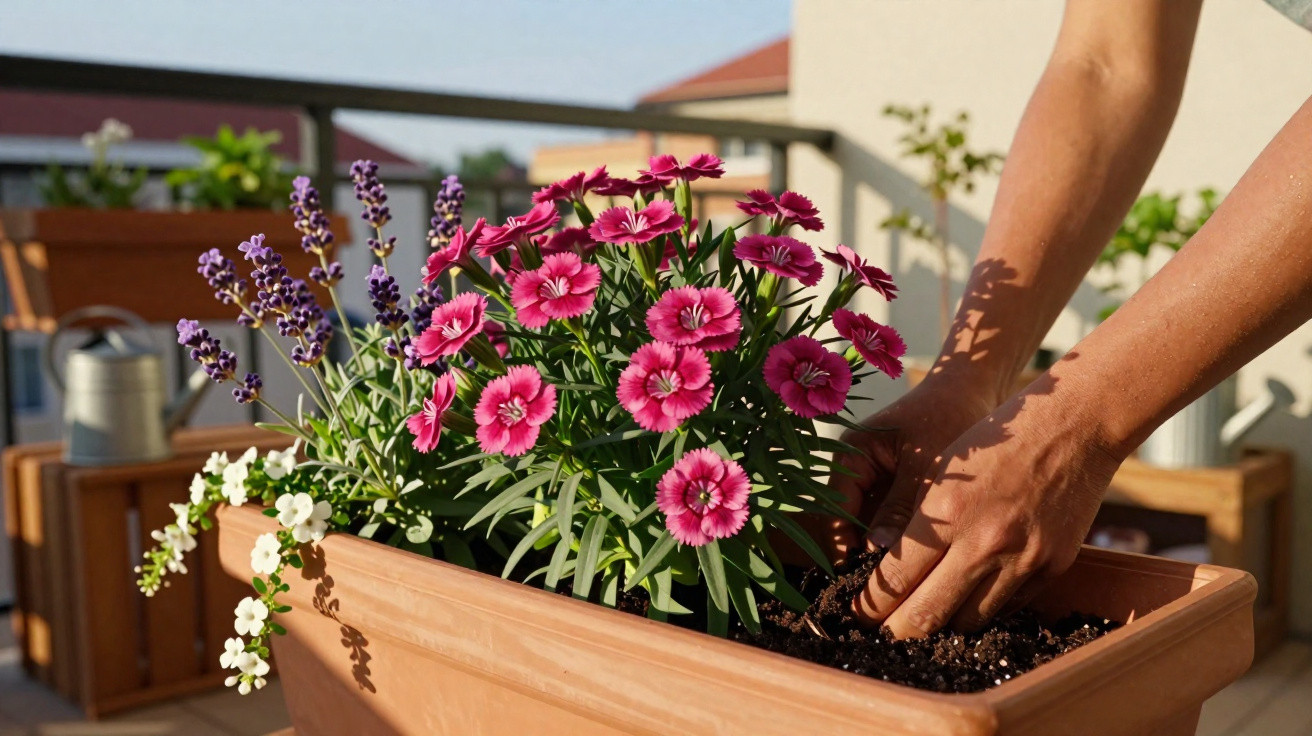
Many amateur gardeners are looking for exactly this: an easy-care plant that lasts throughout the summer, takes up very little room and still provides a striking focal point. The perennial pink Dianthus ‘Bumbleberry Pie’ meets all of these requirements and is ideally suited to contemporary gardens, urban balconies and compact terraces.
Why Dianthus ‘Bumbleberry Pie’ is becoming a widely shared insider tip
A neat, compact habit that instantly brings order to borders
Dianthus ‘Bumbleberry Pie’ grows into dense, rounded cushions around 25–30 cm tall. Its grey-green foliage has a calm, refined appearance, resembling a small cushion of delicate leaves. Firm stems support the flowers upright; they rarely flop over, so the plant consistently looks tidy.
This makes it particularly useful along narrow borders, in rock gardens or at the front of a herbaceous bed. On a terrace, too, a low container planted with this pink can create real visual structure without obstructing the view.
Grey-green foliage, sturdy stems and dense growth: this perennial resembles a natural miniature shrub in a border or on a balcony.
Eye-catching flowers with a fragrant note
The blooms are especially striking: vivid pink, finely fringed and marked by a darker, almost burgundy centre. This colour contrast gives them a subtle watercolour effect that becomes even more pronounced in sunlight. Produced in generous numbers above the foliage, the flowers form true cushions of colour.
They also offer a delicate yet clearly noticeable fragrance reminiscent of traditional garden pinks. Position the plant beside a seating area, balcony chair or garden path and you can enjoy both its colour and scent. The blooms are also well suited to small table posies, where they stay fresh for several days.
Flowers from spring into autumn
A major benefit is that this perennial does not flower only briefly, but for many weeks. The first buds open from spring onwards. With appropriate care, flowering continues into late summer and, in mild areas, can even extend into autumn.
Regularly removing spent blooms encourages the plant to form fresh buds again and again. As a result, the cushion remains colourful almost continuously. The flowers also attract many insects, including butterflies and other pollinators. Deer and other wild animals generally leave pinks alone, which is a real advantage in rural areas.
Position: where the pink will really thrive
The best conditions in the garden
For Dianthus ‘Bumbleberry Pie’ to perform at its best, it needs one thing above all: sunshine. At least six hours of direct sun each day is ideal. Partial shade often results in fewer flowers and looser growth.
The soil should be:
- loose and free-draining
- not persistently wet
- preferably somewhat lime-rich
- free from winter waterlogging
On heavy clay soils, it is worthwhile incorporating sand or fine gravel before planting. This allows surplus water to drain away more effectively and makes root rot less likely. Spring, once the soil has warmed up, is the best time to plant. The perennial can then establish its roots calmly before the hot days of summer arrive.
| Factor | Recommendation |
|---|---|
| Light | full sun, at least 6 hours of sunshine |
| Soil | free-draining, light, rather lime-rich |
| Plant spacing | 25–30 cm between plants |
| Height | around 25–30 cm |
An ideal choice for window boxes and containers
This perennial can also be used without a garden. It performs very well in a pot or window box on a balcony or roof terrace. Choose a container at least 25 cm in diameter, with drainage holes at the base. A high-quality potting compost mixed with sand or lava granules makes a suitable growing medium.
As compost dries out more quickly in containers, watering is needed more often than in a border. The plant will not tolerate waterlogging, though it does cope with briefly drying out between waterings. It is therefore a good way to enhance even modern, minimalist balconies with colour that does not look overdone.
Anyone with only a small city balcony can bring a genuine piece of garden up to the fourth floor with this pink.
Care: a few simple steps for a long flowering period
Watering, feeding and pruning – how to keep the plant looking its best
Care is straightforward, although a few regular tasks are worthwhile:
- Watering: Keep evenly moist during hot weather, especially in containers. Avoid constant wetness.
- Feeding: From May to August, apply a light liquid feed for flowering plants every three to four weeks.
- Removing spent flowers: Cutting away faded blooms promotes new buds and lengthens the season.
- Pruning: At the end of winter, trim back dry or brown shoots so that the cushion can regrow densely.
With this minimal care, the perennial will remain attractive for years. Plant several specimens side by side and they will soon create a dense strip of flowers that frames beds and clearly defines paths.
Combining it with other plants
Thanks to its compact growth, Dianthus ‘Bumbleberry Pie’ mixes well with other perennials and herbs. It looks particularly harmonious alongside:
- lavender or thyme in sunny, dry areas
- low ornamental grasses that introduce movement to a border
- white or purple flowering plants that emphasise the intense pink
- early-flowering bulbs that fill the gap before the pink comes into bloom
In pots, the pink pairs well with silvery foliage, such as Helichrysum or perennial spurge. This creates a contemporary Mediterranean look that also suits urban loggias.
What beginners should also know
Anyone with little previous experience of perennials can make a relatively safe start with this pink. It forgives short dry spells, grows slowly but steadily, and will remain in the same spot for years. There are just two conditions it really dislikes: wet, heavy soil and deep shade.
Another benefit is its hardiness: as a perennial, it does not need to be bought again every year. Once established, it can even be divided after a few years and replanted elsewhere. This gradually creates several islands of colour in the garden or across different balcony containers.
The plant is also well suited to families with children. Its low height makes it easy to reach, allowing children to cut fragrant flowers for small posies while learning, almost incidentally, how important insect-friendly plants are in their own outdoor space.
For anyone who does not want to fill every space with short-lived seasonal bedding plants, this is a long-lasting, versatile and visually striking alternative. Particularly in limited space, this compact pink demonstrates how much impact a single, well-chosen perennial can make.





Comments
No comments yet. Be the first to comment!
Leave a Comment