
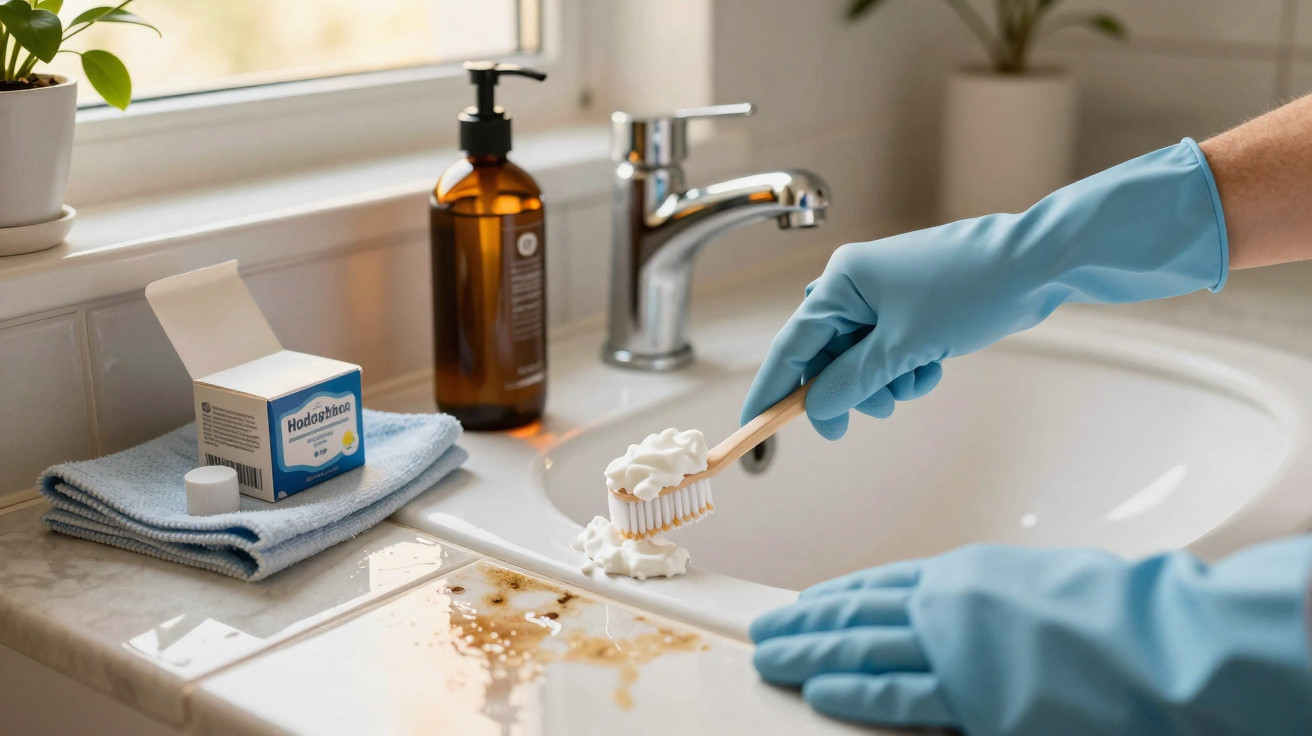
The bottle was open before she rang her sister. Baking soda sat on the worktop beside a half-forgotten brown bottle of hydrogen peroxide from the first-aid box, while a TikTok clip replayed in the background. “They say it cleans grout in seconds,” she said under her breath, scattering the white powder over the bathroom tiles as though salting an icy pavement. Almost immediately, it began to fizz: tiny bubbles emerged from the joints, carrying a faint medicinal scent. It seemed like a clever little science experiment… until foam crept towards the bathmat and she started to feel a mild headache.
Had she found an inexpensive, brilliant cleaning trick, or was she unknowingly creating a chemistry issue in her own home?
Baking soda + hydrogen peroxide: miracle mix or messy myth?
The internet cannot resist a miracle made from two ingredients. In DIY-cleaning terms, baking soda and hydrogen peroxide are the Brad Pitt and Angelina Jolie pairing: appealing, compelling and said to solve nearly every problem. Grout between tiles, scorched pans, yellow trainers and even teeth stained by coffee - somewhere there is almost certainly a reel or pin claiming this fizzy paste will “change your life”.
Keep scrolling and it becomes easy to think you are failing at adulthood if you do not clean with this pair. A low-cost white powder and an ordinary pharmacy antiseptic begin to resemble a haloed chemistry kit.
One young tenant I spoke to insists the mixture saved her deposit. Her oven appeared to have survived ten years of late-night pizzas, and the glass door was so brown that she had stopped trying to see through it. She combined baking soda and 3% hydrogen peroxide into a dense paste, spread it over everything, shut the oven door and went to bed.
The following morning, she used a sponge to wipe it away and filmed the result with the excitement normally associated with winning the lottery. The brown grime came away in sheets. The glass returned to a hazy, almost-new gleam. When her landlord later inspected the kitchen, he actually said, “Wow”.
There is a genuine reason this pairing so often appears “genius”. Baking soda is both mildly abrasive and alkaline, helping it shift greasy, acidic dirt. As hydrogen peroxide breaks down, it releases oxygen, which can help lift stains and offers a mild disinfecting action. Combined, they make a foaming paste that stays on a surface long enough to work properly.
However, they remain chemicals, despite being kept in a cupboard and a medicine cabinet. Used correctly, they provide effective, affordable cleaning. Used carelessly - in an unventilated, cramped bathroom or on an unsuitable material - this so-called “hack” may become a poor choice involving headaches, burns or ruined finishes.
How to use the combo without turning your home into a lab
Using baking soda and hydrogen peroxide safely is surprisingly straightforward. Put ordinary baking soda and 3% hydrogen peroxide - the usual pharmacy concentration - into a small bowl and make a paste that can be spread, using roughly 2 parts baking soda to 1 part peroxide. The texture should resemble yoghurt rather than soup.
Apply it to the item you want to clean, whether that is grout, a stained pan, the oven-door interior or the soles of white trainers. Allow it to sit for 5–15 minutes, then gently scrub with a brush or sponge before rinsing thoroughly with water. In a confined room, open a window or switch on the extractor fan.
The most common error is to regard the mixture as a magical liquid that can go anywhere. Some people coat natural-stone worktops with it, then wonder why their polished finish becomes dull. Others attempt “instant teeth whitening” with an abrasive paste, only to be left with sore gums and sensitive teeth.
Most of us recognise that point at which a TikTok trick feels more appealing than reading the dull information on the back of a packet. You are exhausted, the stain looks awful, and a foamy paste seems harmless. The simple reality is: this remains chemistry, even when it comes from the supermarket. Give it some respect, and it is more likely to treat your surfaces kindly in return.
“Hydrogen peroxide is not a toy,” a hospital pharmacist told me. “At 3% it’s fairly mild, but mixed with abrasives and left on skin, teeth, or certain materials, it can do damage. People forget that because it doesn’t smell ‘toxic’ in the same way bleach does.”
- Never mix with vinegar, bleach, or ammonia
This combination can create irritating or hazardous gases, particularly in very small bathrooms. - Use only 3% hydrogen peroxide
Stronger hair-developer or industrial products are intended for professionals, not shower grout. - Test a concealed area first
This matters particularly for coloured fabrics, grout, wooden chopping boards and stone surfaces. - Use basic protection
Gloves, an inexpensive mask when scrubbing for a long time, and open windows are modest precautions that can make a substantial difference. - Think of it as a treatment, not a lifestyle
Honestly, no one does this every day - and that is better for both your lungs and your tiles.
Genius hack, reckless experiment… or something quietly in-between?
There is something oddly reassuring about these modest fizzing experiments on a kitchen worktop. In one sense, mixing baking soda and hydrogen peroxide can feel like reclaiming control from costly brands and confusing labels. Two unassuming products, some foam, and suddenly the mess gives way. Watching brown grout lighten or a burnt pan gradually reveal its metal again can be deeply satisfying, almost therapeutic.
But that enjoyment can also tempt us to go too far - applying it to skin, using it in shut rooms or spreading it across fragile finishes - because “natural” and “homemade” sound safer than they truly are. One wrong move can turn an intelligent shortcut into another “what was I thinking?” moment.
Perhaps the clever part is not the mixture itself, but learning where its limits are. Treating it as a tool rather than an all-purpose cure. Opening a window without needing a reminder. Refusing to follow a social-media clip that recommends scrubbing your gums with a gritty peroxide paste to get a whiter smile by Friday.
People who have used this pairing successfully for years generally make the same point: it works brilliantly for a handful of particular tasks and is entirely unsuitable for others. They know when to stop. That restrained, almost unexciting judgement rarely becomes viral content, but it is what safeguards your lungs, surfaces and peace of mind.
One useful question may be this: does this particular mess really require a bubbling chemical reaction, or would soap, water and five more minutes achieve the same result? Not every stain needs drama. Some do; some do not. The next time you reach for the brown bottle and white powder, pause briefly and picture the room five minutes later - the odour, the foam and the material beneath it.
That brief pause marks the boundary between a “genius household essential” and a “reckless DIY experiment”. It is also the point at which your home becomes less like a laboratory and more like somewhere you genuinely enjoy living.
| Key point | Detail | Value for the reader |
|---|---|---|
| Understand the mix | Baking soda is mildly abrasive and alkaline; hydrogen peroxide releases oxygen and disinfects | Helps you decide when the combination is truly useful rather than excessive |
| Follow straightforward safety rules | Use 3% peroxide, ventilate the space, do not combine it with other strong products, and test surfaces first | Lowers the chance of harm to health, teeth, skin and household materials |
| Use it as a targeted tool | Keep it for grout, ovens, pans and trainers - rather than using it as a daily whole-house cleaner | Saves time and money while preventing small cleaning tasks from becoming risky experiments |
FAQ:
- Question 1 Can I safely whiten my teeth with baking soda and hydrogen peroxide?
- Answer 1 Using a very mild paste occasionally - with more baking soda and less peroxide - may brighten teeth in the short term. However, dentists caution against regular use because its abrasive texture and oxidising action can wear down enamel and irritate gums. Professional whitening or dentist-approved products are safer over the long term.
- Question 2 Is it safe to clean grout with this mixture every week?
- Answer 2 In most tiled bathrooms, occasional use on heavily stained grout is acceptable, but weekly treatment may gradually weaken grout or fade coloured joints. Keep it for deep-cleaning sessions and use gentler soap-based products for routine cleaning.
- Question 3 Can I keep a ready-made baking soda and hydrogen peroxide paste?
- Answer 3 It is not an ideal plan. Hydrogen peroxide gradually breaks down into water and oxygen, particularly when exposed to air and light. Prepare only the amount needed for one cleaning session, discard what remains, and rinse the container thoroughly.
- Question 4 Which surfaces must I avoid with this mixture?
- Answer 4 Do not use it on natural stone, including marble and granite; delicate or sealed wood; certain metals that tarnish readily; or coloured fabrics that matter to you. Its alkaline and oxidising properties can etch, bleach or dull finishes.
- Question 5 Are the fumes dangerous to breathe in within a small bathroom?
- Answer 5 At standard household concentrations, light ventilation is normally sufficient. However, lengthy scrubbing in an enclosed space can cause irritation, coughing or headaches. Open a window, run the fan and pause if your eyes or throat begin to feel scratchy.



Comments
No comments yet. Be the first to comment!
Leave a Comment