
The evening begins with dew-soft romance: flattering light, the dress you genuinely ironed and lipstick that needed three attempts.
Then you hear it. That small, merciless clink as a necklace turns itself into a metal knot at the base of a tray. You pull at it, mutter under your breath, a clasp breaks and a stone drops out. The car is waiting below, your mood has vanished, and that “special” pair of earrings is… somewhere.
Jewellery should feel like a private superpower. For many of us, though, it sits in a compact jumble of tangled chains, single studs and bracelets only “rediscovered” during a house move. The disorder may seem harmless, but it gradually removes the pleasure of wearing what you own. Pieces disappear, become scratched or simply feel too inconvenient to reach for on a rushed morning. Somewhere between the velvet box and the plastic zip bag, the original intention disappears.
What if your collection resembled a miniature personal boutique rather than a junk drawer?
Why most jewellery collections become tangled and partly lost
Open almost any jewellery box and it can seem to tell the story of a life. There is the necklace given by an ex, the ring from a holiday market that turned your finger green and the inherited brooch you are slightly nervous to handle. They sit in a silent heap, with gold pressed against costume metal and fine chains winding around hoop earrings. It is not merely a pile of objects; it is a pile of memories.
That emotional attachment helps explain why new pieces are put “somewhere safe” without any proper system. We promise ourselves that we will sort everything out “one day”. Then mornings become more rushed, evenings run later and the pile grows. In time, what began as an attractive box on the dressing table becomes a small, shiny area of guilt. You know there are treasures in it, but also know that retrieving one will take ten minutes and two deep sighs.
Most tangled collections share three features. First, every item is kept in one container: necklaces, rings and bracelets piled over one another. Second, there is no zoning - no distinction between pieces worn constantly and items saved for special occasions. Third, there is no routine for returning jewellery. Earrings are left on the bedside table, a ring is thrown into a handbag pocket, or a chain is wrapped in tissue paper for travel and forgotten. People are not necessarily untidy; their jewellery storage simply fails to suit the pace of their real lives.
There is also a practical price to this confusion. Fine chains can stretch or snap after knotting around heavier pendants. Stones can scratch each other through friction. Earring backs slide off studs and vanish forever into the dark gap behind a dressing table. Many women discreetly replace a simple gold hoop every few years, not because the original pair broke, but because one earring never returned from a weekend bag or a hotel bathroom sink.
Creating a “no-tangle, no-loss” jewellery system at home
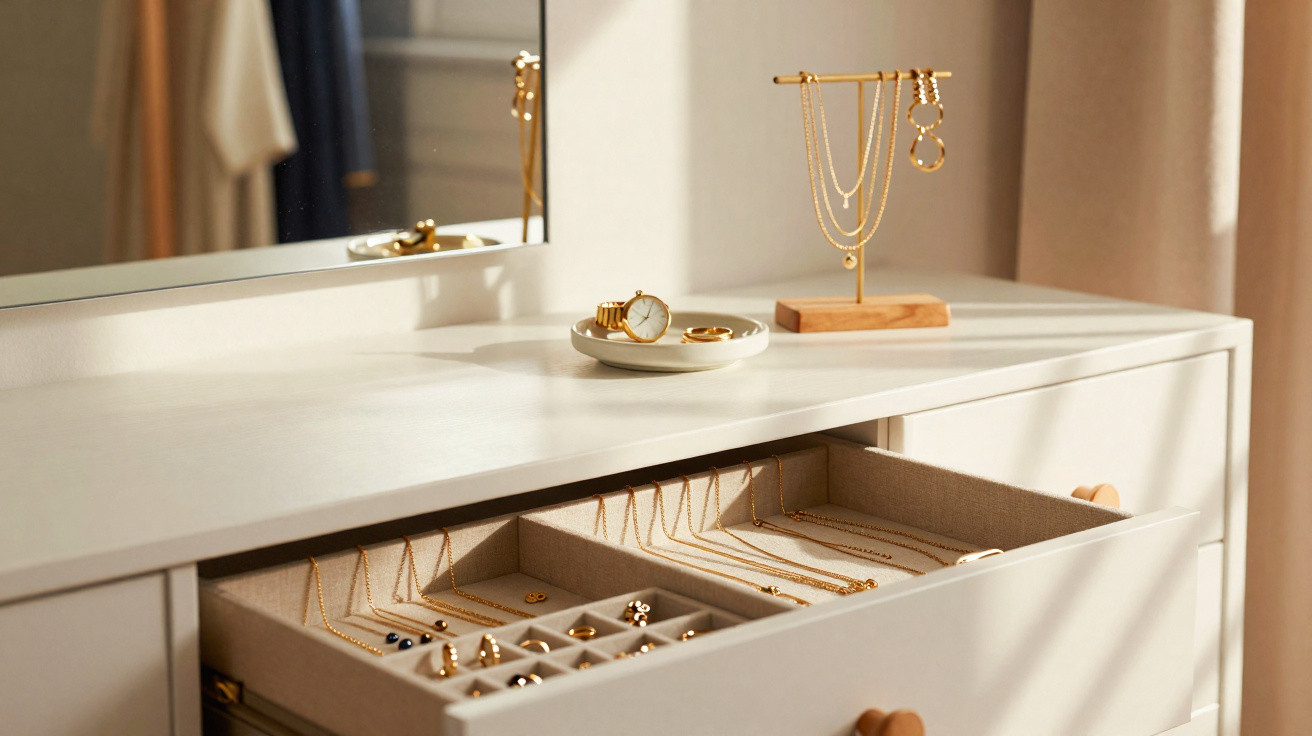
The best jewellery system begins with one choice: every item needs its own lane. This does not require a flawless Pinterest display, only clearly separate spaces. Take a shallow drawer or a solid tray and divide it as though it were a city map. Lay necklaces flat in long rows. Put rings and studs in small sections. Place chunky bracelets and cuffs in a deeper corner. The aim is straightforward: no piece should touch more than one or two neighbours.
Flat storage is the strongest defence against knots. Long chains naturally travel, so leave enough room for them to lie straight. A lined cutlery tray can work remarkably well: every knife slot becomes a lane for a necklace. Fasten clasps and keep pendants facing upwards. If you would rather store jewellery vertically, select a stand with several staggered heights so chains do not gather together. Think in terms of gravity: anything able to slide down onto another item will eventually do so.
Next, establish an obvious “landing strip” for the pieces you wear every day. This could be a small dish beside the bed or on a bathroom shelf, or a little cup near your desk. Jewellery rests there during the day before returning to its compartments at night. Let us be honest: hardly anyone does this every single day. Yet if the main storage is nearby and simple to use, you will do it often enough for tangles to become rare. The system need not be perfect; it only needs to be obvious.
Loss often begins with an apparently harmless thought: “I’ll just put this in my bag for later.” Rings go into zipped pockets, earrings into coin purses and necklaces are loosely wound around perfume bottles. It is portable chaos. Counter it by using one dedicated small travel case, and nothing else. Treat it as a miniature vault kept in your handbag or luggage. Once again, use separate zones: a padded strip for studs, tiny hooks and elastic loops for chains, plus a soft compartment for chunkier bracelets.
When travelling, hang necklaces on their hooks, close the clasp and then place the pendant in a small mesh pocket if the case provides one. This prevents chains swinging freely and wrapping around one another in transit. For an affordable alternative, a basic pill organiser is unexpectedly effective for rings and earrings. One day equals one compartment. Each pair remains together and nothing can escape. You can even label the days if you enjoy planning outfits in advance, creating your own tiny shop display.
At home, keep travel storage close to the place where you genuinely remove your jewellery. If you always take it off on the sofa, put the travel case in a living-room cupboard rather than the bedroom. Your system should follow your routines, not oppose them. One useful emotional prompt is to give precious pieces a “VIP” area that you handle deliberately - perhaps a separate, softer pouch tucked inside the case. The small ritual of zipping it closed tells your brain that these items must not be left in a hotel drawer.
Jewellery goes missing when it has no place that feels official. Give every category a home, then create extremely easy rules for yourself. For example: studs always go on boards, rings always go in cups and necklaces never go on the bedside table. When you ignore the rule, you notice immediately, much like leaving your phone on a café table. Eventually, your hands act almost without thought. You undo a clasp, put earrings on the correct tray and slide a ring into its own slot. No drama and no search before work.
“When clients tell me they’ve ‘lost’ jewelry, nine times out of ten it’s not lost - it’s hiding in a coat pocket, a soap dish, or the bottom of a cosmetic pouch,” says London-based professional organizer Maya Green. “The real game-changer isn’t more space. It’s fewer, clearer places for pieces to go.”
For earrings, a basic perforated board or mesh frame can transform the situation. Pairs remain together, backs stay in place and you can instantly see what you have. Slide the board into a drawer or hang it inside a wardrobe door if visible clutter is not for you. Rings suit shallow, soft-lined cups or rolls - think sunglasses case rather than a bottomless bowl. In a shared household, label each area with initials. No more “Have you seen my gold hoop?” at 7:42 a.m.
Some people rely on original boxes, although these are often rigid and bulky. Combine different solutions: reserve branded boxes for genuinely sentimental or high-value pieces, and choose lighter organisers for everyday jewellery. A useful rule is this: if a box makes you less likely to open it, it is working against you. Storage should welcome you, not intimidate you.
- Make one “landing strip” dish where jewellery can rest before it returns to its main home.
- Use dividers or trays so that no necklace overlaps with more than one neighbour.
- Keep a dedicated travel case, avoiding pockets, tissue paper and loose bags.
- Store sentimental or valuable pieces in softer, more protective areas.
Designing a jewellery system you will actually use
Most organising projects fail in the same way: they look beautiful on the first day, then quietly collapse by the third week. Jewellery is no exception. A velvet-lined box with fifty tiny sections may look stylish on Instagram, but if you rush through mornings holding half a coffee, you will not thread every hoop through its precise space. Your arrangement must work for your least organised self, rather than the idealised version of you.
Consider your getting-ready routine as a short documentary. Where do you stand? Which hand reaches where? Do you select your clothes before your jewellery, or the other way round? The more closely storage follows that natural route, the less effort it takes. If you finish your make-up at the bathroom mirror, keep a slim tray in that room even if the main collection is in the bedroom. Have one drawer for deeper storage and one small station where everyday life actually happens.
On a busy weekday, you have about six seconds of patience for fiddly clasps and missing backs. Let that reality guide your design. Keep your three to five most-worn pieces front and centre, available in a single movement. In the longer term, this makes you candid about what you actually use. Some readers realise that they wear the same five items 80% of the time and begin curating more deliberately. That change alone reduces clutter, knots and the quiet stress of too much choice.
Once the basic structure is established, a handful of small rituals can sustain it without making your life feel like an organising lesson. Do a brief Sunday reset - five minutes, no more - to return stray pieces to their correct areas. Each month, have a “polish and check” session: wipe favourite items, inspect clasps and quietly retire anything that feels more like a burden than a joy. There is no need to do it flawlessly. It is simply a gentle, recurring chance to reconnect with what you own.
Beneath the practical benefits lies something more subtle. Arranging jewellery also honours the different versions of yourself: your everyday self, your party self and your sentimental self who kept Grandma’s locket. When all those versions are crammed into one knotted box, they compete for attention. When each one has a small corner, choosing jewellery in the morning feels more straightforward. Instead of thinking, “I should wear this more”, you begin to ask, “Who do I feel like being today?” That question alone can brighten an ordinary Tuesday.
The appeal of a strong system is that it expands with you. New gifts, travel souvenirs and investment pieces fit into established lanes instead of throwing everything into disorder. If one category begins to overflow - statement earrings, for instance - take it as a gentle prompt to pause and edit rather than purchase a larger box. With time, the items on your dressing table cease to be a heap of tangled metal and become a calm, curated map of your style.
Perhaps the true aim is not perfection, but an easy familiarity with your own collection. It means knowing where everything is, understanding what still suits your life and recognising which pieces deserve more than a knot at the bottom of a dish. That is when you stop merely owning jewellery and begin truly wearing it.
| Key point | Details | Why it matters to readers |
|---|---|---|
| Create clear zones by type | Separate necklaces, rings, bracelets and earrings into individual trays or areas. Use long slots for chains, small compartments for studs and rings, and a deeper section for chunky items. | This immediately limits tangling and reduces morning “where is that thing?” searches, so you genuinely wear what you own. |
| Use a dedicated travel case | Select a compact case with hooks, small pockets and padded sections. Keep all jewellery in this case when leaving home, never loose in bags or pockets. | It helps prevent loss in hotel rooms, handbags and gym lockers while protecting delicate chains from knots during travel. |
| Set up a daily “landing strip” | Put a small dish or tray where you naturally remove jewellery - by the bed, in the bathroom or at your desk - and return items to main storage once or twice weekly. | This makes the system workable on busy days and prevents earrings and rings disappearing into random corners of the home. |
FAQ
How can I untangle a knot of fine necklaces without breaking them?
Put the knot on a flat surface, add a tiny drop of baby oil or unscented facial oil and slowly tease it apart with two fine pins or needles. After separating the chains, gently wipe each one with a soft cloth to remove oil, then hang or lay them flat to prevent another tangle.What is the safest way to store silver so that it does not tarnish?
Store silver pieces in airtight pouches or small zip bags containing an anti-tarnish strip, then keep them in a closed box or drawer. Avoid bathrooms because steam speeds tarnishing, and wear items regularly, as skin oils can actually slow oxidation.Can I keep fine jewellery and costume pieces in the same box?
They can share an overall drawer or tray, but gold, silver and gemstone items should each have their own lined compartment. Costume jewellery can chip or shed plating, potentially scratching or dulling more delicate items when they are piled together.How often should I declutter my jewellery collection?
For most people, a quick review every six months is enough: look for damaged items, single earrings without a match and pieces not worn once in the previous year. Put a small group aside for items you are unsure about instead of forcing a decision, then revisit it during the next review.What is a good option if I have very little space?
Choose vertical organisers: a slim wall-mounted rack for necklaces, a framed mesh panel for earrings and one shallow drawer insert for rings and small items. The backs of doors and the inside of wardrobe doors are often unused, yet can provide remarkably efficient storage without using floor space.

Comments
No comments yet. Be the first to comment!
Leave a Comment