
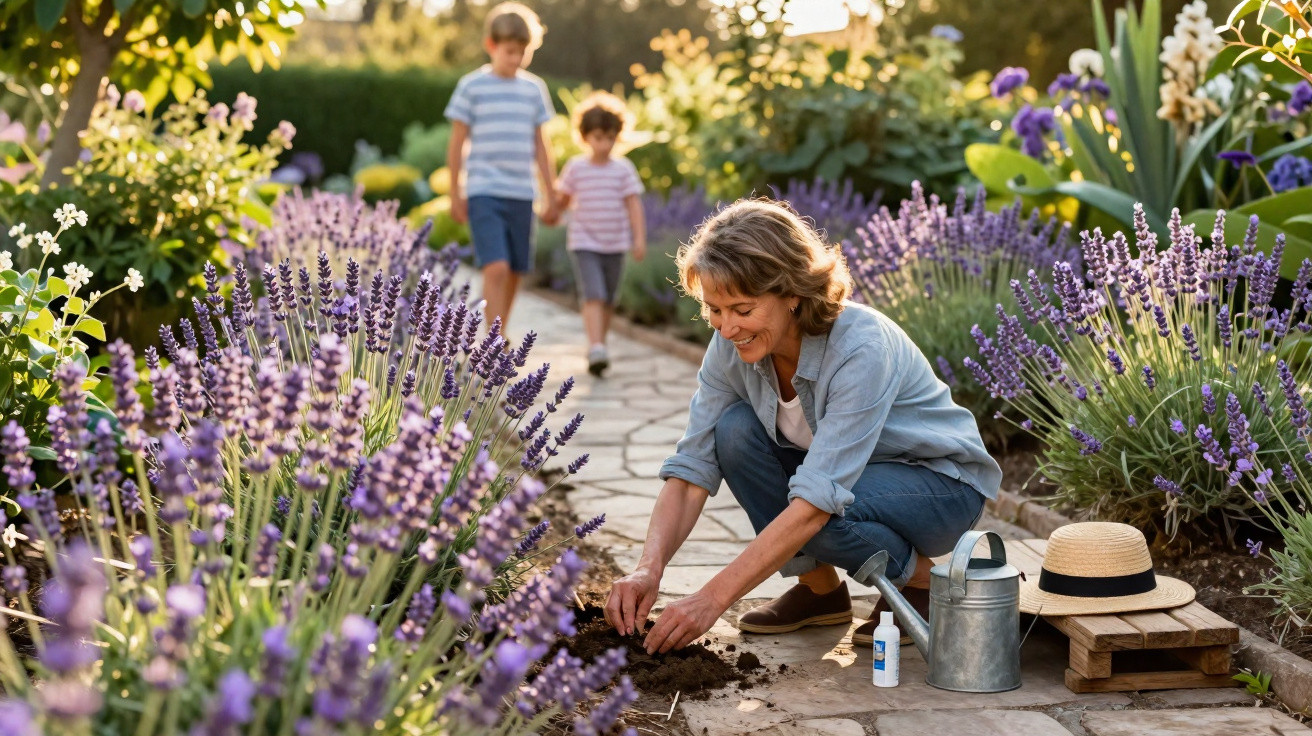
Sprays can smell overpowering, candles soon gutter out, and screens offer no help once you step outdoors. Yet there is a gentler solution in full view: the very edge of your garden path.
The gardener revealed his trick to me at dusk, when the gravel still radiated the warmth it had gathered during the day. With secateurs in his back pocket, he walked beside the path, passing a low lavender border that gave off small violet bursts of fragrance whenever his sleeve touched it. Midges hovered above the lawn, but the path felt like a perfumed passageway, somewhere mosquitoes appeared to avoid as though held back by an invisible barrier. He asked me to pause and listen: the garden was buzzing, but nothing was whining around our legs. Then he told me to walk along the edge once more, slowly. The difference was noticeable.
The lavender path that fights back
Lavender planted beside a path is effective because it grows exactly where your movement creates mild air disturbance. A brushing shoulder or a tote bag grazing the foliage releases the oils behind lavender’s calming scent, and those aromatic compounds are also disliked by mosquitoes. In effect, the path becomes a natural diffuser, replenished by the simple act of walking past.
He had planted a strip of ‘Hidcote’ on one side, with shorter ‘Munstead’ lavender opposite, positioned so the leaves would brush against bare calves. During the first week, he counted six bites after watering late in the day. The following week, once the lavender was flowering and clipped into a low cushion, he had just one. A neighbour borrowed the idea for a brick path and found that visitors stayed outdoors after dinner without automatically swatting at their wrists.
There is straightforward biology behind the appeal. Lavender contains linalool and linalyl acetate, volatile compounds that disperse easily when heated by sunshine or disturbed by air movement, creating a light layer of scent near ground level. Mosquitoes track carbon dioxide and the chemistry of human skin; lavender partly muddles those signals while adding an aroma they tend to avoid. Because stone and gravel retain warmth into the evening, the fragrance continues to be released steadily, like a quiet whisper that does not stop.
How to line your path with lavender
Choose robust varieties that cope well with pruning and the bustle beside a footpath: Lavandula angustifolia ‘Hidcote’ for rich purple flowers, ‘Munstead’ for a neat compact border, and lavandin ‘Grosso’ for taller, more dramatic flower spikes. Plant them 14 to 18 inches apart to form an unbroken line, angling each root ball slightly towards the path. Water them thoroughly when planted, then allow the top inch of soil to dry before watering again. Select a position with six to eight hours of sun each day.
Place the plants where they will actually be brushed; that is the purpose of a path border. Set them too far back and the effect disappears, but put them too close and boots will damage the stems. Sandy or stony ground is ideal. If your soil is clay, make a raised strip using grit and compost, or grow lavender in long troughs alongside the paving. We have all experienced the moment when a lovely garden idea encounters real life and heavy soil. Let’s be honest: nobody actually does that every day.
Maintain a low, flowing shape, rather like lavender washing against the path, with a gentle trim after the first display of flowers. Snip off faded blooms loosely, stopping before you reach old wood, as it does not readily produce new growth. Avoid shaping the plants into tightly clipped balls: these are fragrant borders, not topiary soldiers.
“Paths are where you live,” the gardener told me. “So put the scent where you’ll brush it, and the bugs where they’d rather not follow.”
- Plant it where you walk: placing lavender 6–8 inches from the path keeps the fragrance nearby and ensures frequent light contact.
- Consider sun and drainage: an open position, lean soil and good airflow are always better than waterlogged roots.
- Trim rhythm: give plants a soft clip after flowering, followed by a light tidy in late summer-avoid hard cuts in autumn.
- Mix sizes: use compact varieties around tight bends and taller plants near gates for a lavender “hello”.
- Edge smart: gravel, brick and paving can reflect warmth and encourage stronger fragrance release.
The ripple effect of a scented lavender edge
A lavender border will not eliminate every mosquito, nor is it a replacement for screens or sensible precautions around standing water. However, it can alter the atmosphere of a garden. The air seems fresher, evenings feel more leisurely, and conversations stretch beyond the back door. It is a hedge with two roles: one for your sense of smell and another for your ankles, both provided by a plant that needs little more than sunshine and some care.
| Key point | Detail | Benefit for the reader |
|---|---|---|
| Lavender beside the path reduces bites | Volatile oils are released when the foliage is brushed, masking the signals mosquitoes seek | Fewer outdoor interruptions and greater comfort at dusk |
| The right variety and spacing matter | ‘Hidcote’/‘Munstead’ planted 14–18 inches apart and 6–8 inches from the edge | A dense, touchable strip that releases fragrance as you pass |
| Care is minimal but precise | Sun, drainage, a gentle post-flowering trim and no cutting into old wood | A long-lasting border that looks attractive and works hard |
FAQ:
- Which lavender works best to deter mosquitoes? English lavender (Lavandula angustifolia), including ‘Hidcote’ and ‘Munstead’, is ideal for edging. Lavandin ‘Grosso’ produces a stronger fragrance and taller spikes if you have enough room.
- Will this replace bug spray entirely? No. It can ease the problem along the path and reduce bites for many people, but you still need basic steps such as clearing standing water and using protection on nights with lots of mosquitoes.
- How close should I plant it to the walkway? Around 6–8 inches from the path, so knees, hems and bags brush the plants. That slight contact refreshes the cloud of scent.
- What if my soil is heavy clay? Build a raised strip with coarse grit and compost to improve drainage, or plant in long containers lining the path; the essential point is preventing roots from sitting in wet soil.
- Will lavender harm bees or pets? Bees enjoy its daytime flowers, which is part of its appeal. For pets, lavender plants are generally safe in the garden; discourage them from chewing the foliage and avoid concentrated oils around cats and small dogs.






Comments
No comments yet. Be the first to comment!
Leave a Comment