
The designer paused in the doorway, saying nothing at first.
She simply looked at the enormous white kitchen island: drawers marching in neat rows, a perfectly concealed pull-out bin and a meticulously labelled spice area.
Then, with a faintly apologetic smile, she delivered the line nobody wants to hear after spending five figures on cabinetry: “This is going to look… very 2020 in about a year.”
The couple exchanged puzzled looks. This was their showpiece, their Pinterest vision, their supposedly safe choice.
What the designer revealed next had the power to quietly end a trend - the kind of idea that makes conventional storage islands suddenly appear dated.
The 2026 kitchen that doesn’t want to hide anything anymore
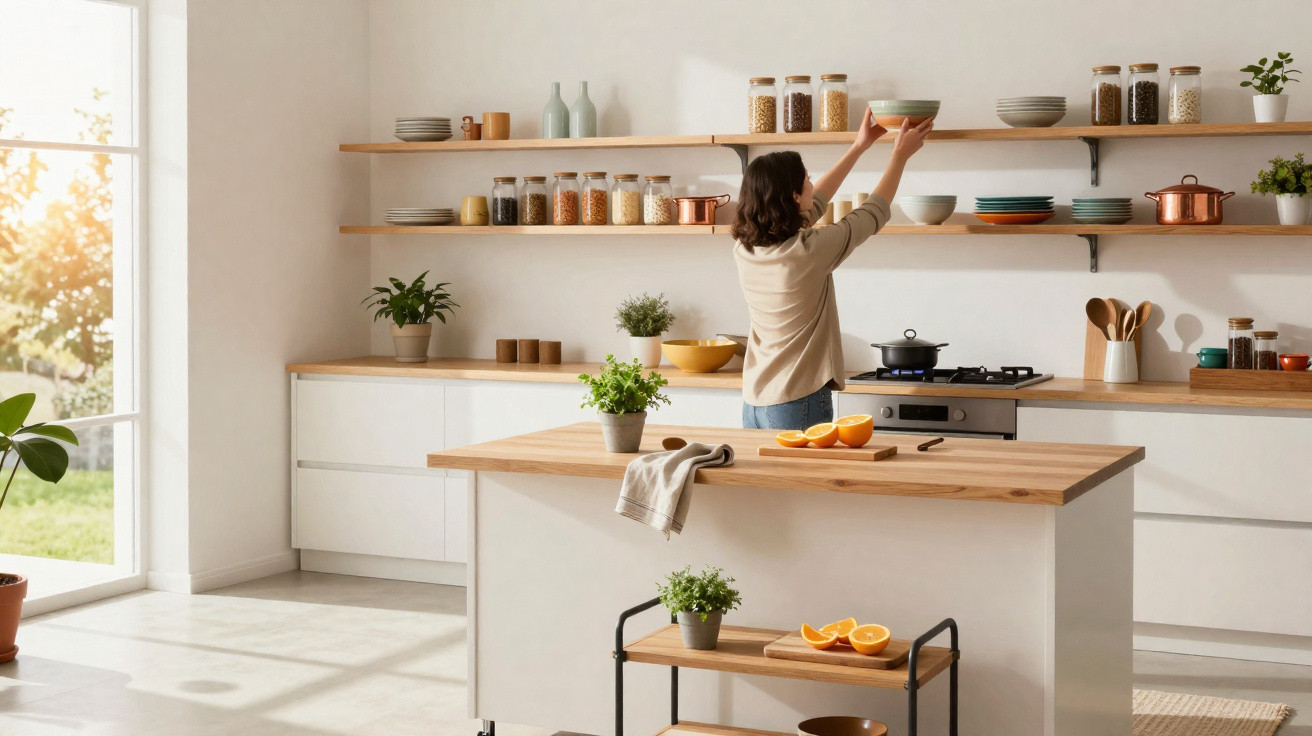
Step into the most progressive kitchens of 2026 and the visual change is immediate.
There is less furniture, less mass and fewer bulky forms occupying the centre of the room.
The former ruler of the space - the large storage island crammed with cupboards and drawers - is getting smaller.
In some kitchens, it has disappeared entirely.
Its replacement might be a slimmer preparation table, an open metal frame or a sculptural workbench with more in common with an atelier table than a conventional island.
Pans are displayed openly, mixing bowls rest on exposed shelving, and oils and condiments sit on rails as they would along a restaurant pass.
The entire room seems to have more air.
Spend an afternoon in an upmarket kitchen showroom today and the pattern becomes clear.
Customers still initially request large islands, almost automatically.
Then a designer brings out the 2026 trend boards: a long stainless-steel table on slim legs, a monolithic stone worktop floating above a restrained base, or an island designed more as a “stage” than as storage.
People visibly lean in, take out their phones and record it all.
One German manufacturer has reduced closed base cabinets in islands by almost 40% in its latest catalogue, using open structures and ultra-slim drawers only where they are genuinely essential.
The point is understated, yet unmistakable.
Storage is shifting to walls, pantries and back kitchens.
The centre of the room is being released for another purpose: cooking, displaying and sharing.
Why has the all-powerful storage island fallen out of favour so quickly?
Partly, it is a matter of visual exhaustion. We have encountered the same aesthetic everywhere: property listings, influencer home tours and renovation programmes.
Lifestyle also plays a role. More people shop for groceries more frequently, keep fewer supplies at home and prepare faster meals while still wanting them to feel considered.
There is little need for deep drawers packed with 20 mismatched plastic containers that never get used.
The kitchen’s growing role as a live background matters too: for remote-work calls, social media and drinks with friends.
Architects describe this as “de-bulking” the middle of the room, restoring movement and conversation.
The new island is no longer an oversized toolbox.
Instead, it resembles a versatile open platform where everything is visible and quick to reach.
How designers are replacing chunky islands without killing your storage
The principle behind the 2026 trend is not “less storage” but “better placed storage”.
Designers are relocating substantial cabinetry into tall walls, integrated pantry rooms and compact utility areas.
That allows the kitchen’s middle to accommodate lighter pieces: legged islands, narrow butcher’s-block tables and double-sided preparation stations.
They are easier to walk around, can accommodate stools underneath and, when fitted with concealed castors, may even be moved.
A typical contemporary arrangement features a tall wall of floor-to-ceiling concealed storage and appliances in one clean run, followed by a lean island that is mainly worktop, with only a few discreet drawers for everyday utensils.
The capacity remains the same, but the bulk is reduced.
It creates a completely different impression on entering the room.
Anyone who has cooked in a professional kitchen will recognise the approach.
Chefs seldom work from large, weighty islands filled with deep cupboards.
Instead, they use open stainless-steel tables with a small number of drawers for knives, spoons and towels.
Everything else is kept on wall shelving, rails or in a nearby walk-in store.
Home designers are adapting that model into a warmer domestic style: timber frames in place of steel, fluted stone worktops, rounded edges and bar-style footrests.
You still have an attractive island around which to gather, but it no longer attempts to conceal half your life inside it.
There is, admittedly, an element of performance involved.
You cook in front of guests, children sit on one side doing homework, and someone snaps a quick photograph of your neatly arranged olive-oil bottles.
The island becomes a sociable feature rather than merely a functional one.
A straightforward idea drives this change: the more you conceal, the more you forget.
Deep island drawers frequently turn into resting places for duplicate utensils, old lids and unidentifiable packets.
When storage is transferred to full-height cupboards, shallow pull-outs or organised pantry zones, it becomes easier to see what you own.
You throw away less food, avoid buying duplicates and retain the equipment you genuinely use.
Designers also point to a very practical factor: expense.
All of the complicated drawer mechanisms inside an oversized island cost money.
A slimmer island with fewer moving components, combined with sensible tall storage, can sometimes reduce the budget or allow you to spend more on an exceptional worktop instead.
Honestly, nobody organises every drawer as perfectly as the catalogue images suggest.
How to future-proof your kitchen if you’re planning a remodel before 2026
Before committing to a large-block storage island, take a coffee break.
Then take a pen and make two simple lists: the items you need within reach for daily cooking, and those you use only weekly or less often.
Everyday tools should go in light, easily accessible places: a shallow drawer in a lean island, a rail with hooks or an upper shelf.
Items used weekly or monthly can be stored in a tall unit, a discreet pantry area or even a utility room.
Once you have done this, you can begin reducing the island in your design.
Take away one cupboard.
Replace a heavy base with legs.
Swap a bank of drawers for an open shelf displaying mixing bowls or baskets.
Without imitating anybody, you are already moving towards the 2026 aesthetic.
A common concern is: “I’ll lose storage and regret it forever.”
That concern makes sense, particularly for anyone who has lived in small rented homes or busy family houses.
The key is to assess what you truly use.
Most kitchens quietly contain three bread knives, four colanders and that collection of novelty glasses from 2013.
Designing around actual routines rather than imagined situations often reveals that a huge island core is unnecessary.
What you need is an intelligent wall, a worthwhile pantry and a comfortable preparation area holding everything you use every day.
We all know the moment: pulling a random gadget from the back of a deep drawer and realising you had completely forgotten it existed.
Interior architect Léa Martin puts it this way: “The center of the kitchen is the new living room sofa.
If it’s too big, too heavy, too stuffed, you can’t move, you can’t play, you can’t live.
A lighter island doesn’t mean less comfort, it means more freedom.”
- Start with the wall, not the island
Design full-height storage along at least one wall so the island is not expected to hold everything. - Think like a restaurant line
Position knives, spoons, oils, salt and chopping boards within an arm’s reach of your main preparation area. - Reserve deep storage for large, specific items only
Roasting tins, stand mixers and large pots. If something does not merit its own designated place, consider whether you need it at all. - Leave some breathing space
An island slightly smaller than your original plan often feels more luxurious once you are able to move around it.
A kitchen that shows instead of hiding: trend or real shift?
The move away from storage-obsessed islands invites a broader question.
Are we merely replacing one Pinterest trend with another, or is there a more fundamental shift in how we live at home?
The preference for lighter, more open islands reflects a wider wish to see and use the things we own.
Less stockpiling, more circulation.
Less “just in case”, more “this truly earns its place here”.
It also mirrors the way kitchens are increasingly both stage and sanctuary.
They are places where you present a small part of your life on video calls and social stories, but also where you quietly make a bowl of pasta at 10 p.m. in your oldest T-shirt.
The monolithic storage island belongs to an era when visible success was expressed through scale: a large car, a large sofa, a large kitchen block at the centre of the room.
The 2026 kitchen appears more adaptable, almost athletic, ready for a weekday lunch, an experimental recipe or three friends arriving unexpectedly.
You may not remove your cupboards tomorrow.
But if you are planning your future kitchen today, the key question is no longer “How many drawers can I fit in my island?”
It is “How light can the center of my kitchen feel… while still holding the life I actually live?”
| Key point | Detail | Value for the reader |
|---|---|---|
| Shift away from storage-heavy islands | 2026 kitchens favour slimmer, open or legged islands with fewer deep cupboards | Helps readers avoid investing in a look that will date quickly |
| Storage moves to walls and pantry | Tall units and utility zones manage bulk storage, keeping the centre light | Explains how to retain capacity without sacrificing visual space or comfort |
| Design from real habits, not fears | Separate everyday tools from occasional items when planning the layout | Reduces clutter, cost and regret while making the kitchen easier to use |
FAQ:
Is the classic storage island completely “out” for 2026?
Not immediately, but substantial block-like islands filled with deep cupboards already look dated in high-end projects.
If you love your existing island, keep it; if you are renovating, consider a lighter version that will age better.Can a small kitchen follow this trend?
Yes. In smaller spaces, a narrow peninsula or a table-style island on legs combined with a tall storage wall can work better than a bulky block that consumes the room.Will I regret losing all those drawers?
Most people regret clutter rather than a lack of drawers.
With well-planned wall storage and a careful edit of what you own, a leaner island usually feels more freeing than restrictive.Does an open, minimal island cost more?
Not always. Complex pull-out mechanisms are expensive.
A simpler island with fewer moving parts can release funds for quality materials or better appliances.What’s one simple change to modernize my existing island?
Take the doors off one section to form an open shelf, fill it with attractive everyday pieces and clear out one deep drawer.
That one change can already reduce the visual heaviness of the entire block.



Comments
No comments yet. Be the first to comment!
Leave a Comment