
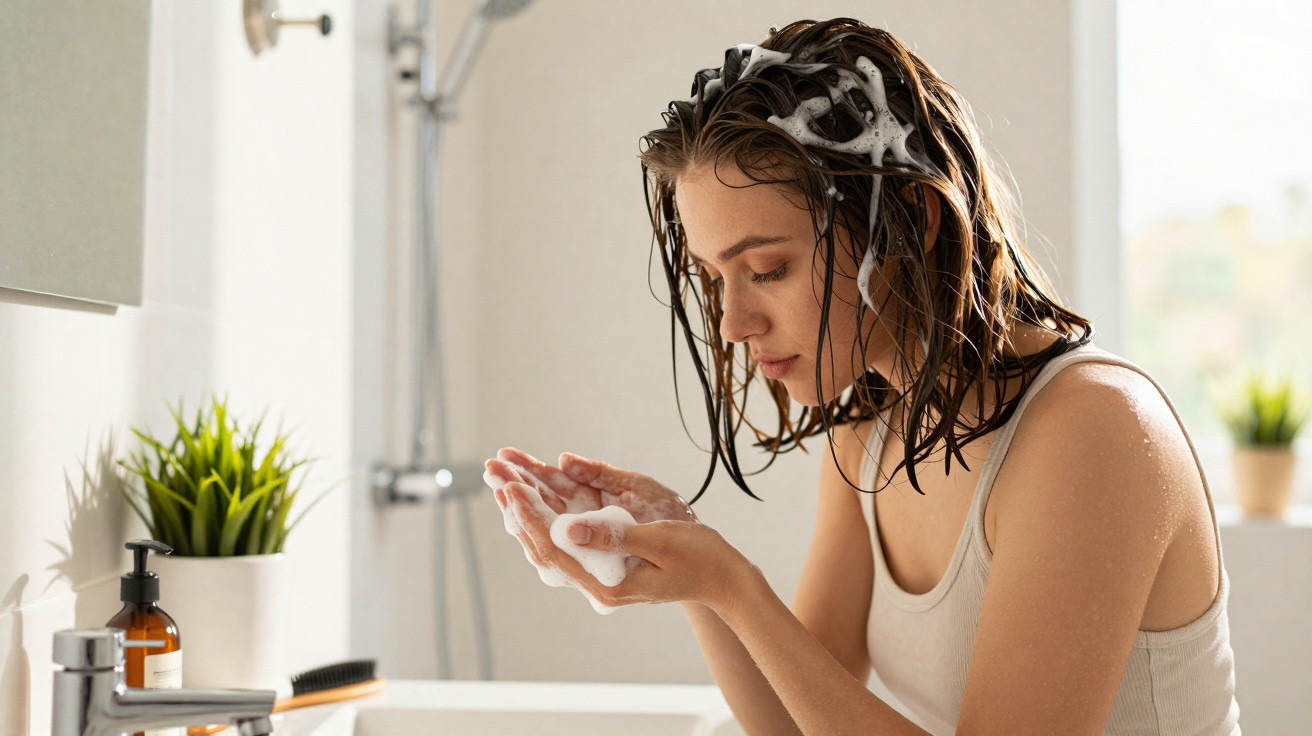
At home, that very same shampoo can somehow leave your hair limp and lacklustre.
According to a Berlin hairdresser, the explanation often begins with a small habit beneath the showerhead: the first place shampoo makes contact with your scalp. If you squeeze a dollop directly onto your crown, you could be undermining your scalp without knowing it.
Why your shampoo technique matters more than the brand
Most of us regard washing our hair as straightforward: wet it, lather up, rinse and finish. The shampoo itself may seem to do all the work. Yet, how you apply it can affect the condition of your scalp for several days.
Shampoo is formulated to cleanse the scalp before the lengths of your hair. Depositing it directly on the highest part of your head creates a highly concentrated chemical spot. That area is repeatedly stripped, while the remaining scalp may receive very little cleansing.
Putting shampoo directly on the top of your head can overload one area with cleanser, while leaving other parts under-washed and irritated.
This inconsistent cleansing can cause two issues simultaneously: roots that become oily again too fast, alongside dry, frizzy ends that conditioner never seems able to satisfy.
What actually happens when shampoo hits your crown first
The “oil rebound” effect on your scalp
Your scalp produces sebum, the natural oil that protects both your skin and hair. If one area - commonly the crown - is scrubbed too firmly and too often, the skin may respond by creating extra oil to protect itself.
Consequently, the top of your head can feel greasy within 24 hours even though the rest of your hair remains fresh. Many people then add more shampoo, scrub more vigorously or wash every day, all of which can intensify the pattern.
Dry lengths and fragile ends
When you vigorously lather from the crown downwards, a dense stream of foam travels over the hair lengths. For hair that is already dry or coloured, this can remove the limited moisture still present.
In time, this may result in:
- ends that feel like straw and knot quickly
- additional split ends despite regular trims
- colour fading faster than the bottle promises
- a coarse surface that will not lie smooth, regardless of the serum used
Healthy hair washing is less about scrubbing foam everywhere and more about directing product where it is actually needed.
The professional trick: lather from the hands, not from the bottle
Ask a hairdresser about what they avoid doing, and they will seldom say that they squeeze shampoo straight onto the scalp. Salon routines usually differ from the approach many people take at home.
A step-by-step pro-style wash
This straightforward approach reflects what many professionals across Europe and the US advise:
- Fully soak your hair and scalp using warm rather than hot water.
- Put the shampoo into your hands instead of directly onto your head.
- Rub your palms together to distribute the shampoo and create a little foam.
- Begin by placing your hands at the sides and back of your head, rather than on the crown.
- With your fingertips, gently spread the product around the entire scalp, including the top, without concentrating it in one place.
- As you rinse, allow the lather to run through the lengths instead of scrubbing your ends.
In effect, you are applying diluted foam rather than a concentrated dollop to the crown. For many people with sensitive or flaky scalps, this change alone can lessen irritation.
The CWC method: conditioner–wash–conditioner
Hairdressers dealing with very dry, bleached or curly hair frequently use the so-called CWC routine. Its initials mean:
| Step | What you do | Why it helps |
|---|---|---|
| First “C” – conditioner | Put conditioner only on the mid-lengths and ends of wet hair. | Protects delicate areas from harsh cleansing. |
| “W” – wash | Wash the scalp with shampoo using the hand-lather method, avoiding dollops on the crown. | Cleans the roots and scalp while preventing excessive dryness in the lengths. |
| Second “C” – conditioner | Rinse, then apply conditioner to the lengths once more and leave it for several minutes. | Restores moisture and smooths the cuticle. |
The CWC routine treats the scalp and the lengths as two different zones with different needs, instead of attacking them with one blanket approach.
This approach can be especially useful during winter, when cold winds and heated indoor air can make hair brittle.
Why hairdressers often shampoo twice
A further salon practice that can puzzle clients is double shampooing. It is not invariably an upsell; there is a rationale behind it.
The initial wash lifts sweat, styling-product residue, urban pollution and oil. A second wash can then act with less obstruction, requiring less product and distributing it more evenly over the scalp.
If you decide to shampoo twice at home, make both washes gentle and continue to avoid applying fresh product directly to the top of your head. Work mainly around the sides, back and hairline before moving the lather across the crown.
Scalp health: the “soil” your hair grows from
Consider your scalp as skin that happens to produce hair. It can respond to harsh care just as the skin on your face would.
Typical indications that you are treating the crown too aggressively while washing include:
- a tight, itchy feeling immediately after washing
- flakes appearing mostly around the top and front
- redness or soreness when the area is touched
- hair that is oily at the roots yet coarse at the ends
Changing the area where shampoo first goes helps limit friction and chemical strain on that particular section of skin day after day.
Choosing products that support better technique
Even the best method has limits when a shampoo formula is exceptionally harsh. For frequent washing, particularly in cities with hard water, many trichologists suggest mild shampoos that do not contain strong sulphates.
Check labels for terms including “scalp balancing”, “moisturising” and “for daily use”. Aloe vera, glycerin, oat extract and light plant oils are generally gentler on the scalp than strong detergents and heavy fragrances.
For very dry or curly hair, combining CWC with a richer conditioner and an occasional hair mask may restore softness without making it necessary to scrub the crown more forcefully.
Real-life scenario: what changes when you stop crowning your shampoo
Picture two people with shoulder-length hair during a cold, windy period. Each washes their hair every second day and uses the same mid-range shampoo and conditioner.
Person A applies shampoo directly to the top of their head, rubs hard and then pulls the foam through the lengths. Person B uses the hand-lather method, massages the entire scalp and lets the rinse cleanse the lengths.
After one month, Person A reports a crown that looks shiny yet greasy, as well as tangled ends, and feels obliged to wash daily before important meetings. Person B can often go for three days between washes, with less itching and fewer knots when brushing.
Changing where you place shampoo can extend the time between washes, calm an irritable scalp and cut down on styling damage.
When your scalp or hair needs extra attention
When your scalp is heavily flaky, exceptionally oily or you experience sudden shedding, a change in technique will not resolve every issue. A dermatologist can assess conditions such as seborrhoeic dermatitis, psoriasis or hormonal changes that influence hair.
Even then, doctors commonly recommend handling the crown gently: use lukewarm water, avoid your nails and do not leave concentrated blobs of product sitting in one place.
For those exercising every day, a middle ground may be effective. After intense training, some people opt for a quick water rinse and a small amount of shampoo around the hairline, reserving a complete, thorough wash for every second or third day and always avoiding direct application to the top of the head.
Key terms worth knowing before your next wash
Two expressions regularly arise in conversations about shampoo habits:
- Build-up: accumulated residue from styling creams, dry shampoo, pollution and hard water. It may leave hair feeling coated and dull, and can obstruct scalp pores.
- Cuticle: the exterior layer of every hair strand, formed from tiny scales. Rough treatment and powerful cleansers raise these scales, leaving hair frizzy-looking and rough to the touch.
Being gentler with your crown and more deliberate with shampoo does not call for expensive products or an elaborate routine. It begins with one minor adjustment: lather the shampoo in your hands, spread it afterwards, and ensure the top of your head is the final rather than the first place the shampoo reaches.






Comments
No comments yet. Be the first to comment!
Leave a Comment