
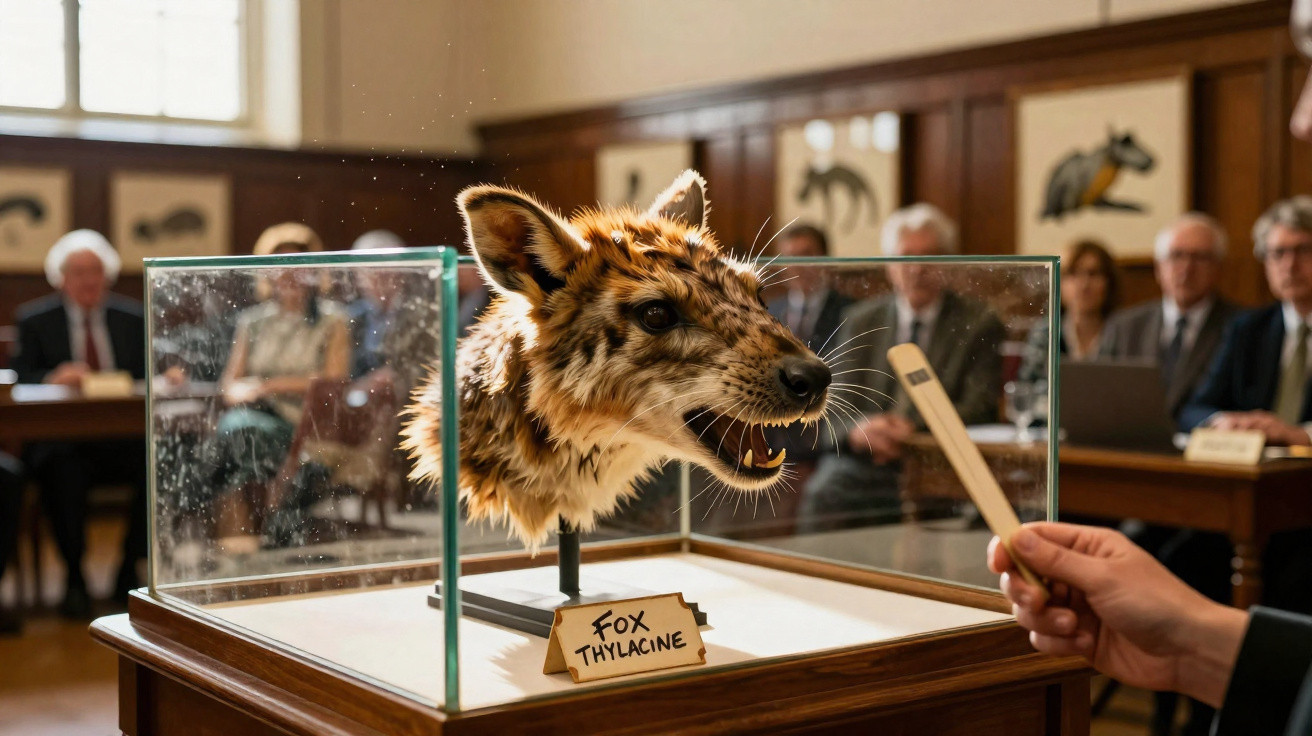
A peculiar stuffed head, with protruding eyes, a bulging brow and a stiff near-smile, looked amusing enough at an antiques market for someone to pay 50 quid for it.
When its purchaser later put it up for auction, however, they were astonished when it sold for 1,000 times the original price.
The reason was simple: it was not a fox at all, but the head of an exceptionally rare extinct animal.
“I collect weird and wonderful fox heads – good, bad, and the ugly – to show the differing qualities of taxidermy over the years and by different taxidermists,” James Cranfield, a UK dealer in natural-history curiosities, told ScienceAlert.
A listing describing the object as a “19th-century fox head” appeared in Cranfield’s routine auction notifications. Its comical appearance first drew his attention, but closer inspection changed everything.
“When I clicked on it and it opened up to a bigger picture, it was like a bolt of lightning to my brain and eyes that it wasn't a fox,” said Cranfield.
“I immediately thought, 'that looks like a thylacine'.”
The thylacine mistaken for a fox
The thylacine (Thylacinus cynocephalus) was a carnivorous marsupial, now extinct, which looked somewhat like a large dog. It was widely called the Tasmanian tiger because of the stripes running across its back. Once, the animal ranged throughout Australia and reached as far north as New Guinea.
By the arrival of European settlers, however, its range had shrunk to Tasmania alone. During the 19th and early 20th centuries, thylacines were regarded as a threat to farm animals and were systematically killed; Tasmania’s government even paid bounties for them.
Protection arrived only after the damage had been done. The final known thylacine died at a Tasmanian zoo on 7 September 1936.
Almost exactly 90 years on, another individual has emerged on the opposite side of the world.
Although the mount had been presented as a fox, Cranfield recognised the signs that it was not. Its teeth provided the strongest evidence: foxes and their relatives have six upper incisors, the front teeth positioned between the canine teeth, whereas this head has eight. Thylacines also had eight.
Cranfield was not the only collector to identify its likely true nature. An intense bidding contest ensued, eventually pushing the price to £62,600 (over US$85,000).
To establish that he had not spent a staggering sum on an ordinary fox, Cranfield arranged X-ray and CT scans of the head.
“The news could not have been better,” Cranfield explained. “Not only is it a genuine thylacine head, the X-rays have revealed the most perfect, pristine skull within the mount.
“I'm very pleased that now that I haven't got egg on my face for spending [so much] on a fox head. I could have never shown my face in the community or online or anywhere,” he laughed.
“I would have had to have become a hermit.”
Specialists support that conclusion, and the mount has since been formally entered into the International Thylacine Specimen Database (ITSD).
“I have examined and analyzed the radiographs of the specimen, with particular attention to the skull and dentition,” Stephen Sleightholme, ITSD Project Director, told ScienceAlert.
“The radiographic evidence provides clear diagnostic support for its identification as a thylacine.”
A rare taxidermy-mounted thylacine head
Only one other taxidermy-mounted thylacine head is known. That specimen belongs to the private collection of Dr Eric Guiler, a University of Tasmania zoologist who headed several searches for living wild thylacines in the decades following the death of the last captive animal.
“The ITSD currently contains more than 800 known specimens, encompassing a remarkably diverse range of material, including skulls, skeletons, alcohol-preserved organs, taxidermy mounts, microscopy slides, skins, and alcohol-preserved pups and adults,” said Sleightholme.
Despite being old and less than perfectly preserved, this head may offer further insight into the animal’s head, skull and dental structure. If researchers can obtain DNA, it could also provide additional genetic information.
The teeth offer the most promising and least invasive source for sampling, and Cranfield has already contacted Australian scientists about doing so.
“We could easily do this as we have been sampling thylacine teeth using a Dremel drill for some time,” Brandon Menzies, a bioscientist at the University of Melbourne, told ScienceAlert.
“You just take about 100 milligrams of bone powder.”
Menzies works with the Thylacine Integrated Genetic Restoration Research (TIGRR) Lab, which is led by geneticist Andrew Pask. The group has been reconstructing the thylacine genome and investigating the animal’s biology, ultimately aiming to reverse its extinction.
The thylacine is among several extinct species selected for de-extinction by the US bioscience firm Colossal, alongside famous lost animals including the woolly mammoth and dodo. Whether such a goal is achievable, or ethically acceptable, remains disputed.
That places considerable expectation on this small head. Even if DNA is collected, though, Menzies does not expect it to transform the de-extinction effort. Its greatest contribution would probably be broadening what is known about the species’ genetic diversity.
Questions about the specimen’s past
Further testing may also reveal one of the most compelling aspects of the find: the history of the specimen itself. It seems to be substantially more than a century old, raising the question of where it has spent all that time.
“The fact that this specimen appears to have remained unrecognized and outside established scientific collections is itself significant,” said Sleightholme.
“In the case of an extinct species, every surviving specimen constitutes a finite and potentially irreplaceable source of biological information.”
Its original source is uncertain. Cranfield suggests it could have been a hunting trophy, perhaps one submitted under the Tasmanian government’s bounty scheme.
“There were roughly 2,186 specimens killed and presented during the bounty from 1888 to 1912,” said Menzies.
“We don't know where they all went. Many remains were simply destroyed by the government after bounty payment.”
It is equally unclear how the head made its way to the UK. It might have been traded as an antique or transported as part of a private collection.
Yet a more intriguing explanation remains possible: perhaps the head reached Britain while still attached to a living thylacine.
Thylacines were exported and displayed in zoos around the world during the early 20th century, London among them. Cranfield says the animal’s former owner may have spent time abroad, after which the mount could have been prepared locally when it died.
To investigate that possibility, Cranfield wants experts to identify the timber used in its shield.
“If we can test what that wood is and what the shield is made of, if it turns out that it's some species that's endemic to Australia, that will then go with my hypothesis that the mount was created in Australia, and at some point in its history it came over to the UK,” Cranfield said.
“If it shows that the wood used to create the mount was English, that's then a different avenue that we go down and go okay, well it was prepared here.”
Whether that examination proves informative or not, it is only one of numerous possible tests. Isotopic analysis, for example, might verify the mount’s age.
Cranfield is prepared to make the head available for scientific study using a range of techniques, provided the work is credible and non-destructive.
Preserving an awkward taxidermy curiosity
Then there are those conspicuous protruding eyes. Cranfield initially debated replacing them with more lifelike ones or correcting the overfilled forehead that has distorted the animal’s shape. He has instead decided that the head should remain an historical curiosity.
“As somebody who is interested in historical taxidermy, my plans are not to do that much to it,” he explained. “It's like trying to put makeup on a mummy. It's still going to be not looking great.”
Such objects document the methods, assumptions and knowledge of the period in which they were made, and that past deserves to be preserved as well.
“Although it looks strange, preservation and taxidermy do strange things to specimens, and the taxidermist would often make the heads and faces more fearsome or action-packed,” Menzies explained.
Besides, it would be hard to look at that awkward face and declare it inadequate. Cranfield thinks its unusual appeal could win over devotees of ‘bad taxidermy’, placing it alongside Melbourne Museum’s Sad Otter and the Lion of Gripsholm Castle.
“That doesn't look anything like a lion – but what would be the benefit of soaking that specimen down and remounting it? You would then be losing a sort of cultural artifact,” Cranfield said.
“Those sorts of peculiar specimens become firm favorites of visitors to museums.”
Cranfield is currently speaking with several institutions about the possibility of putting the head on public display, though it remains undecided which museum could acquire an unofficial new mascot.
Wherever the thylacine head is ultimately displayed, the animal is at last returning to public attention.
“For too long, it has been forgotten and in obscurity as a novelty fox head,” said Cranfield.
“It now needs to be shone a light on with the respect that it deserves.”
This article was fact-checked by Rachel Garner and edited by Clare Watson. Although we take pride in our process, we are only human. If you spot an error, please let us know.



Comments
No comments yet. Be the first to comment!
Leave a Comment