
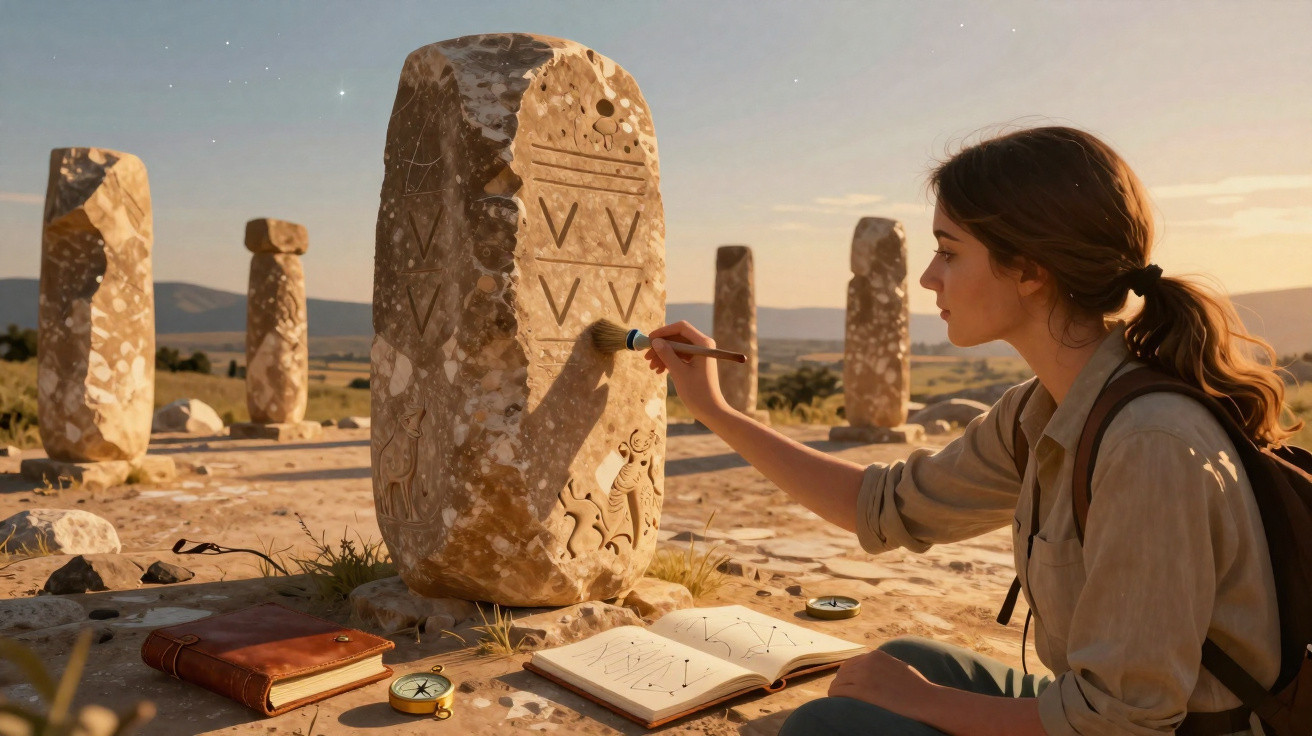
Göbekli Tepe, the ancient monument in Türkiye, ranks among the most extraordinary ancient wonders anywhere on Earth. More than 10,000 years ago, this temple complex flourished as a cultural epicentre. It is the oldest known monument of its type and has left behind enduring mysteries about a people who lived in the distant past.
Göbekli Tepe and the possible earliest calendar
A wall carving within the complex may now offer the earliest known evidence of a calendar, potentially used to measure time and follow the changing seasons.
The precise role Göbekli Tepe played for the Neolithic people of Türkiye remains unclear. However, recent discoveries indicate that it may have been occupied, at least periodically, as an observatory for watching shifts in the night sky. A particularly significant carved pillar is the Vulture Stone, which bears an image of a bird surrounded by stylised motifs.
Earlier research headed by chemical engineer Martin Sweatman proposed that the figures on the Vulture Stone may stand for constellations. It also suggested that other engravings could document the descent and impact of a comet roughly 13,000 years ago, before the monument was constructed.
That collision would align with the event believed to have brought about the Younger Dryas, a brief ice age with worldwide effects. It also appears to have taken place as communities were increasingly adopting farming during the period known as the Neolithic Revolution.
V-shaped carvings and the passage of time
Sweatman has extended his work by arguing that the V-shaped markings carved on Göbekli Tepe's pillars might signify individual days, while carvings on other pillars could portray further astronomical events.
In a detailed assessment spanning over 50 pages, Sweatman presents his case. After counting and examining the V-shaped symbols, he concluded that, if each one corresponds to a day, one pillar depicts a 365-day year: 12 lunar months plus 11 additional days to complete the solar year.
The bird of prey shown on the Vulture Stone has a V mark around its neck. Sweatman's interpretation identifies the bird of prey with the constellation linked to the summer solstice, meaning the V symbol it wears may denote the solstice itself.
Comparable V markings appear at the necks of other figures on other pillars, as well as on statues and figures discovered elsewhere. Sweatman argues that these signs could likewise relate to the movement, management or marking of time.
Astronomical interpretations of the pillars
Sweatman's earlier research also identified a relationship between the animals represented on the pillars and Earth's precession - the gradual shift in the orientation of Earth's rotational axis. Two pillars additionally appear to show the annual Taurid meteor shower, regarded as the probable origin of the Younger Dryas comet.
Archaeologists working at Göbekli Tepe have challenged Sweatman's previous conclusions, and his latest interpretation may attract criticism too. Nevertheless, the proposed elements fit together closely and, as an expanding body of research continues to show, ancient peoples were fully capable of observing, analysing and recording changes in their environment.
More research and debate will undoubtedly follow, but that can only benefit science.
For the moment, Sweatman has the final word.
"It appears the inhabitants of Göbekli Tepe were keen observers of the sky, which is to be expected given their world had been devastated by a comet strike," he says.
"This event might have triggered civilization by initiating a new religion and by motivating developments in agriculture to cope with the cold climate. Possibly, their attempts to record what they saw are the first steps towards the development of writing millennia later."
The findings were published in Time and Mind.



Comments
No comments yet. Be the first to comment!
Leave a Comment