
Countertops shining, an empty sink, and the dishwasher quietly running in the corner: it is the sort of sight that gives you an unexpected sense of satisfaction as you enter with your morning coffee.
Then, during an interview, the woman I was speaking to changed the atmosphere completely. She opened the dishwasher door partway, took hold of its rubber seal and drew it back. Behind it sat a fuzzy grey-green streak of mould.
She laughed, equally embarrassed and appalled. “I clean everything,” she said. “Everything… except this.” In that moment, the immaculate-looking kitchen no longer seemed quite so immaculate.
That neglected piece of rubber – the dishwasher door gasket – is exactly the sort of place mould thrives.
The dishwasher door gasket: mould’s hidden home in a “clean” kitchen
When people think about mould, they tend to picture the obvious culprits: old Tupperware pushed to the back of the fridge, a wet sponge or a dark patch beneath the sink. Very few people consider the edge of the dishwasher door. Yet the rubber seal around its frame is practically prime waterfront property for fungus.
For hours after a wash cycle, the gasket remains a little damp. Small fragments of food and traces of detergent collect inside it. Add heat, moisture and nutrients, and you have something close to a holiday resort for mould spores. Since the door is normally shut, the problem is easy to miss unless you crouch down and pull back the seal.
If your kitchen “always smells a bit musty” however often you clean the bin, this concealed edge may well be to blame. What appears to be a light grey mark along the gasket is frequently active mould, growing unnoticed in the very appliance you rely on to clean your dishes.
A UK appliance engineer told me that he checks beneath the seal on nearly every callout. “Nine homes out of ten, there’s mold there,” he said. “Even in kitchens that look like they’ve come straight from a showroom.” This is not simply an exaggeration: several laboratory studies of household appliances have identified dishwashers as hotspots for fungi and bacteria, particularly around rubber seals and pooled water.
One consumer survey a major retailer shared with me found that over 60% of people had never cleaned their dishwasher gasket, even once. Many were unaware that it could be wiped or pulled back. They presumed the hot wash cycles sterilised everything. In reality, those cycles concentrate on the chamber holding the dishes, rather than the concealed rubber folds beyond the spray zone.
Social media is full of videos showing people running a white cloth through that channel for the first time. It comes away marked with black streaks. The comments repeatedly say the same thing: “I thought my dishwasher was clean.” There is a particular unease in finding mould where you put the plates your family eats from.
Why does this narrow rubber strip become so unpleasant so quickly? The answer is straightforward biology. Mould spores are present throughout the air and settle silently on surfaces every day. Give them dampness, darkness and a little organic matter, and they begin to grow. The gasket forms a slim, shaded passage with poor airflow. Drops of water remain there after every wash, especially when the door is closed immediately afterwards.
Food debris and detergent residue create a fine biofilm – an almost invisible slimy coating. This layer helps shield microbes from chemicals and heat. Therefore, even when your dishwasher reaches high temperatures, the outer rim does not receive the same intense wash. Leave long periods between thorough cleans, and that damp, rubber-lined channel can become a place where mould takes hold for months.
Strange kitchen odours are often blamed on hard water or “old plumbing”. At times, that is correct. But in many cases, the real problem is this rubber ring.
Clean dishwasher mould from the seal in under a minute
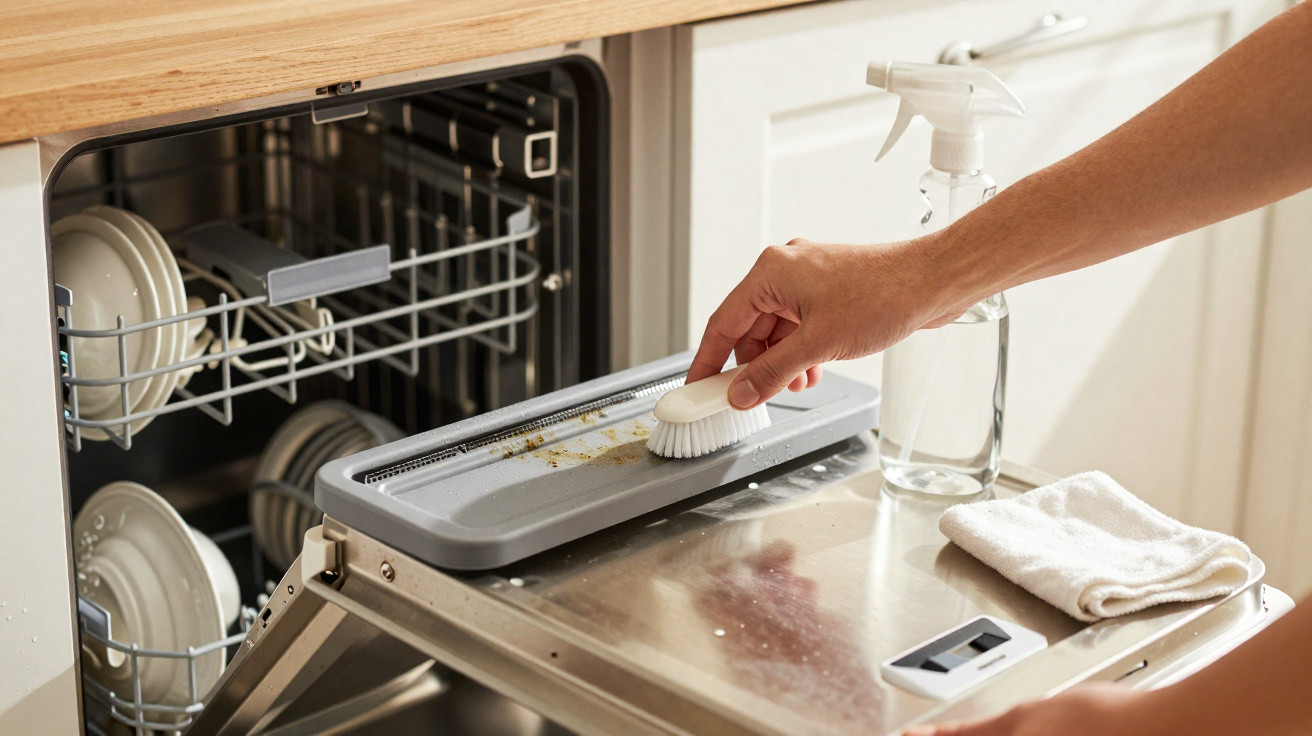
The reassuring part is that this unpleasant little edge takes less time to clean than your phone screen. Stand before the dishwasher with its door open enough to be secure, but not lying fully flat. Using your spare hand, gently ease back the rubber gasket to reveal the channel inside. This is where the mould sits, forming a grimy ring.
Use a cloth or a substantial piece of kitchen roll folded in half. Lightly spray it with a mixture of equal parts white vinegar and water, or with an ordinary kitchen disinfectant. Firmly wipe the cloth around the entire gasket, both inside and outside, as though cleaning a narrow window frame. Work steadily rather than rushing. Completing one circuit of the seal usually takes 30 to 40 seconds.
For persistent dark marks, stop and press the cloth into the groove with your fingers, then rub it backwards and forwards for a few seconds. There is no need for frantic scrubbing. The aim is to break up and remove the biofilm. Discard the cloth, leave the door slightly ajar to dry in the air, and you will have cleaned one of the kitchen’s grimiest areas in less than a minute.
This small habit is most effective when it is informal rather than treated as a ritual. Kitchen hygiene routines often fail because every task is presented as a “deep clean” requiring a whole Saturday afternoon. That is precisely why such jobs get delayed for months. Instead, make this a 60-second addition to something you already do: emptying the dishwasher.
Do it while the kettle boils, or when you are wandering around the kitchen during a phone call. Let’s be honest: nobody really does it every day. Still, doing it once or twice a week makes a noticeable difference. The smell diminishes, the gasket remains pale rather than streaked, and you no longer have to wonder what is hiding beneath that rubber lip.
If your skin is sensitive, put on thin washing-up gloves. For households with someone who has asthma or allergies, this modest routine can eliminate one more source of airborne spores. It is not a miracle solution, merely a sensible and low-effort measure in a home that will never be a sterile laboratory – nor does it need to be.
“The fastest wins in kitchen hygiene are usually hidden in the boring corners no one talks about,” says a London-based hygienist I spoke to. “That dishwasher seal is one of them. People are shocked, not because it’s filthy, but because it was filthy right under their nose.”
After the main wipe, a handful of simple changes can stop mould returning quite so rapidly:
- Leave the dishwasher door slightly open for 20–30 minutes once a cycle ends, allowing the seal to dry.
- Once a month, run an empty hot cycle with dishwasher cleaner or a cup of white vinegar.
- Change gaskets that are badly cracked or damaged; deep splits are magnets for mould.
- If soap scum is forming around the seal, use less detergent.
- After especially steamy cycles, wipe away visible condensation from the inside of the door.
There is no need for a cupboard packed with specialist products; the routine matters more than the bottle every time. One wipe around the gasket can alter the feel of the entire kitchen: less “mysterious smell”, more “clean without overthinking it”.
Rethinking what “clean” means in the kitchen
There is something subtly unsettling about discovering mould in a place you assumed was sterile. It challenges the delicate boundary between “I’ve got this under control” and “What else am I missing?” Once you notice a black mark along a gasket, it is difficult to forget it. It can also draw your attention to other overlooked spots: underneath the sink plug, beneath the rim of the salt cellar or in the join behind the base of the tap.
This is not an argument for living in a continuously disinfected show home. A kitchen is a lived-in room, not a magazine photograph. On a Wednesday evening, when pasta water is boiling over and children are asking for snacks, nobody is thinking about microbes clinging to rubber. From a human perspective, that is entirely normal. The useful shift is from guilt to curiosity: which quiet, neglected areas matter more than those you polish three times a day?
Once you have cleaned the dishwasher seal, other routines often adjust a little as well. You may leave the door ajar more often. You may no longer blame the bin for every unusual smell. You may begin to see cleaning as a collection of swift, targeted actions rather than one huge, intimidating event. That subtle change in mindset – from “I must deep-clean everything” to “I’ll hit one high-impact spot now” – makes mould feel less like an enemy and more like a manageable part of daily life.
In that sense, this strange little piece of rubber becomes unexpectedly symbolic. It is easy to overlook, slightly unpleasant and quietly significant. It is the type of place absent from glossy cleaning checklists, yet it influences how your kitchen truly feels to live in every day.
| Key point | Detail | Why it matters to the reader |
|---|---|---|
| The dishwasher door gasket | A damp, dark area filled with residue that readily collects mould and odours | Understand where unseen contamination can hide in a kitchen that appears clean |
| Cleaning in under a minute | Simply wipe the full edge with a cloth moistened with vinegar or disinfectant | Adopt a realistic routine that improves hygiene without taking up your weekend |
| Preventing mould from returning | Leave the door ajar after cycles, run a monthly empty cycle and replace damaged gaskets | Limit odours and reduce exposure to spores over the longer term |
FAQ:
How often should I clean my dishwasher door seal? Once a week is a good aim for most households. If you cook frequently or notice odours, a quick wipe two or three times a week helps prevent mould from becoming established.
Can I use bleach on the gasket to remove mould? You can, although it is generally excessive and may gradually damage rubber. A diluted bleach solution is acceptable from time to time, but vinegar or a standard kitchen disinfectant is kinder to the material and effective for regular wiping.
What if the mould does not come off when I wipe it? Soak a cloth or cotton bud in vinegar or cleaner, hold it against the affected area for a minute, then rub again. If a mark remains but the surface is smooth, it is likely old discolouration rather than active mould.
Is mould on the seal harmful to my health? In most homes, it is more unpleasant than dangerous. However, reducing sources of mould is sensible for people with allergies, asthma or weakened immune systems. This quick clean is a small, low-stress protective measure.
When should I replace the dishwasher gasket completely? It is time to do so when the seal is cracked, torn, warped or no longer flexible. Persistently damp cracks harbour mould and may affect the way the door closes and drains. Replacement gaskets are usually inexpensive and straightforward to fit.




Comments
No comments yet. Be the first to comment!
Leave a Comment