
An ordinary Saturday at the end of the day: you decide to cook something special.
The recipe is ready, fresh ingredients are spread across the worktop and a playlist is playing softly. Then comes the first cut: the knife catches on the tomato, crushes the onion and slips on the garlic. Every movement brings a small frustration. It is not merely slower; it feels as though you are battling the utensil itself. You glance aside and vaguely recall seeing a knife sharpener in a shopping centre at an absurdly high price. You give up. You pick up a knife that is “slightly less bad” and carry on. Yet the whole experience changes: it becomes more tense and less enjoyable. Cooking loses its appeal when the blade cannot keep up with your intentions. Hardly anyone talks about it.
Why do your knives always seem blunt?
Everyone has a knife drawer with a glorious past. The knives were once new, shiny and as sharp as a chef’s blades. Now, many are stained, have loose handles and cut unevenly. The strange thing is that few people admit that everyday habits are to blame. We wash them, dry them quickly, store them among other cutlery and knock the blade against the chopping board without thinking. Every so often, we run one over an old honing steel and assume that has fixed everything. Reality arrives when the tomato turns into purée and the chicken tears instead of slicing cleanly.
In home kitchens, this scene plays out quietly time and again. An informal survey among friends always uncovers the same stories: someone has cut a finger because a knife slipped on a potato skin; someone else gave up chopping delicate herbs because the edge would not grip at all. Some people buy new knives every year, as though they were disposable. Admitting that we do not know how to sharpen them is almost taboo. Sharpening seems to belong to a technical world of bladesmiths and professional kitchens. Yet that is exactly where the issue lies: in ordinary daily life and the small shortcuts that build up over time.
A knife edge does not simply “die” all at once. It gradually bends and develops invisible micro-serrations that throw the cut off course. You may not see anything at a glance, but you can feel it. A blunt blade demands more force, raises the chance of accidents and takes away precision. The principle is straightforward: the more a knife fights the food, the greater the risk to your fingers. There is another, less obvious side too. Once you realise that sharpening knives at home is possible without costly machines, your relationship with cooking changes. A knife stops being just another tool and becomes something worth looking after: a small ritual of respect for everything that goes across the chopping board.
Home methods that genuinely work for sharpening knives
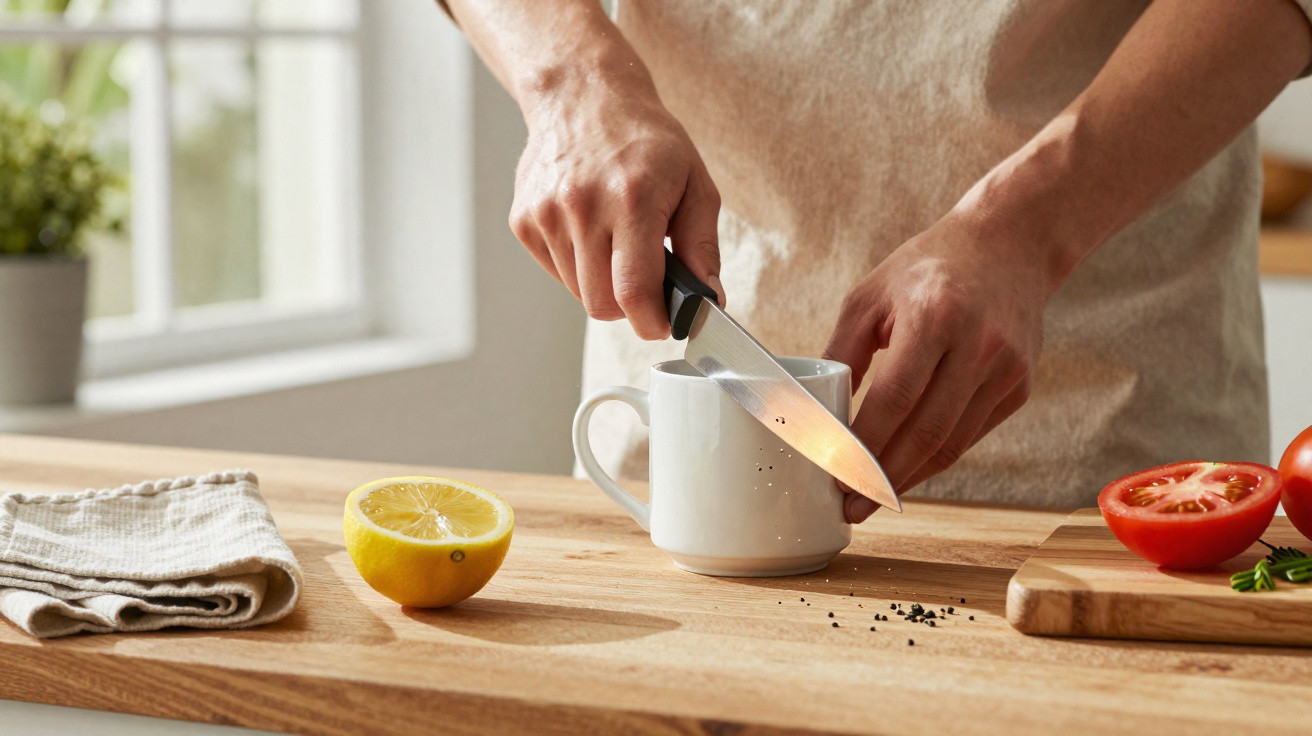
There is good news: you can sharpen a knife at home with items that nearly everyone already has. One of the best-known techniques uses the base of a ceramic mug. That rough, unglazed ring acts as an improvised sharpening stone. Simply turn the mug upside down, hold it securely on the worktop and draw the blade across it at an angle of roughly 15 to 20 degrees, as though lightly scraping the surface. Use gentle strokes from the heel to the tip, switching sides as you go. There is no need to rush; what matters is a steady rhythm. Within a few minutes, the edge responds and cutting feels like proper cutting again.
Another approach uses wet-and-dry sandpaper, available from DIY shops. A sheet with a grit of 1000 or 1200, secured to a flat surface and dampened with water, becomes an inexpensive sharpening stone. Glide the knife over the sandpaper at the same angle throughout, without applying brute force. It may sound like something from an online tutorial, but it works well for household knives. To be honest, nobody does this every day. Even so, repeating this bit of care from time to time completely changes the experience. There is also the standard honing steel, that metal rod: it does not truly sharpen the blade, but it realigns the edge and helps the work done by the sandpaper or ceramic last longer.
“A well-maintained knife speaks to the chopping board.” You know when the edge is right because the cut glides rather than drags.
Many home cooks discover this almost by chance when they try simple techniques. The most frequent mistake is using too much pressure or getting the angle wrong, which creates an odd “second edge”. Another is attempting to sharpen serrated knives as if they had smooth blades. Rather than overcomplicating things, keep three basic actions in mind:
- Keep the angle consistent: neither too narrow nor too wide.
- Make long, continuous strokes rather than excessive back-and-forth sawing motions.
- Finish by drawing the blade lightly along one side only, to settle the edge.
Care, limits and the pleasure of cutting properly
At home, nobody needs to become a cutlery specialist to eat better. However, some boundaries are worth observing. Knives that are badly damaged, with deep chips in the blade or genuine bends, need professional help. The same applies to harder imported steel knives, which do not respond well to aggressive improvised methods. Sharpening knives at home works best with everyday kitchen knives that are used on vegetables, meat, fruit and bread. These are the knives for which you immediately feel the difference a renewed edge makes. Suddenly, onions chop into almost perfect cubes and tomato skin gives way without resistance. The sensation is almost therapeutic.
Safety matters as well. Sharp knives frighten many people, but the real danger lies in a blunt blade. When it sticks in a carrot and slides sideways, your finger is often in its path. A well-maintained edge needs less force, follows your movement and does not make you fight the food. This can even alter the posture of the person cooking. The body relaxes, the arm works more lightly and cutting becomes part of the enjoyment rather than a chore. What appears to be a technical change ends up affecting something bigger: the desire to cook more often and try recipes that once seemed far too laborious.
Some people develop small rituals: quickly sharpening their favourite knife before Sunday lunch, using the ceramic mug in the same corner of the worktop or storing the sandpaper in a dry envelope. Others prefer simply to realign the edge with a honing steel every two or three uses. There is no single formula. There is only what works in your real routine, with the time you have and the patience you are willing to give it. When that relationship falls into place, the atmosphere in the kitchen changes. A simple, almost invisible action, such as running the blade over ceramic for a few minutes, becomes a quiet form of self-care.
Perhaps that is what stands out most in this whole story: the chance to turn a daily annoyance into a small pleasure. The knife stops crushing food and begins cutting it with respect again. The sound of the edge entering an onion, meat or bread becomes almost like discreet music. When someone visits your home and notices, “Wow, your knives really do cut,” you realise this care makes a difference. You begin to see that forgotten drawer differently. There is plenty of metal in there asking for a second chance.
| Key point | Detail | Value for the reader |
|---|---|---|
| Ceramic method | Use the rough base of a mug or plate as a sharpening surface | An immediate, low-cost solution for restoring an edge at home |
| Using wet-and-dry sandpaper | Fine sandpaper on a flat surface with water, imitating a sharpening stone | Greater control over the angle and a more even cutting result |
| Regular maintenance | Realign the edge with a honing steel and prevent knocks to the blade | Longer-lasting knives, precise cuts and a lower risk of accidents |
FAQ:
Question 1 How often should I sharpen my knives at home?
It depends on how often they are used. People who cook every day can renew the edge with home methods every one or two months and use a honing steel for quick maintenance once a week.Question 2 Can I damage my knife by using sandpaper or ceramic?
If you use too much pressure or vary the angle too much, you can create an uneven edge. Start slowly, spending only a few minutes, and test the cut on soft foods such as tomato or onion.Question 3 Can serrated knives be sharpened at home?
It is more complicated. Professional servicing or tools made specifically for serrations are ideal. Sandpaper, stone and ceramic methods work better on smooth-bladed knives.Question 4 Does storing a knife loose in a drawer damage its edge?
Yes. Constant contact with other cutlery and metal surfaces gradually knocks the edge. A simple blade guard or wall-mounted holder makes a considerable difference.Question 5 Is it worth buying a sharpening stone if I already use improvised methods?
If you enjoy cooking and want greater precision, a good stone provides control and consistency. Home tricks work well for everyday use, but a stone takes edge quality a step further.



Comments
No comments yet. Be the first to comment!
Leave a Comment