
A succulent can endure cliffs, deserts and abandoned office windowsills, yet somehow fail in your sitting room. One day it is full and glossy; the next, it is as wrinkled as an old balloon lost beneath the sofa.
Like most people, you may push a finger into the compost, study the leaves and wonder whether it needs water or divine intervention. Your phone may be crammed with screenshots saying, “Water every 10 days”, “Every 3 weeks”, or “Only when dry”. None agrees with the others, and your plant is not reading blogs.
Then a friend casually presses a leaf between two fingers and says, “Nope, not yet.” There is no app or timetable involved, only a quick squeeze. The leaf gives the honest answer.
The solution, it turns out, has been sitting in that plump little cushion all along.
The moment your succulent “speaks” through its leaves
Look at a well-watered succulent in morning light. Its leaves seem nearly swollen from within, as if they contain a hidden gel. Light lands on them with a soft, matt finish, and they offer a slight resistance when brushed. That mild firmness is the first sign that everything is fine.
A thirsty plant looks different. Its leaves appear a little flatter, with duller edges. Fine lines develop down the sides, rather like reverse stretch marks. You do not need a botany qualification to spot it; your hands understand the difference immediately.
This is when the “pinch test” becomes clear: a succulent genuinely holds water in its leaves, and a gentle squeeze lets you check that natural reservoir.
Imagine a small jade plant on a kitchen windowsill in January. The heating is running, a draught comes through the window, and its owner is busy doomscrolling rather than searching for a “winter watering schedule”. The top layer of compost appears dry and accusing, as though it is pleading for a drink. The owner reaches for the watering can.
Before pouring, they hold one glossy oval leaf between thumb and forefinger. It is firm: not solid as a rock, but like a grape that would split if squeezed too firmly. There are no wrinkles or softness. They pause, set down the watering can and leave it alone.
Three days afterwards, the same check gives a new result. The leaf has become slightly more bendable, as though its internal pressure is dropping. A faint line has appeared along one side. No calendar app can provide that kind of subtle, real-time update.
Scientists explain that succulents have adapted to retain water in their tissues. Their survival strategy is to store moisture in leaves and stems before using it gradually. When internal supplies are high, the cells are pressurised and full. As reserves diminish, cells lose turgor, while the leaf becomes softer and wrinkled.
The pinch test simply allows your fingers to interpret plant physiology without technical language. Compost can be deceptive because its surface dries more quickly than its centre. Watering timetables are only estimates based on an “average home”, which hardly ever exists. Leaves provide a live reading: a built-in gauge of how much water the plant actually has available.
After feeling the contrast a few times - plump versus floppy, smooth versus creased - you will begin to rely on touch more than any watering reminder on your phone.
How to do the “pinch test” without damaging your succulent
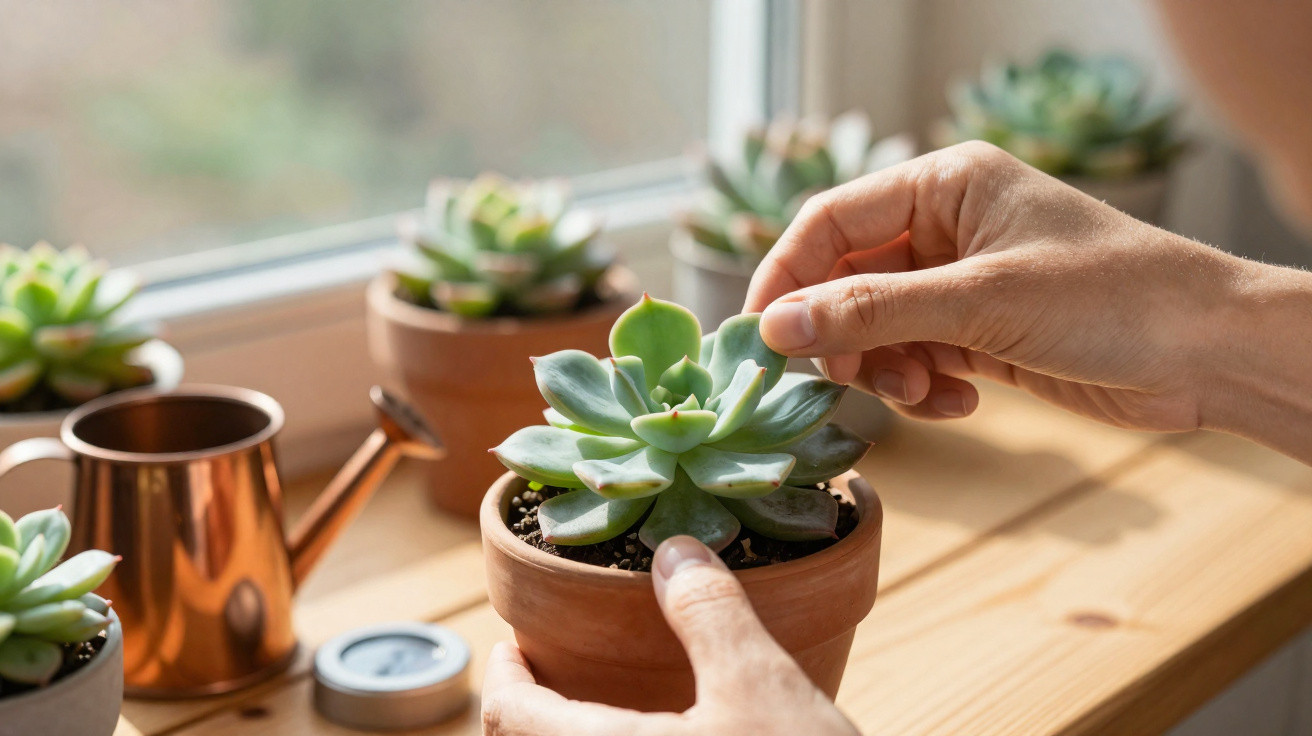
Choose one healthy leaf around the plant’s middle rather than the smallest new growth or the oldest leaf at the base. Rest your thumb beneath it and place your index finger on top. Apply a light pinch, as if checking whether a peach is ripe, rather than squeezing a stress ball on your desk.
A firm leaf with a little bounce is likely to be well hydrated. If it feels exceptionally stiff and nearly hard, you may have watered too recently. A soft leaf that compresses easily or bends slightly beneath your fingers is the signal that the plant is using its reserves and will soon need a drink.
For your first few checks, test two or three leaves from different areas of the plant. There will be some differences, but an overall pattern will emerge. In time, your hands develop an internal scale ranging from “balloon” to “deflated football”. That is when the technique starts to feel automatic.
Succulent enthusiasts often fall into one of two groups: over-carers and ghosters. The first water “just in case”, fearing that the plant might spend even one day without moisture. The second forget the plant is there until its leaves resemble prunes and guilt arrives at 11 pm on a Sunday.
The pinch test provides a sensible middle ground. It encourages you to look and touch before reaching for water. During a hectic week, simply pinch a leaf as you walk past the shelf. It takes two seconds and needs no elaborate routine. Let’s be honest: nobody really does this every day, and that is perfectly fine. Checking every few days is usually sufficient.
If leaves are already very soft and heavily wrinkled, do not panic and flood the plant. Water gradually, allow the compost to absorb it, then wait. The leaves will not recover within an hour; it may take several days. Overreacting is how well-meant care becomes root rot.
“Once you learn to read the leaves, you stop asking the internet and start asking the plant,” confided a London houseplant collector who swears by the pinch test after losing half her collection to overwatering during lockdown.
New plant parents can also keep a short mental checklist alongside the pinch test. When a leaf feels soft and you feel tempted to water, consider the following:
- Has the plant experienced strong sun or heatwaves over the past few days?
- Is it in a shallow pot with a drainage hole?
- Does the compost seem dry below the surface as well as on top?
- Are leaves soft across the plant, rather than only on one old or damaged leaf?
- Once watered, can surplus water drain freely from the bottom?
This brief process changes an uncertain guess into an informed decision. You are not merely watering a pot; you are responding to signals.
Wrinkled versus plump: learning your succulent’s “normal”
No two succulents develop wrinkles in precisely the same way. A plump echeveria displays stress differently from a string of pearls or a haworthia confined to a teacup. That is why observation is more useful than any general rule. The pinch test is not only a trick; it is a habit of paying attention.
On a quiet evening, while your plants are content, press a few leaves and remember how they feel. That becomes your baseline. In the following weeks, repeat the motion whenever you think they may be thirsty. You will notice the shift from firm to flexible and from taut to lined. It is subtle, but once you recognise it, you may wonder how it ever escaped you.
For a shelf full of plants, this makes watering feel less like a chore and more like a quiet exchange. On some days, you may water only two pots and leave the rest untouched. In certain weeks, you may skip watering completely because every pinch clearly says: “I’m fine.” After a difficult day at work, this small act of decision-making can be surprisingly grounding.
Most of us know the slightly embarrassing experience of removing a mushy succulent from its pot and finding brown, slimy roots. Overwatering commonly results from good intentions combined with detachment: you water to feel responsible rather than because the plant has asked for it. The pinch test reverses that relationship. First you ask, then you wait for the response.
There is no magic, complicated kit or rigid timetable involved. All you need is your fingers, leaves and some curiosity. Pass the technique on to a friend who “mysteriously” keeps killing cacti, then watch their face when they feel their first genuinely thirsty leaf. It is almost like discovering a secret button on a living thing.
That is the understated strength of this small gesture: it directs your attention back to where the plant has been communicating all along - in the space between your fingers and its skin.
| Key point | Detail | Benefit for the reader |
|---|---|---|
| Plump versus wrinkled leaves | Full, firm leaves indicate good hydration, while wrinkled, soft leaves indicate low reserves | Helps you decide when to water without relying on a schedule |
| The “pinch test” gesture | Lightly pinch the middle of a healthy leaf, as you would a ripe fruit | Provides a straightforward method that takes two seconds while passing by |
| Avoiding overwatering | Use the leaves as an internal gauge rather than judging by the compost surface | Greatly reduces the risk of rotten roots and soft, failing plants |
FAQ:
How often should I do the pinch test on my succulents?
Every few days is generally enough. Build it into occasions when you walk past the plant instead of following a strict routine.What if the leaves are wrinkled but the soil still feels a bit damp?
Wait and observe. Allow the compost to dry more fully before watering again, and make sure the pot has good drainage.Can I damage the leaves by pinching them?
Not if you pinch gently. Use a light touch, keep your nails away, and avoid sharply twisting or bending the leaf.Do all succulents react the same way to the pinch test?
Not quite. Some are naturally more rigid or thinner than others. Learn how each healthy plant normally feels, then use that as your reference point.Is the pinch test enough, or do I still need to check the soil?
The pinch test should be your main guide, but pairing it with a quick check of compost dryness and pot drainage delivers the most dependable result.




Comments
No comments yet. Be the first to comment!
Leave a Comment