
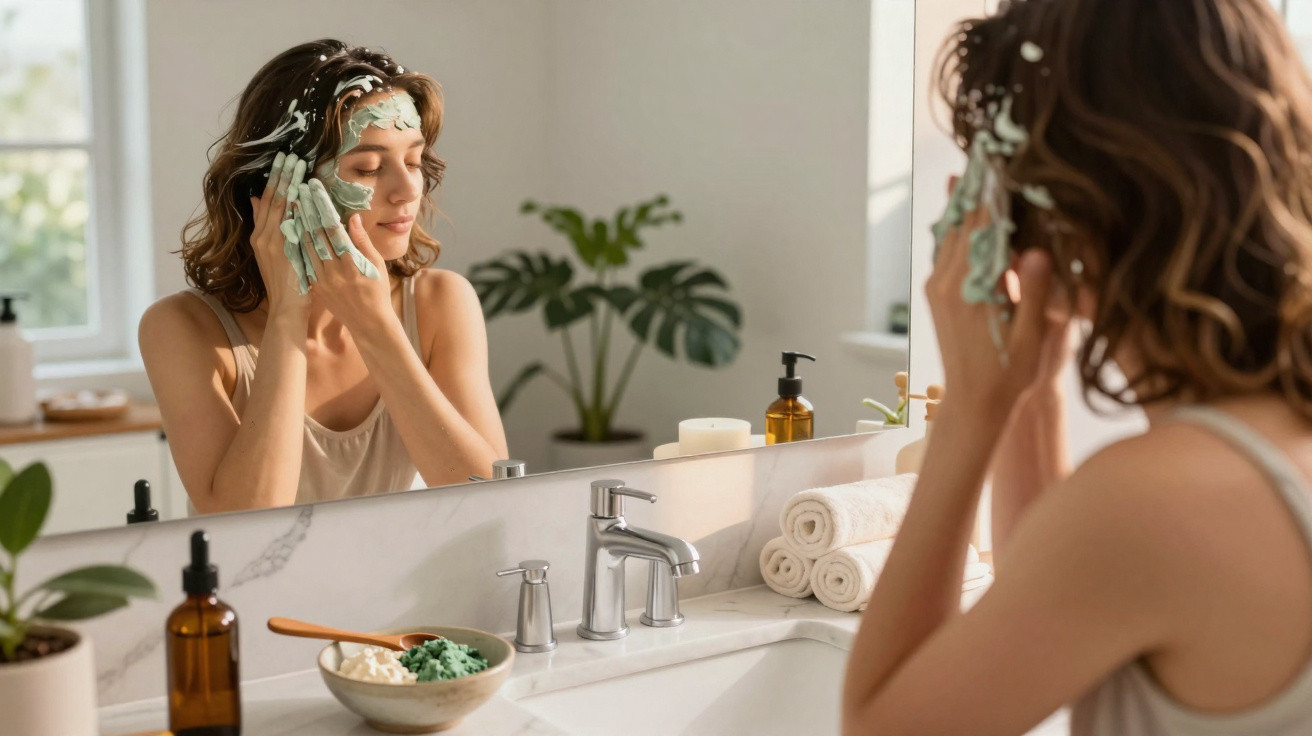
Not every hair clay mask works in the same way, and the clay’s colour reveals more than it might seem. Green, white, pink or red, each type has found a place in hair care because it interacts differently with oiliness, build-up and the feeling of balance on the scalp.
Why has clay become part of hair care?
Clay consists of extremely fine mineral particles taken from the ground and used in cosmetics for their absorbent properties. In hair care, it is used as an additional treatment, particularly in routines seeking a deeper cleanse, oil control and a refreshed feeling on the scalp.
This approach forms part of clay therapy, a practice already well known in skincare. The principle is straightforward: certain clays can interact with impurities and build-up on the surface, helping the roots feel lighter. However, the result depends on the clay type, the formula and what the hair genuinely needs.
How does clay work on hair and the scalp?
For application, clay is usually blended with a suitable liquid until it becomes a smooth, creamy paste. Once applied to the scalp, it may help lift excess oil and product build-up, which accounts for its popularity in routines designed to cleanse and rebalance the roots.
However, they do not all work with the same strength. Some types are more closely associated with absorption, while others are used in gentler, revitalising care routines. Choosing simply because something is currently popular can therefore be a mistake. Before adding this step to your routine, it is best to consider the ingredients and how your hair behaves.
What is the difference between the main types of clay?
The most popular colours in hair care are green, white, pink and red. Each is generally linked to particular qualities, and knowing the distinctions can help you make a more suitable choice while avoiding overuse and unrealistic expectations of what clay in hair can truly achieve.
Green clay
This is usually the first type that comes to mind when the priority is controlling oiliness and achieving a more intensive clean feeling on the scalp.
White clay
It is regarded as a gentler option and is often found in treatments aimed at sensitive hair or skin that reacts easily.
Pink clay
Combining qualities associated with white and red clays, it is commonly selected for balanced, delicate care.
Red clay
Its mineral composition includes iron, and it is frequently connected with a revitalised feeling in hair care.
Its colour relates to the dominant mineral composition, but that does not mean every advertised claim has the same level of evidence behind it. Above all, remember that clay can complement your care routine, but it does not replace professional assessment when there is itching, sensitivity or persistent changes to the scalp.
Watch the video shared by the Ingrid Volavicius YouTube channel discussing the benefits of clay for hair.
How can you apply clay without drying out your hair?
The key considerations are the amount used and how often it is applied. Because some clays have greater absorbent power, overuse can strip away important natural components and leave the hair feeling rough. When the aim is to rebalance the roots, it generally works better to focus the application on the scalp rather than spreading it through the full lengths.
It is also vital to rinse the product out completely after the recommended time and to avoid improvised mixtures containing harsh ingredients. The paste should be creamy and comfortable to apply, without running or becoming too hard. If your hair is already dry, chemically treated or highly sensitive, use it even more cautiously to avoid worsening dryness.
Is it worth adding clay to your hair routine?
For many people, yes, provided it is used with a clear purpose and in moderation. Clay can serve as an occasional boost for cleansing and balance, especially during periods of increased oiliness. The mistake is to treat it as a universal solution, overlooking the fact that every hair type responds differently and that the scalp has limits too.
If you want to try this treatment, do so carefully and consistently rather than on impulse. Choose the right clay, monitor how your hair responds and stop using it if irritation occurs. A healthy scalp does not depend on trends, but on informed choices. The sooner you understand what your hair needs, the better the results will be.




Comments
No comments yet. Be the first to comment!
Leave a Comment