
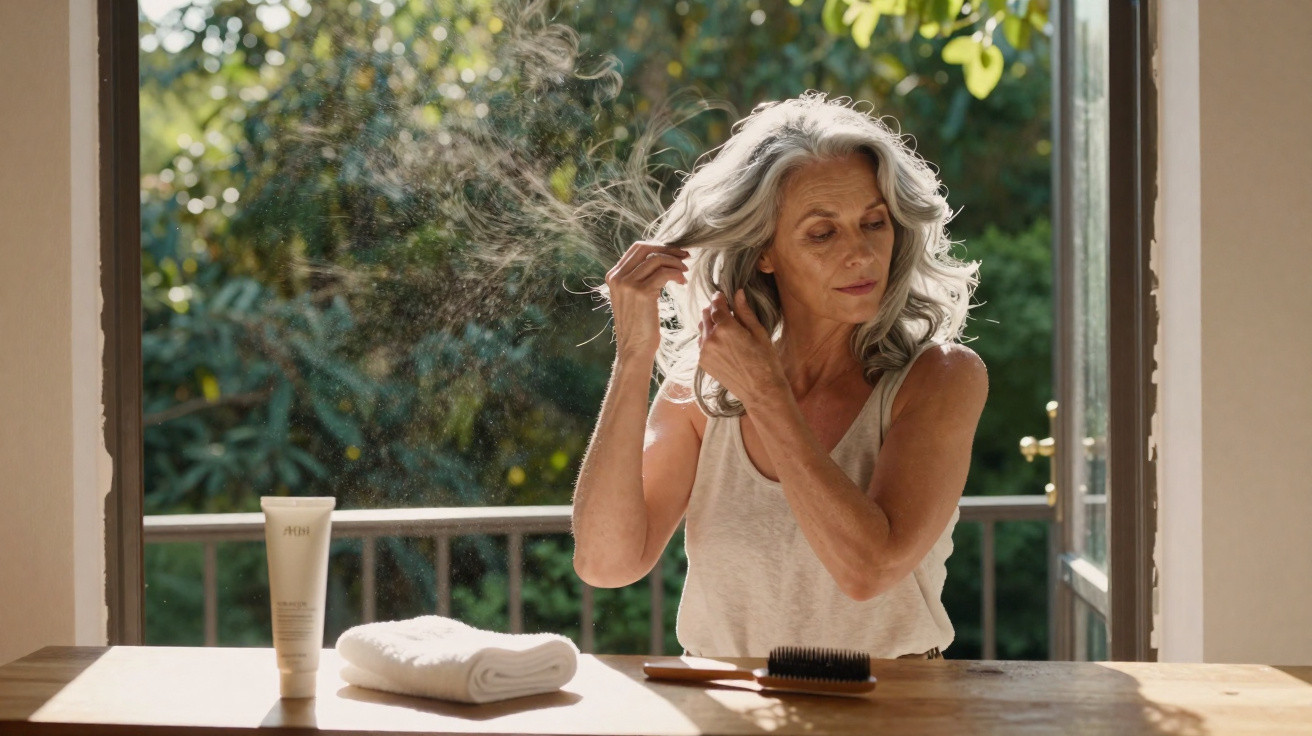
Frizz in mature hair can become more pronounced on humid days because dry, porous or sensitised strands absorb moisture from the air unevenly. Serums and oils can add shine and tame flyaways, but their effects are usually shorter-lived when used on their own. To keep hair smooth, the routine must also hydrate, condition and form a protective coating over the hair fibre.
Why does humidity make hair lose its smoothness so quickly?
The outer layer of each strand consists of cuticles. When this surface is uneven or damaged, moisture in the air can enter the hair fibre more easily. This temporarily changes the interactions between keratin molecules, causing different sections of the hair to swell unevenly.
This is why an apparently flawless blow-dry can change within minutes of entering a humid environment. The more porous the hair is, the more strongly it is likely to react to changes in the weather.
- Humidity enters porous hair fibres more readily;
- Strands may swell unevenly;
- The shape created during drying begins to come undone;
- Broken hairs and new growth make flyaways more noticeable;
- Heat and chemical treatments can increase cuticle sensitivity.
Why do serum and oil not solve the whole problem?
Oils and serums help to reduce friction, enhance shine and smooth the surface, but many work mainly as finishing products. If the fibre is highly porous, applying a few drops only after a blow-dry may not provide enough protection against moisture entering the hair. Results improve when the finishing product is part of a routine that starts during washing.
Which formulas help create a barrier against humidity?
Anti-frizz finishing products may contain polymers and conditioning agents that create a thin film around each strand. This coating limits uncontrolled moisture exchange between the hair and its surroundings, while also reducing friction between fibres. Cosmetic silicones are often included in these formulas because they promote slip, shine and surface protection.
Where there is damage linked to colouring, bleaching or heated styling tools, products containing hydrolysed proteins and amino acids can also be part of the routine. Conditioning ingredients and humectants, meanwhile, help preserve flexibility.
- Use conditioner after washing to improve cuticle smoothness;
- Look for finishing products with anti-frizz or humidity-protection benefits;
- Choose lightweight formulas if hair is fine;
- Keep richer products for hair that tolerates greater amounts of oils and butters;
- Apply heat protection before using a hairdryer or straighteners.
What changes in mature and grey hair?
Over time, some people notice changes in hair thickness, oil production, density and texture. Grey strands can also feel coarser and stiffer for some people. Combined with a history of colouring, heat styling and other treatments, these factors can make mature hair more prone to dryness and surface unevenness.
- Avoid excessively hot showers;
- Minimise friction when drying hair with a towel;
- Do not repeatedly run straighteners over the same section;
- Hydrate and condition according to the needs of the hair;
- Focus oils mainly through the mid-lengths and ends if the roots become weighed down easily.
Protection needs to begin before hair meets humidity
Trying to control frizz only after the strands have already absorbed humidity usually requires more product and delivers a less long-lasting result. A more effective approach is to prepare the fibre during washing, limit damage while drying and finish with a formula that leaves an even coating over the hair. Serum can still be part of this sequence, but it no longer has to carry sole responsibility for the finished look.
For mature hair, this approach also prevents immediate shine from being mistaken for lasting protection. A few drops of oil can transform the appearance of the ends within seconds, whereas humidity control relies on a more conditioned surface that is less vulnerable to environmental changes. Hydration, heat protection and film-forming finishing products work together so hair retains movement and smoothness even as air humidity rises.





Comments
No comments yet. Be the first to comment!
Leave a Comment