
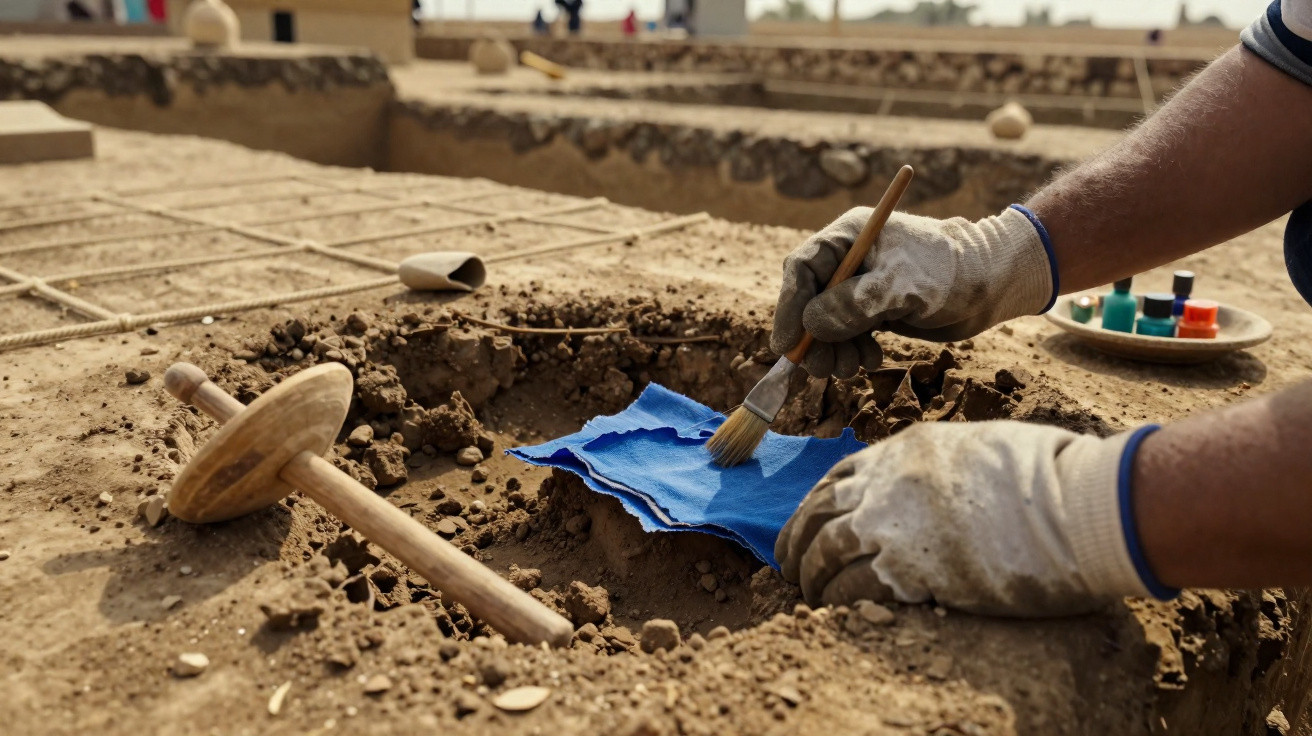
Two charred cloth fragments unearthed in western Turkey contain the oldest known blue-dyed fabric from the Bronze Age in this part of the world.
Preserved after a house fire almost 4,000 years ago, the blue fragment is reshaping historians’ understanding of textile production and colouring practices in ancient Anatolia.
Fire preserved ancient textiles
Charred deposits within a house at Beycesultan Höyük, close to Çivril in western Turkey, trapped two tiny textile pieces beneath fallen rubble, allowing them to survive for millennia.
By plotting the position of each fragment within the burnt rooms, Associate Professor Dr. Çiğdem Maner of Koç University connected the finds with textile-making activity.
Maner collaborated with excavation teams between 2016 and 2018, when scorched floor surfaces exposed the fragments, still adhering to the ground.
This unusual preservation transformed an ordinary domestic catastrophe into direct proof of craft decisions made during the early second millennium BC.
Pre-loom textile technique
Laboratory analysis found that the earlier textile, designated Tx1, dates from between 1915 and 1745 BC, in the era of the Old Assyrian trading colonies.
Microscopic examination revealed that its yarn was made using nålbinding, a process in which yarn is looped with one needle rather than interlaced on a loom.
Rather than weaving together two thread systems, the textile maker created rows of loops that could be pulled tighter or allowed to stretch.
No previous example of this single-needle technique has been recorded in Anatolia or the broader Near East, making Tx1 unique.
Ancient dye chemistry
Chemical analysis identified indigotin, the compound responsible for many rich blue colours, in the older textile fragment.
For dyeing with indigo plants, makers must first convert the pigment into a water-soluble form capable of entering the fibres. Exposure to air then changes the substance back into insoluble blue, locking the colour into the cloth as it dries.
Locally available woad provided a practical source of dye, and its extensive use as an indigo plant has been well documented.
Hemp under the soot
Both textile fragments were made from hemp rather than wool, setting the discovery apart from many Bronze Age textiles. Hemp yarn is produced from plant stems, whose lengthy cells bind together when spun.
The use of hemp also indicates local cultivation and processing, as the plant grows successfully across many areas of Turkey.
Selecting hemp expands what archaeologists can conclude about local materials and trade, moving beyond the familiar wool-focused account.
A plainer second cloth
The later fragment, Tx2, originated in a house destroyed by fire between 1700 and 1595 BC, when influential Hittite rulers were extending their power across much of central and western Anatolia.
Its yarns were arranged in tabby weave, a simple over-and-under structure repeated in each row, indicating that the fabric had been produced on a loom.
Neat rows of intersecting threads crossed the material, consistent with straightforward household cloth rather than a specialised stitch.
Such plain weaves are seldom found in Bronze Age Anatolia, so Tx2 strengthens an otherwise limited body of evidence.
Spinning and weaving tools
Numerous tools were concentrated around both fragments, associating the textiles with active workrooms rather than with scraps accidentally discarded on the ground.
Spinners used spindle whorls-small weights that stabilise a spindle-to transform loose fibres into durable yarn.
In one work area, a 0.45-kilogram stone disc rested directly on the blue textile, while nearby postholes identified the place where a loom had stood.
Groups of implements, including weights from a warp-weighted loom-a vertical frame tensioned by suspended weights-indicated organised production.
Textile trade documented
Written sources from neighbouring kingdoms regarded cloth as an important commodity, describing taxes and commercial payments made in textiles.
Cuneiform inscriptions on clay tablets-wedge-shaped impressions pressed into damp clay-recorded wool, dyed clothing and consignments travelling between cities.
Blue cloth featured in these records as a prestige item, and it is also represented in elite Egyptian burials and Aegean art.
Considered alongside these texts, the Beycesultan fragments appear less exceptional in isolation, instead demonstrating a broader market in which dyed fabric was valued.
Settlement without a name
Beycesultan has not yet been identified by a written ancient name, because excavators have recovered no cuneiform tablets from the site.
In the absence of such records, scholars have assessed its significance through its architecture, storerooms and the dense concentration of textile equipment.
Its substantial house layouts and specialised spaces implied regional importance, although the settlement’s political position remains difficult to establish.
The recovery of dyed and stitched textiles in this context offers a fresh means of interpreting status and labour from room to room.
Preservation against the odds
Most ancient textiles never reach museum collections because moisture and microorganisms destroy fibres long before archaeologists can uncover them.
“The soil in the region is generally too humid for the long-term preservation of fabric, though a few fragments have survived,” wrote Maner.
Fire can prevent decay through carbonisation, which heats organic material into stable carbon and leaves behind a fragile textile that retains its structure.
“Two burnt textile fragments found at Beycesultan offer an unexpected insight into the Bronze Age textile industry in Anatolia,” added Maner.
A clearer textile story
With one blue looped fragment and one simply woven piece, Beycesultan now illustrates how craftsmanship, raw materials and status converged in everyday spaces.
Later excavations may establish whether these techniques remained local or spread elsewhere, yet the existing evidence already places Bronze Age textiles within actual rooms.






Comments
No comments yet. Be the first to comment!
Leave a Comment