
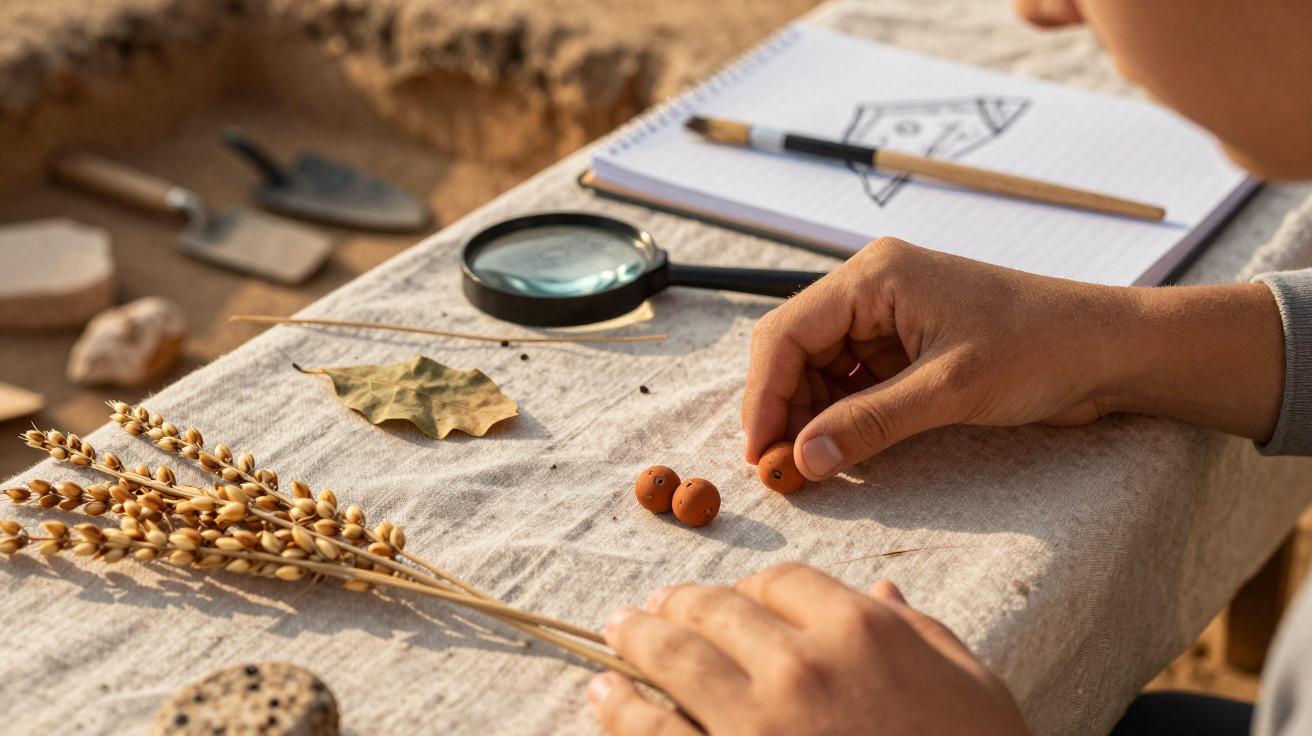
Long before pottery was made or fields were cultivated, somebody took a piece of clay and fashioned it into an object intended for wear. It was neither a vessel nor a tool, but an ornament.
More remarkably still, tiny fingerprints left in the soft clay show that children were among its makers.
A recent discovery in the Levant indicates that clay was used to communicate identity and belonging thousands of years before archaeologists had previously believed.
An international research group headed by Laurent Davin, a postdoctoral researcher at the Institute of Archaeology at the Hebrew University of Jerusalem, has documented the earliest known clay ornaments in Southwest Asia.
The team describes 142 clay beads and pendants produced roughly 15,000 years ago by Natufian hunter-gatherers in present-day Israel. These communities were beginning to establish permanent settlements well before agriculture emerged.
“This discovery completely changes how we understand the relationship between clay, symbolism, and the emergence of settled life,” Davin said.
An unexpectedly significant discovery
Until now, clay was not thought to have served this sort of cultural purpose so early in Southwest Asia.
Archaeologists had broadly associated symbolic clay practices, particularly objects worn for display or to express identity, with later agricultural societies and the Neolithic “package” of technological developments.
Clay was believed to have had little, if any, decorative function during the Natufian period. That is what makes the scale of this discovery so important: only five clay beads from this era had previously been identified anywhere in the world.
The recovery of 142 examples is unlikely to represent an isolated or unusual experiment. Instead, it points to a repeated practice carried out over generations and at several locations.
A quiet Natufian clay ornament tradition spanning three millennia
The ornaments came from four Natufian settlements: el-Wad, Nahal Oren, Hayonim and Eynan-Mallaha. Collectively, the sites represent more than three thousand years of occupation.
This chronological range matters because it points to continuity. Beads appearing at a single location at one point in time could be interpreted as an innovation that never became established.
However, comparable items found across several settlements and over such an extended period indicate an enduring tradition.
The beads are small enough to be easily overlooked during excavation, and they were formed from unfired clay. Their fragility makes the survival of so many specimens striking in itself. Nevertheless, they have endured, with their surfaces retaining evidence of their production and use.
How the Natufian beads were produced
The researchers recognised beads made as cylinders, discs and ellipses, shapes that sit easily in the hand and could have been threaded, handled and worn.
Many examples were covered with red ochre through a process known as engobe, in which a thin coating of liquid clay is applied smoothly to an object’s surface.
The researchers state that this represents the earliest known use of this colouring method anywhere in the world.
This evidence takes the story beyond the simple fact that early people made beads. It indicates close attention to surface finish, colour and visual appearance. They were not merely shaping clay; they were giving it a style.
The large quantity and range of bead forms also suggest experimentation within established boundaries. Rather than producing arbitrary shapes, people created recognisable types, frequently enough for those forms to become familiar.
Plants served as more than food
One particularly compelling aspect of the study is the close resemblance between many bead forms and plants. The team identified nineteen separate bead types, several of which resemble wild barley, einkorn wheat, lentils and peas-plants that Natufian groups gathered, processed and consumed extensively.
The finding has an almost poetic implication. Although these people had not yet become farmers, certain plants already held a central place in their lives. They collected and relied on them, and probably structured seasonal activities around them.
The beads imply that these plants had symbolic significance too. The natural world was not simply a source of food; it also provided a language of meaning.
More revealingly, traces of plant fibres survived on some beads. These remains provide unusual evidence for the ways in which the ornaments were threaded and worn, details that normally disappear when organic materials decay.
It is possible to imagine the absent cord: a strand of small clay forms, perhaps coloured red with ochre, resting against skin or clothing.
The fingerprints that reshaped the interpretation
The most compelling evidence lies not in the ornaments’ colour or forms, but in the traces of the people who made them.
Fifty fingerprints are preserved on the ornaments, allowing the researchers to estimate the makers’ ages. The impressions belonged to children, adolescents and adults.
This is described as the first occasion on which archaeologists have directly identified the makers of Palaeolithic ornaments, as well as the largest assemblage of fingerprints recorded from this period.
That evidence alters the discovery’s human dimension. The story is not simply that Natufians produced beads, but that they made them collectively. It suggests shared work, learning and meaning within everyday life, rather than an activity confined to elite ritual.
Certain objects appear to have been especially suited to children, among them a miniature clay ring just ten millimetres across. It is difficult not to imagine a child wearing or carrying it, or imitating the work of older hands.
Creating ornaments may have offered a means of acquiring skills, copying elders and taking in social values without the need for an explicit lesson.
A symbolic shift before agriculture
For many decades, archaeologists generally placed the symbolic emergence of clay in Southwest Asia within the Neolithic, alongside farming settlements and pottery. This research strongly challenges that chronology.
Together with other recent discoveries, including a clay figurine reported from Nahal Ein Gev II, the findings indicate that clay began to be used symbolically earlier, in the first phases of sedentarisation. At that time, communities still hunted and gathered but were increasingly living permanently in one place.
In such a way of life, identity becomes more visible to others. People remain neighbours for longer, relationships recur and become deeper, and there are more opportunities to signal affiliation, belonging or status-whether subtly or conspicuously.
Clay ornaments align closely with this social transition. They could be seen, worn and carried by individuals as they moved around a settlement.
“These objects show that profound social and cognitive changes were already underway,” said study co-author Professor Leore Grosman. “The roots of the Neolithic lie deeper than we once thought.”
What the beads reveal
It is easy to regard the Natufians solely as “the people right before farming”, as though their significance lay only in what followed. This discovery calls for a more complete understanding.
They were symbolic-cultural innovators in their own right. They worked with clay not because they were progressing towards pottery, but because it offered an effective material for expression. It was readily available, easy to shape, and capable of retaining both colour and form. It could convey meaning.
Since the evidence contains fingerprints from several age groups, the account is not limited to symbolism as an abstract idea. It concerns social life: children learning, adults creating, and communities sharing an aesthetic language shaped by plants, ochre and touch.
Fifteen thousand years on, the beads continue to fulfil their intended purpose. They show that somebody was there-and that they had something to communicate about who they were.
Image credit: Laurent Davin






Comments
No comments yet. Be the first to comment!
Leave a Comment