
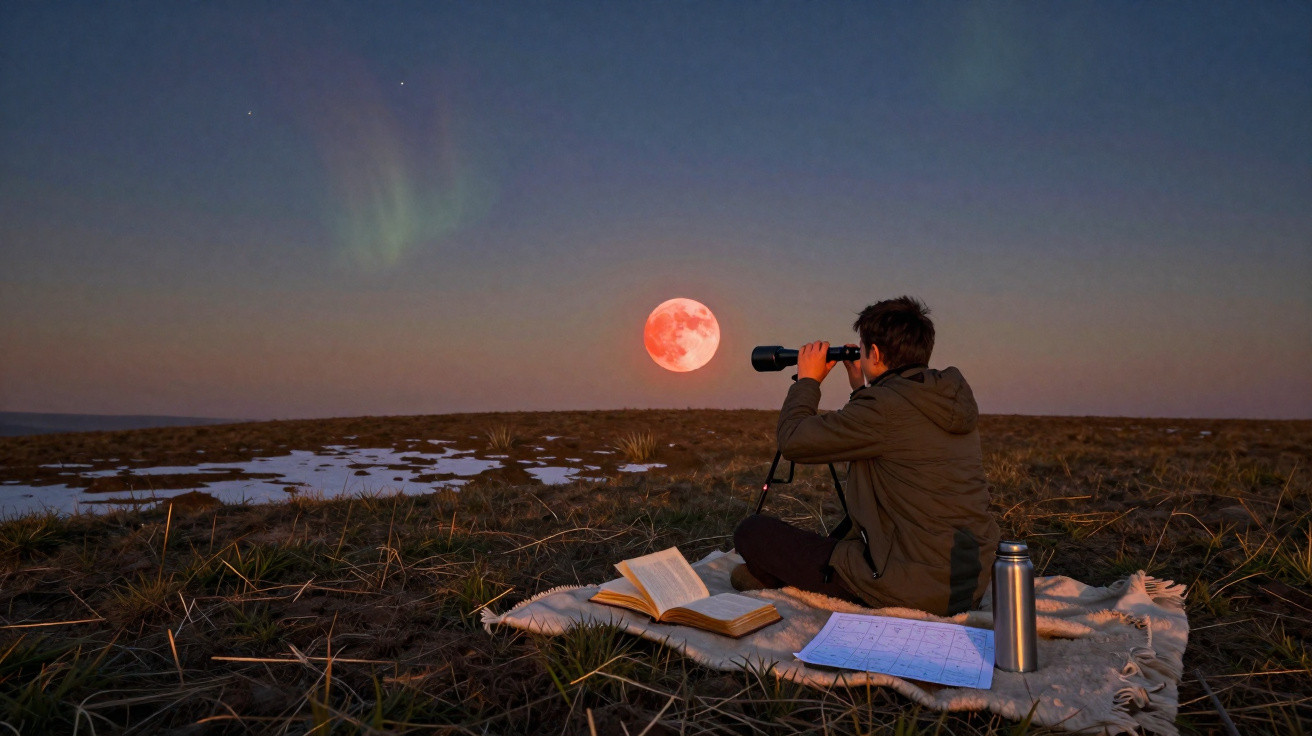
On 3 March, the night sky will take on a striking new appearance as the moon becomes a rich copper-red, producing the spectacular sight called a blood moon.
People watching the sky across large parts of North America and further afield may be able to see the event.
A blood moon occurs during a total lunar eclipse, as Earth moves precisely between the Sun and the moon and prevents direct sunlight reaching the lunar surface.
Although it may seem that the moon should disappear into darkness, it instead begins to shine in red and orange tones.
Why the blood moon appears red
Before sunlight arrives at the moon’s surface, it travels through Earth’s atmosphere. The atmosphere scatters much of the blue light, while allowing a greater proportion of red and orange wavelengths to pass through.
Earth’s atmosphere then bends this surviving red light towards the moon, giving it its copper-red appearance at the eclipse’s peak.
This cannot occur every month, as the Sun, Earth and moon need to be aligned almost perfectly.
The moon must also pass through Earth’s orbital path at a precise location known as a node. As this exact positioning is uncommon, a total lunar eclipse is seen only around once every two-and-a-half years.
The Worm Moon
The March full moon has traditionally been called the Worm Moon, a name that comes from Native American and colonial-era traditions.
The Worm Moon signals the period when earthworms start emerging again as the soil thaws.
As this year’s Worm Moon falls during a total lunar eclipse, some skywatchers have named it a “Worm Blood Moon.”
When and where to watch
NASA says the eclipse will start at 3:44 a.m. Eastern Time, when the moon moves into Earth’s outer shadow. Initially, the effect will be subtle, appearing as little more than a slight reduction in brightness.
The partial eclipse will begin at 4:50 a.m. ET. At this point, Earth’s central shadow will cover part of the moon. To the unaided eye, this can resemble a dark “bite” being removed from the moon.
Totality starts at 6:04 a.m. ET. The whole moon will then be within Earth’s shadow, glowing a dark red. At 7:03 a.m. ET, totality will finish as the moon gradually leaves the shadow and its red colour recedes.
The partial phase ends at 8:17 a.m. ET, while the full event will be over by 9:23 a.m. ET.
Where the moon will be visible
NASA states that observers in eastern Asia and Australia will witness totality during the evening, when the moon is completely red.
Across the Pacific, the eclipse will take place overnight. Those awake early in North and Central America, along with the far west of South America, will have the clearest opportunity to watch it before sunrise.
Only a partial eclipse will be visible in central Asia and much of South America, while viewers in Africa and Europe will not be able to see the event.
How to get the best view
NASA says that little is needed to watch a lunar eclipse beyond clear conditions and an unobstructed sightline to the moon.
“You can observe a lunar eclipse without any special equipment,” noted NASA.
“All you need is a line of sight to the moon. For a more dramatic experience, seek a dark environment away from bright lights. Binoculars or a telescope can also enhance your view.”
Binoculars may bring out delicate shadows and tonal variations on the lunar surface, whereas a telescope can make the spectacle more dramatic.
Anyone wishing to photograph the eclipse should mount their camera on a tripod and use slightly longer exposures to record the moon’s gradual transition to a copper glow.
Biblical prophecy and the red moon
The approaching blood moon has prompted fresh online discussion. Some social-media users are connecting the eclipse with biblical prophecy, citing passages in which the moon turns to blood before periods of major upheaval.
A verse commonly referenced is Joel 2:31, which describes the Sun becoming dark and the moon turning to blood before a “great and terrible” day.
Comparable language is found in Acts 2:20 and Revelation 6:12, linking a blood-red moon with dramatic cosmic events. Many believers understand these passages as symbols of far-reaching change, judgement or a divine warning.
A sky that looks otherworldly
Although total lunar eclipses are astronomical events that scientists understand well, their intense red light still encourages religious and cultural interpretations dating back thousands of years.
When the moon becomes copper-red on 3 March, it will be the result of an exact celestial arrangement – with the Sun, Earth and moon quietly falling into alignment with predictable precision. Even so, understanding the science does little to lessen its effect.
For a brief period, the familiar night sky will appear altered and almost otherworldly, showing that even regular cosmic events can retain an extraordinary quality.






Comments
No comments yet. Be the first to comment!
Leave a Comment