
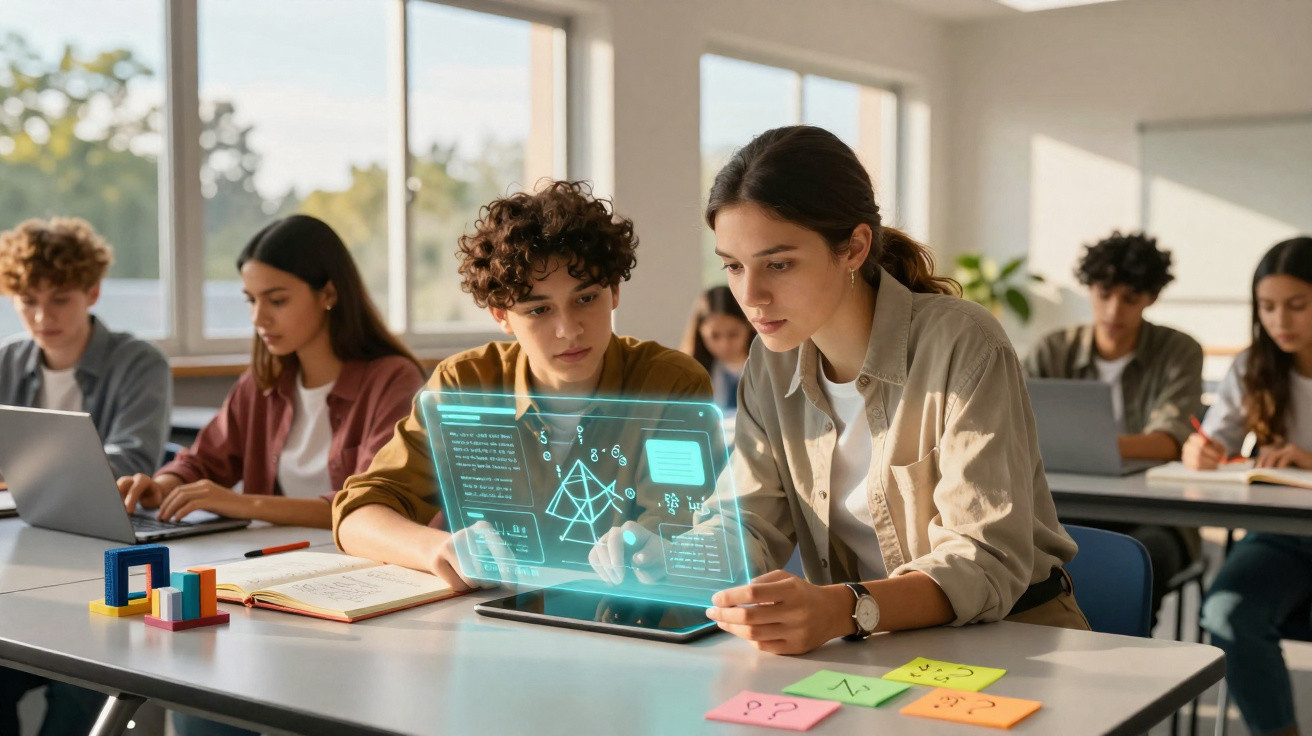
Artificial intelligence is bringing long-standing flaws in modern education into view, weaknesses that were present well before chatbots appeared.
A new paper contends that many abilities for which pupils are still assessed, such as summarising information and producing straightforward essays, can now be completed by AI tools within seconds.
Rethinking what students should learn
Professor Yong Zhao of the University of Kansas (KU) has spent years examining why schools change so little, regardless of the efforts made to reform them.
In his view, the central issue is not that students use artificial intelligence. It is that schools still evaluate work which technology can reproduce with ease.
If AI can complete an assignment successfully, then perhaps the assignment itself should be reconsidered.
That argument has intensified discussion around bans, cheating rules and AI-detection tools.
Professor Zhao’s latest paper proposes that educators may be missing a broader chance to reconsider both what students ought to learn and how they should show that learning.
AI exposes old problems
The paper begins with a stark assertion: according to Zhao, the main difficulty posed by AI in classrooms is not the technology itself.
Generative AI is now capable of carrying out much of the work schools ask students to do. These tools can summarise set reading and transform a simple instruction into an adequate essay in seconds.
Where an assigned task can be completed by a chatbot, a student’s decision to use one becomes less obviously a matter of poor character.
Outdated goals remain
One recent survey reported that almost six in ten US teenagers believe AI-assisted cheating occurs regularly in their school. Zhao sees this as evidence of a problem more fundamental than cheating.
The objective has itself become outdated, he says, as schools continue to reward work that machines can now generate. “AI did not create this obsolescence. It revealed it,” he writes.
In a small experiment, participants who used a chatbot to write essays had weaker links between brain regions during the writing process and retained less of what they had written.
The research followed 54 writers using brain-monitoring caps. Those supplied with AI displayed the lowest level of mental involvement of any group and reported little sense of ownership over their essays.
Schools that resist
Yet this does not answer why schools prove so resistant to change, the question Zhao explores through much of the paper.
Reformers have been trying for a century, but the underlying framework remains. Pupils are still grouped by age, subjects are still kept separate, while examinations and rankings continue to dominate.
Academics describe this persistent arrangement as “the grammar of schooling”, a deeply embedded collection of practices that survives one reform after another.
Built to stay the same
Zhao explains this resilience as a form of peace treaty. In his account, a school is an agreement between groups that expect different things from it.
Parents seek clear evidence that their children are succeeding. Universities want recognisable qualifications to help them sort applicants, while governments require figures that can be compared between schools.
Grades, timetables and standardised tests satisfy these interests reasonably well at the same time. As a result, any reform that disrupts the arrangement encounters opposition before it can begin.
Professor Zhao distinguishes between improvement, which helps the current system function more effectively, and transformation, which challenges the purpose of that system.
The courageous minority
Zhao does not propose repairing the whole system in one move, an approach he considers nearly impossible. Instead, he argues for beginning in places where people can genuinely make changes.
As he puts it, a courageous minority consists of the small group of teachers, students and leaders in almost every school who are dissatisfied with existing practice.
They seldom possess significant authority. However, they do have an area within their control: one classroom, a small mentoring group, a capstone project or a school-within-a-school.
Professor Zhao draws on panarchy theory, which describes how complex systems evolve. This theory suggests that major systems seldom transform from the top down.
Smaller, sheltered spaces have greater freedom to test ideas. If an experiment works, it can move outwards, attract supporters and gradually reshape the wider system.
Work that machines can’t do
In practical terms, this means teachers reworking familiar assignments.
Rather than writing a conventional persuasive essay, students could choose an actual issue in their local area, collect data themselves and present recommendations to an audience beyond their teacher.
A mathematics class could investigate traffic near the school and recommend safer crossings, rather than working through invented rate-based questions.
The aim is to require students to undertake work that a machine cannot simply return for them. This theory is already undergoing testing.
Zhao and his colleagues have established a network of around 20 schools in several countries. Educators take part in calls at unusual hours to create small experiments within their own schools.
These projects include student-led learning days, podcasts run by students and enquiry projects in which children decide what deserves investigation.
Changes for education
Worldwide labour forecasts predict that AI will generate about 170 million jobs and eliminate roughly 92 million by 2030. The work that remains is expected to depend more heavily on judgement and the capacity to collaborate effectively with others.
A school that continues to reward routine output is preparing students for the area of the economy contracting most quickly. Simply adding more technology is not necessarily a safe default, either.
Population research has associated greater screen time among children and teenagers with reduced well-being, including poorer self-control and greater difficulty completing tasks.
That relationship appeared across thousands of young people in one large study. Additional digital tools do not automatically produce better learning.
The future of learning with AI
Zhao shifts the focus of the argument. The issue is no longer how schools can exclude AI, but what they should ask students to do once AI is present in the classroom.
His theory holds that meaningful transformation will not come through a sweeping policy imposed from above.
Instead, it will begin with a small number of people creating better learning in the spaces they already control, before potentially spreading further.




Comments
No comments yet. Be the first to comment!
Leave a Comment