
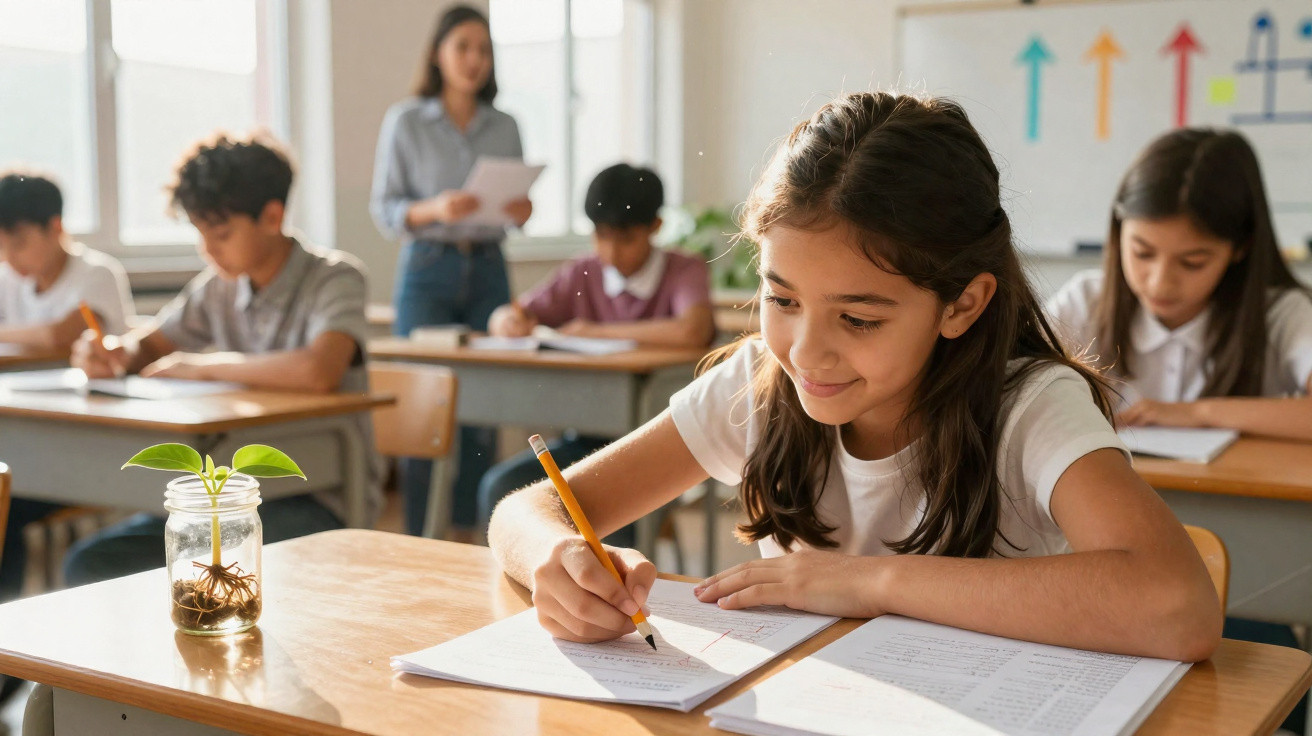
Success at school depends on more than natural ability. Although many pupils assume that hard work alone is sufficient, research points to a deeper influence. A pupil’s approach to learning can affect their results, self-confidence and even how much they enjoy school.
Research from the Norwegian University of Science and Technology (NTNU) explores how motivation operates and the factors that genuinely make a difference.
Factors that influence pupil success
The researchers examined 249 pupils between 15 and 19 years old. They aimed to discover how motivation influences grades, confidence and enjoyment in subjects including Norwegian and physical education.
Their research considered four central concepts: growth mindset, self-belief, passion and grit.
A growth mindset means believing that skills and abilities can be strengthened through effort. Self-belief, meanwhile, is the confidence that a person can complete tasks successfully.
Passion describes a powerful desire to do well, whereas grit is the capacity to continue when things become hard.
The team also assessed how these qualities relate to practical outcomes, including grades, confidence and pupils’ overall school experience.
Why growth mindset is most important
“One of the clearest findings in the study is that believing you can improve through practice is the most consistent motivational factor when it comes to grades and experiencing a sense of mastery in academic subjects,” said Birger Olav Sætre, lead author of the study.
A growth mindset enables pupils to remain optimistic when learning becomes difficult. The research identified it as the factor most strongly associated with higher grades in both Norwegian and physical education.
Pupils with this outlook also reported feeling more competent. When work was challenging, they continued to make an effort because they believed they could improve. That straightforward belief may influence success over the long term.
How self-belief shapes performance
Self-belief, or self-efficacy, has a separate yet significant effect. A pupil might accept that improvement is achievable while still lacking confidence in particular tasks.
The study showed that self-belief was particularly significant in physical education. It had a strong influence on both pupils’ confidence and their enjoyment of the subject.
Physical activities provide immediate evidence of progress. For instance, a pupil may quickly notice gains in strength or performance. Such progress increases confidence and motivates further effort.
“This makes sense, since this is a subject where pupils receive clear and immediate feedback on their skills and often draw on experiences from activities outside school,” said Sætre.
When pupils believe they are capable, learning is more engaging.
Passion and grit: what the study found
Passion and hard work are widely seen as direct routes to success, but the findings offer a more nuanced picture.
“Pupils who were ambitious and highly focused on performing well often excelled,” said Sætre.
Yet passion and grit were not the most powerful indicators of grades. Passion had a modest positive relationship with success, but it was less prominent than mindset and confidence.
Grit had a limited effect. It offered some help with enjoyment in subjects such as Norwegian, but did not have a strong influence on academic performance.
The findings indicate that effort is important, but the mindset driving that effort is even more significant.
Gender differences in motivation
The research identified differences between boys and girls as well. Boys reported greater levels of passion and grit, but this did not translate into stronger academic outcomes.
“Boys reported having more grit and higher drive to perform, but this did not result in them achieving better grades,” said Sætre.
Girls achieved better results in Norwegian and felt more confident in the subject. This suggests that mindset and confidence may have a greater effect on outcomes than effort or ambition alone.
Motivation by itself cannot ensure success; the quality of that motivation is crucial.
How motivational factors interact
According to the study, these motivational qualities are linked. Growth mindset and self-belief are closely connected: pupils who believe they can improve commonly also have faith in their own abilities.
Growth mindset is also associated with passion. Pupils who feel that learning is achievable are often more interested in pursuing their goals. Together, these links form a strong foundation for learning.
Motivation does not work in isolation. Several factors combine to influence how pupils learn, perform and feel at school.
Learning through mistakes and challenges
The research highlights one key point: pupils do not have to be perfect. Making mistakes is an ordinary part of learning.
Progress occurs when pupils confront challenges rather than avoid them. Learning becomes more manageable when they recognise that improvement requires time and effort.
“Schools can therefore benefit greatly by helping pupils see that it is always possible to improve and understand that making mistakes is part of the learning process,” concluded Sætre.
This perspective can reshape pupils’ views of school. Rather than being afraid of mistakes, they can treat them as stages on the path to success.





Comments
No comments yet. Be the first to comment!
Leave a Comment