
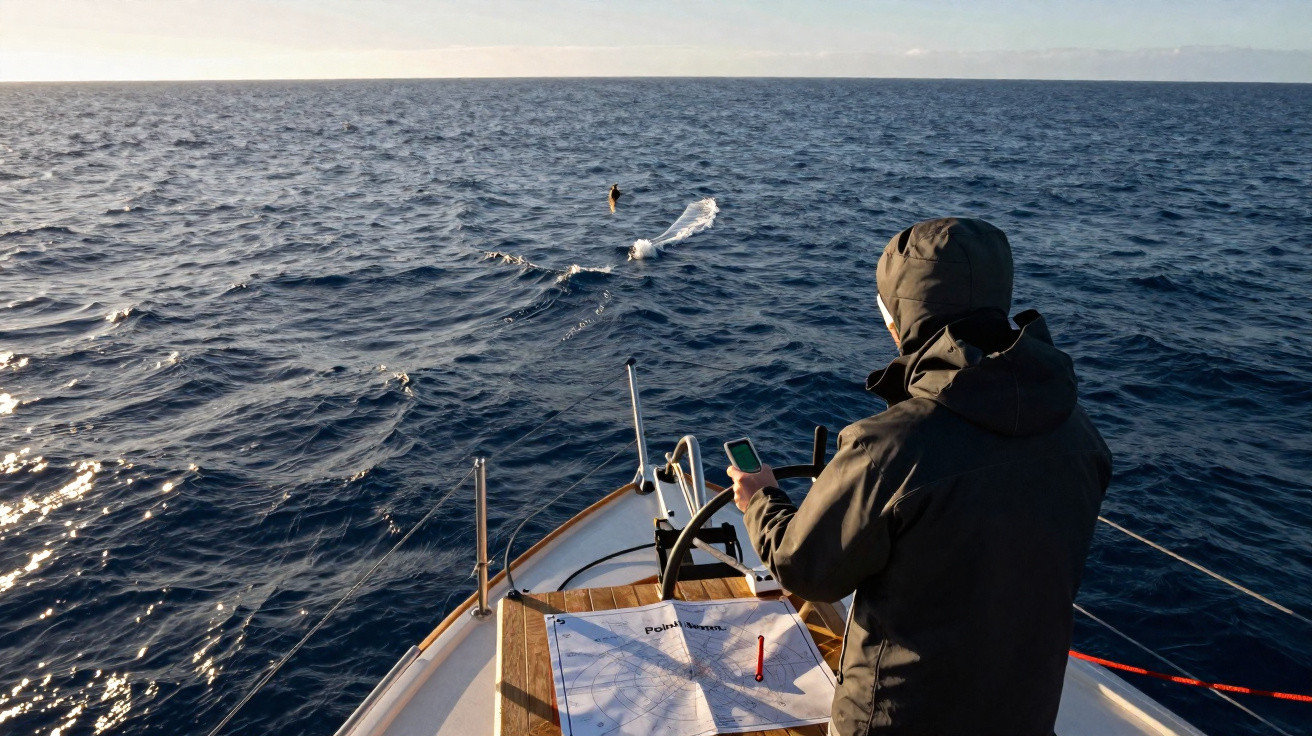
The Pole of Inaccessibility is the calculated location furthest from a coastline or geographical boundary. In its best-known form, the oceanic pole, it is called Point Nemo and lies in the South Pacific, so far from any land that it has become a symbol of extreme isolation. There are no nearby islands, harbours or cities: only open sea, ocean currents and a distance that is difficult to comprehend on a map.
What does Pole of Inaccessibility mean?
A Pole of Inaccessibility is the place located furthest from a defined edge. On a continent, it may be the point furthest from the coast; in the ocean, it is the location furthest from any island or shoreline.
The concept does not directly assess altitude, climate or danger. Instead, it measures geographical distance. This is why there are several poles of inaccessibility: an oceanic one, an Antarctic one, a Eurasian one and others calculated according to the area being examined.
Where is the ocean’s most remote point?
The location furthest from every coastline is Point Nemo, in the South Pacific, near the coordinates 48°52.6′S and 123°23.6′W. It is approximately 2,688 km from the nearest land.
Its closest land references are small and isolated: Ducie Island in the Pitcairn archipelago; Motu Nui, near Easter Island; and the Maher Island area, close to Antarctica. This triangle of distances helps establish the ocean’s remote centre.
How is Point Nemo calculated?
The calculation identifies the largest possible circle within the ocean that does not touch any coastline. Its centre is the location where the distance to the nearest land areas is balanced.
In practice, geographers use digital maps, coastal coordinates and models of the Earth to solve this problem. The more accurately islands, reefs and coastlines are defined, the more refined the result becomes. As a result, small cartographic updates can slightly alter its precise location.
What is at Point Nemo?
There is no monument, hidden island or permanent platform at Point Nemo. It is deep, open sea, far from major human routes. At certain times, the closest people may be in orbit aboard the International Space Station.
The area has also become known as the “spacecraft cemetery”. Space agencies use a remote part of the South Pacific for the controlled re-entry of satellites, cargo craft and decommissioned stations, reducing the risk of debris falling over inhabited areas.
Why does this place fascinate geographers and adventurers?
Its appeal comes from the combination of mathematical precision and complete emptiness. The oceanic Pole of Inaccessibility demonstrates that there are still places on Earth without a human landscape, roads, harbours or any visual reference beyond the horizon.
Modern expeditions have already attempted to reach Point Nemo to document the experience, collect water samples and test the limits of open-sea navigation. The site draws interest because it turns a cold coordinate into a tangible question: what do we feel when we are at the point furthest from every coast on Earth?





Comments
No comments yet. Be the first to comment!
Leave a Comment