
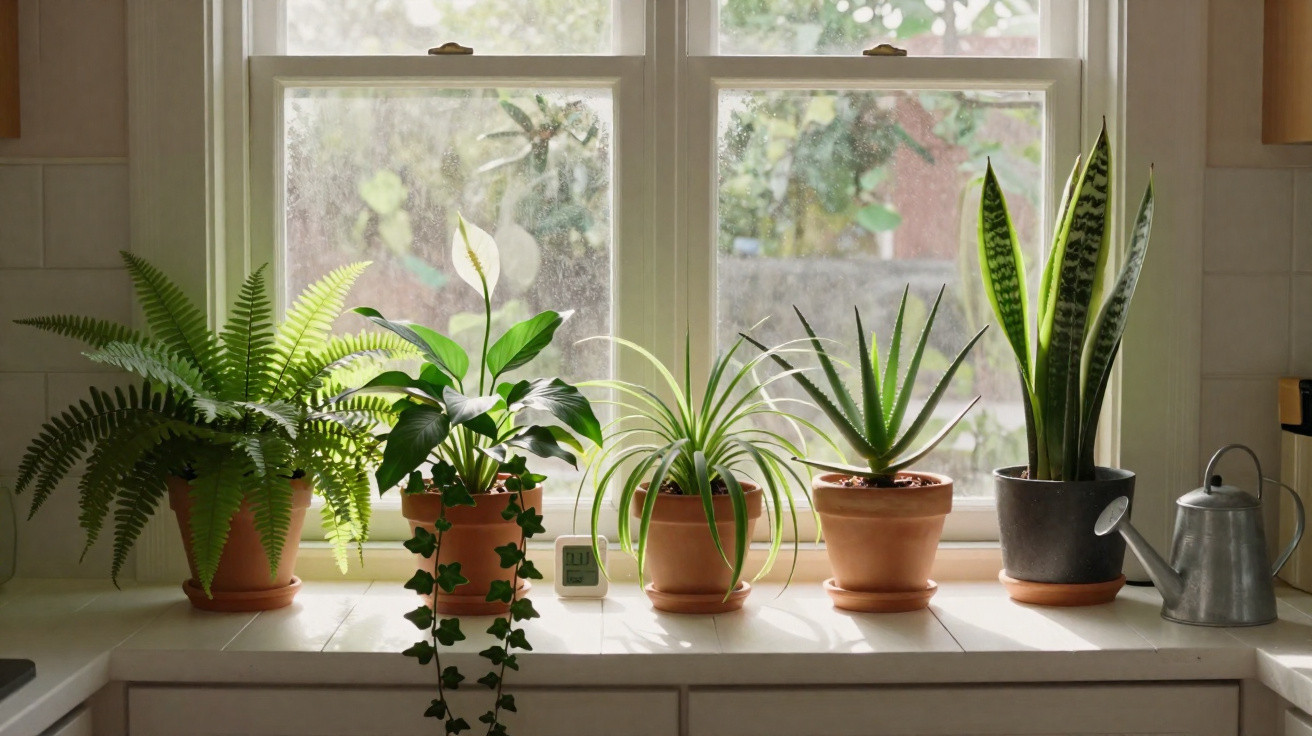
Every morning, misted-up panes, dark spots around the frames and a musty smell: many homes quietly struggle with excessive moisture.
Ignoring it can lead not only to peeling paint and crumbling silicone seals, but also to allergies and breathing difficulties. Alongside airing rooms and heating them, there is an often-overlooked aid for damp windows: carefully chosen houseplants placed directly on the windowsill.
When the window ‘sweats’: what moisture really indicates
Warm indoor air can hold far more water than cold air. When this warm, humid air meets a cold window pane, it cools down abruptly. The water it contains then forms tiny droplets: condensation.
If these droplets remain on the glass, frames and seals day after day, they create a permanently damp microclimate. This is precisely the environment mould fungi favour. They first settle in corners, then in silicone seals and, later, potentially on the walls surrounding the window.
Experts recommend relative humidity of between 40 and 60 per cent. If readings consistently exceed this range, the usual warning signs begin to appear:
- windows that are regularly misted up or wet in the morning
- a musty, ‘cellar-like’ smell in individual rooms
- small black spots in seals and window frames
- flaking paint in corners above windows
A simple hygrometer costing only a few pounds can be used to check this in every room. If it regularly displays more than 60 per cent, it is worth taking action before mould becomes a permanent resident.
Damp window frames are rarely merely a cosmetic issue. They point to an indoor climate that gives mould fungi ideal conditions in which to establish themselves.
How houseplants on the windowsill improve the air
Many houseplants do not react badly to humid air; they make use of it. They take up water from their surroundings through their leaves and roots, then release it again over time. Their effect on the indoor climate is therefore less like that of a dehumidifier and more like a gentle buffer, helping to soften upward peaks.
At the same time, certain species filter pollutants from the air. NASA experiments into air purification by plants are among the research pointing to this. In practice, that means a sensible combination of airing rooms, heating, positioning furniture correctly and selecting plants carefully can make vulnerable window areas considerably more ‘resilient’ to mould.
There is, however, a clear limit: plants on their own cannot solve a moisture problem in a badly affected home. They are one part of the solution, not a miracle cure. Without regular burst ventilation, effective ventilation and sound masonry, even the most attractive planted windowsill will achieve little.
Common mistakes with plants at damp windows
Anyone hoping to use houseplants as an aid against mould should keep several points in mind:
- No standing water: Empty saucers after watering, as waterlogged conditions encourage mould in the pot.
- A well-drained pot: Drainage holes and a layer of expanded clay or pebbles prevent roots from sitting in water.
- Keep space from the wall: Do not press leaves directly against cold external walls, as concealed damp patches can develop.
- Wipe leaves regularly: Dust and a film of moisture on leaves encourage fungi.
These six plants are particularly helpful at damp windows
Some species are far better suited than others to the humid, and often cool, conditions around windows. Here are six candidates that repeatedly stand out positively in studies and in practice.
1. Boston fern – the classic choice for bathrooms and kitchens
The Boston fern thrives in humid locations. It will usually be perfectly happy at a bright bathroom window without intense midday sun. Its delicate fronds absorb plenty of water from the air, and it generally copes well with temperature fluctuations.
The key is to keep the compost consistently moist, but never wet. If the pot dries out completely, the fern quickly sheds leaves. Too much water left in the saucer, on the other hand, causes its roots to rot. Loose, humus-rich compost helps maintain the right balance.
2. Peace lily – an air humidifier with a side effect
The peace lily is almost a classic among plants used for indoor climates. It absorbs moisture and certain pollutants from the air, while tolerating positions where many other plants would fail: partial shade, occasional very high humidity and a place close to a window.
There is one important point for pet owners: its leaves are toxic to cats and dogs. Anyone with pets should keep a peace lily out of their reach or choose another species.
3. Ivy – a hardy competitor to mould
Indoor ivy tolerates quite a lot and copes surprisingly well with the slightly cool currents of air around a window. Whether in a hanging planter or a pot on the windowsill, it uses the more humid air near the pane and may help filter mould spores from the air.
It prefers bright to partly shaded positions and compost that remains fairly evenly moist. Strong direct sunshine in high summer can scorch the leaves; light curtains or a position facing east or north can help here.
4. Spider plant – undemanding and quick-growing
The spider plant is rightly considered ‘indestructible’. It needs bright but not full sun, and will forgive the occasional missed watering. Window recesses in living rooms or hallways are ideal.
Its long, narrow leaves increase the surface area through which water can be absorbed and released again. Placing several spider plants alongside one another enhances this effect, while also creating a small jungle look on the windowsill.
5. Aloe vera – for bright, relatively cool windows
Aloe vera is a succulent, meaning that it stores water in its leaves. It copes very well with drier compost and handles temperature changes at the window much better than many delicate flowering plants.
It is comfortable at very bright windows, such as those facing south or west, provided that high-summer midday sunshine does not beat down on it uninterrupted for hours. Anyone wanting to water less often while still doing something for the indoor climate will often find aloe a good fit.
6. Sansevieria (snake plant) – minimal care, maximum resilience
The snake plant is among the easiest houseplants of all to care for. It tolerates dry central-heating air, but also copes with slightly raised moisture levels at windows. Its thick, upright leaves store water and release moisture into the room only slowly.
It can handle bright and sunny light as well as partly shaded corners. For people who travel frequently, this plant is a reliable companion for sparse, empty windowsills – and provides a small contribution to better air at no extra cost.
How to combine plants with a sensible ventilation routine
Plants are only useful when the rest of your indoor climate management is reasonably well organised. A simple routine is often enough:
- Open windows fully for 5–10 minutes in the morning and evening for burst ventilation.
- Do not turn radiators off completely, so that walls do not become cold.
- Avoid pushing furniture directly against cold external walls; leave some space.
- Position suitable plants specifically at vulnerable windows.
Brief cross-ventilation in the bathroom or kitchen after showering or cooking prevents large amounts of water vapour from spreading through the rest of the home in the first place. Plants that enjoy humid air benefit from this short burst of steam, without droplets permanently collecting on the window pane.
Risks, limits and useful additions
Despite their benefits, plants also involve a certain risk: overly wet compost and permanently damp saucers can themselves become sources of mould. White fluff on the surface of the compost, a stale smell or small flies (fungus gnats) are clear warning signs. The remedy is to water less, replace the top layer of compost and improve drainage in the pot.
People who are particularly sensitive to mould should monitor growth in their pots and replace old or unhealthy plants promptly. Removing dead leaves regularly also reduces the risk.
| Plant | Ideal for | Light requirements |
|---|---|---|
| Boston fern | Bathrooms, kitchens, humid rooms | Bright, without direct midday sun |
| Peace lily | Living room, bedroom (without pets) | Partial shade to bright |
| Ivy | Windows with slight mould marks | Bright to partial shade |
| Spider plant | Almost all living spaces | Bright, not permanently in full sun |
| Aloe vera | Bright, cooler windowsills | Very bright, partly sunny |
| Snake plant | Bedroom, hallway, office | Bright to partial shade |
When plant-based help is no longer enough
If substantial mould patches keep returning despite consistent ventilation, heating and plant placement, this often points to structural problems: leaking façades, thermal bridges, faulty seals or poorly adjusted ventilation systems. In that case, there is little alternative to a professional inspection.
Those who act early have more options. A hygrometer, a critical look at windows and seals, and a few carefully positioned plants can provide valuable clues. In this way, a window prone to mould can sometimes become a green, healthy focal point rather than a permanently damp problem area.






Comments
No comments yet. Be the first to comment!
Leave a Comment