

Saturday, 4:37 p.m.
The vacuum cleaner is out, a partly folded heap of washing sits on the sofa, and the sink is silently demanding attention. This morning, you promised yourself it would be a “big cleaning day”. Then life intervened: a message, a phone call, a child’s meltdown, a nap that lasted longer than planned.
When you finally take stock, the house is not a catastrophe… but it is not “finished” either. It is stuck in that hazy middle ground where you feel bad for not doing more, yet worn out by the thought of beginning again tomorrow.
One unspoken question lingers in the room.
What if the issue is not that you fail to clean enough, but that your home demands too much from you?
Reconsidering what “clean enough” actually looks like
Visit ten homes and you will find ten entirely different definitions of “clean”. One friend may have a gleaming kitchen but use bedroom chairs as extra wardrobes. Another might have toys scattered everywhere while her bathroom resembles a hotel suite. Your own expectations probably change according to your mood and the sort of week you have had.
This constantly shifting standard is exhausting. We pursue the flawless image seen in magazines or TikTok reels, even though dust begins to settle again that very day in real life. The aim is not a showroom; it is a home that does not feel like it is battling you every time you come through the door.
Imagine arriving home on a Tuesday evening after a draining day. Shoes are left by the door, three glasses sit forgotten on the coffee table, and there is a faint mark around the sink. It is not chaos, but it is cluttered enough to irritate you when you are already tired. You then spend 40 minutes “catching up”, feeling rushed and resentful, rather than settling into your own life.
Now picture that same day with the same you, except the shoes go into a basket, post has a tray and dishes are rinsed as standard. Life is still visible all around you, but nothing feels like an unfinished job shouting for attention. The same square metres, but far less pressure on your mind.
The real difference is not how frequently you scrub, but how fast your home returns to its baseline. That “baseline” is your own definition of acceptable: a standard at which you could invite a friend for coffee without launching into a two-hour panic clean.
Once you have set that boundary, your decisions become more straightforward. Rather than deep-cleaning unseen corners, you can create shortcuts: own fewer things, have fewer flat surfaces that collect clutter and make laundry routines simpler. The less friction your home creates, the less it needs your continual attention.
Let’s be honest: nobody really does this every single day.
Micro-habits that discreetly prevent chaos
The most effective way to clean less is to make “cleaning” a collection of tiny background actions. It is not a major occasion or a Saturday task, but a set of micro-habits built into what you already do.
Wipe the bathroom sink while waiting for the tap water to heat up. Fill the dishwasher as you cook rather than afterwards. Each time you walk to another room, take one item in the right direction. These actions take seconds, yet over a week they can remove the need for entire cleaning sessions.
You are not putting in more effort; you are reducing the mess before it has a chance to grow legs.
Take the notorious “clothes chair”, for example: one person’s laundry Everest that could vanish with one small adjustment. Put a laundry basket exactly where you normally drop your clothes. Do not choose the ideal Pinterest location; choose the place that suits your real habits. Suddenly, 80% of that pile does not appear. The same principle applies to post: position a small tray or wall pocket exactly where post tends to land when you come inside.
We often accuse ourselves of laziness when the real problem is that our homes are poorly arranged for the way we genuinely live. Small changes are more powerful than heroic motivation.
There is a subtle sense of relief when your home begins to work with you rather than make you feel judged.
“Cleaning less isn’t about giving up on hygiene,” says a professional organizer I interviewed once. “It’s about designing a space that forgives your real life.”
- Place a laundry basket where clothes actually end up, rather than where they “should” go.
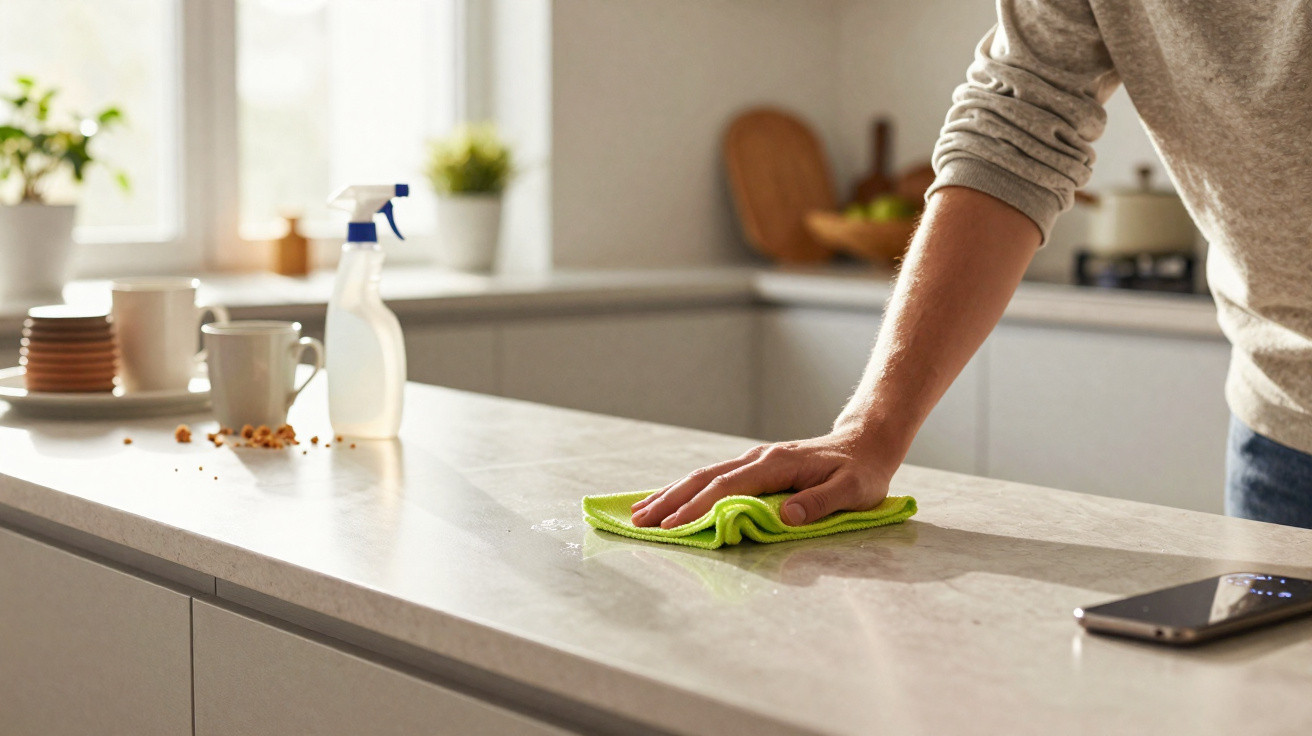
- Keep a spray cleaner and cloth in the bathroom, so a wipe takes 20 seconds.
- Keep one general-purpose basket in the living room for toys, remotes and miscellaneous items.
- Try a 5-minute reset before bed: clear surfaces and roughly straighten cushions.
- Store everyday items at arm height instead of in awkward cupboards you will avoid opening.
These are not glamorous systems. They are small, forgiving shortcuts that gradually reduce the overall mess across your week.
Own less, forgive more and breathe more easily
Sooner or later, any discussion about cleaning less reaches the subject of possessions. The more items you own, the more visual clutter, dust and decisions you create. Every additional mug, cushion, toy or “maybe one day” gadget becomes something you will eventually need to pick up, dust or move.
You do not need to become a minimalist monk. Simply start asking yourself: “Do I like this enough to clean it again and again?” If the answer is no, that item is quietly taking your time - and your weekends.
Space is not only measured in square metres. It is also mental bandwidth.
There is also a second, less obvious issue: how we speak to ourselves. Many of us live with a constant inner soundtrack saying, “I should clean more”, “My place is embarrassing” or “Everyone else manages this”. Shame has a sly effect: it encourages us to put off cleaning because we already feel that we have failed.
A more compassionate script alters behaviour. “My home is lived in”, “I’m allowed to be tired”, “Done is better than perfect”. From that place, you are more likely to spend 7 minutes tidying than abandon the task altogether because a full deep clean feels impossible. Guilt is heavy. Lightness is surprisingly efficient.
When you begin to see your home as a living system instead of an endless project, everything becomes gentler. Perhaps your baseline is visible floors, manageable dishes and a bathroom that is not frightening, with everything else open to negotiation. During busy weeks, that is enough. In quieter weeks, you do more - not because you have to, but because you have the capacity.
People rarely share photographs of this middle ground. Yet it is where most everyday life takes place: a kitchen where someone has just cooked, a hallway containing a forgotten scarf, a sofa with a half-read book. That’s not mess. That’s proof you exist here.
| Key point | Detail | Value for the reader |
|---|---|---|
| Define your “clean enough” baseline | Select a realistic everyday standard rather than pursuing perfection | Reduces guilt and the sense of an endless to-do list |
| Use micro-habits, not marathon cleaning | Build 10–60 second actions into routines you already have | Keeps clutter low without additional exhaustion |
| Let go of objects that drain you | Assess possessions by asking whether they are worth cleaning repeatedly | Less clutter, quicker tidying and calmer rooms |
FAQ:
How often do I really need to clean to keep my home decent?
Most homes remain “decent” with a light 10–20 minute reset on most days, plus a more thorough 60–90 minute clean once a week. The important thing is distributing small tasks throughout the week so nothing builds into a crisis.What should I prioritize when I have almost no time?
Focus on the areas that calm your mind most quickly: clear dishes from the sink, take out rubbish, clear one main surface and give the bathroom a quick wipe. Even if everything else must wait, these four steps immediately improve how your home feels.How do I stop my family from undoing all my efforts?
Assign everyone one simple task connected to a particular moment: children put toys into the living-room basket before screen time, your partner wipes the counter after dinner, and you do the 5-minute bedtime reset. Clear, small responsibilities work better than a vague request to “help more”.What if my home is already very messy? Where do I start?
Choose one contained space, such as the kitchen counter, coffee table or bathroom sink. Set a 15-minute timer, remain in that area and complete it. Seeing a visible result builds momentum and makes the rest seem less overwhelming.Can I really be clean if I don’t deep-clean often?
Yes, provided your daily habits stop grime from accumulating. Regular light wiping, effective ventilation, replacing sponges and cloths, and keeping on top of rubbish and laundry contribute more to hygiene than occasional extreme clean-athons.

Comments
No comments yet. Be the first to comment!
Leave a Comment