
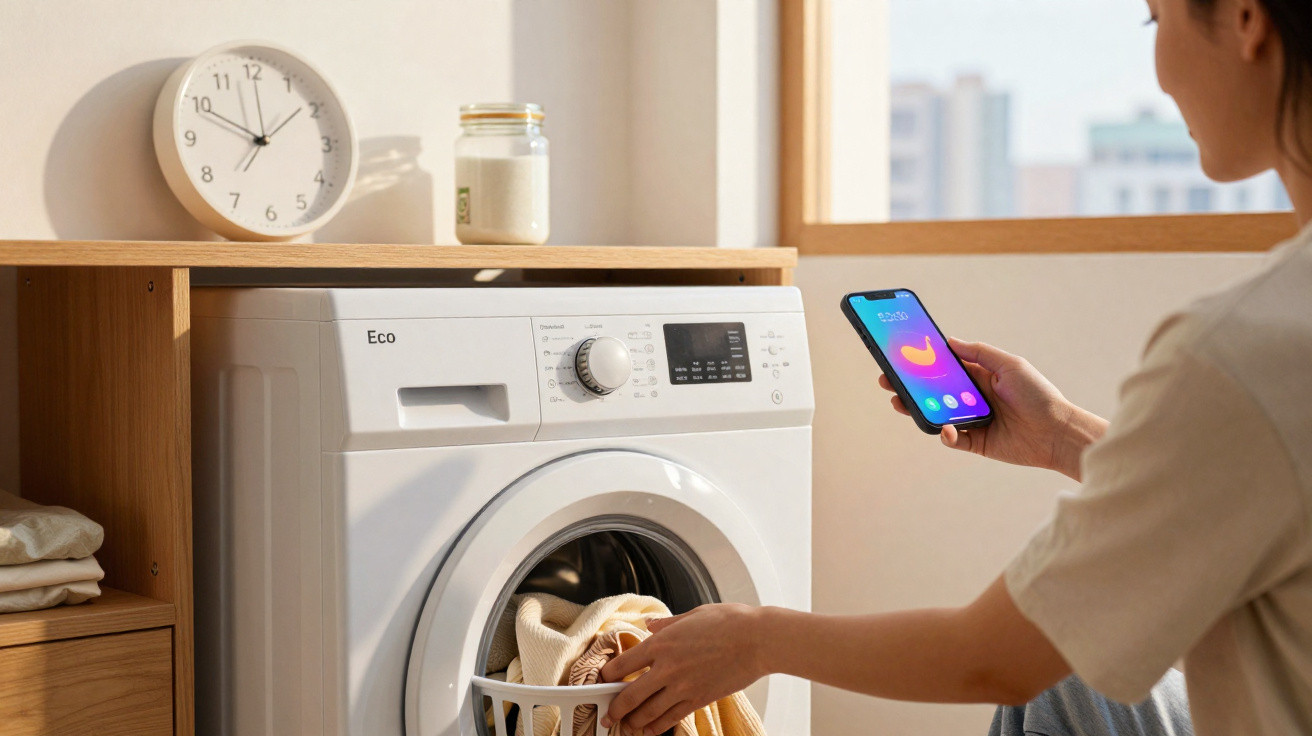
The laundry pile keeps growing, daily life is hectic, and the washing machine often goes on when you finally get home. Yet the time you choose can affect the final electricity bill. By making small changes to your washing routine, you can save a noticeable amount over the year while also easing pressure on the electricity grid.
Why the time you wash has become so important
Saving electricity is no longer simply about switching off lights. Grid operators and energy suppliers have to balance supply and demand every day. Household appliances, including washing machines, account for a measurable share of this demand. Estimates suggest that washing alone represents around five to six per cent of all household electricity use.
The good news is that, unlike a fridge or central heating, you can choose when your washing machine runs. This makes it an especially useful way to cut both costs and CO₂ emissions without sacrificing convenience.
“Anyone who starts their washing machine at the wrong time often pays up to twice as much per kilowatt-hour as necessary.”
The evening hours you should avoid for washing
Electricity demand peaks between 18:00 and 22:00. During this period, many homes are using the cooker, television and lights, perhaps alongside a dishwasher and tumble dryer. This combination puts the grid under strain and makes energy more expensive.
Many electricity tariffs use so-called peak periods or high-tariff hours. During these times, the price per kilowatt-hour is significantly higher. A washing machine does not necessarily use more electricity when it runs then, but every unit it consumes costs more.
Doing your laundry during these evening hours therefore costs extra and adds to pressure on the grid. It is not especially climate-friendly either, as grid operators may need to rely on less efficient power stations at times of peak demand.
Common mistakes made in many households
- Washing immediately after work purely out of habit
- Families scheduling a “washing machine run” for after the evening meal
- Starting a long programme without checking the time
- Ignoring the delayed-start function even though the machine has one
Once you spot these habits, you can adjust them without any extra effort – often, all it takes is pressing the delayed-start button.
The best times to run your washing machine
The opposite of costly peak periods is off-peak or low-demand time. Under many contracts, this broadly falls between 22:00 and 06:00. General demand is lower during these hours, so energy suppliers charge less per kilowatt-hour.
“Ideal period: set the washing machine to run between 22:00 and 06:00, depending on your personal tariff.”
This can be particularly worthwhile if you have a dual-rate meter or a dedicated day-and-night electricity tariff. In extreme cases, the difference can amount to several pence per kilowatt-hour. Across a year, simply changing the start time can quickly produce savings of several tens of pounds.
Practical everyday examples
A sensible washing routine could look like this:
- Late evening: Load the machine at 21:30 and set it to start at 23:00.
- Early morning: Schedule the programme to finish at 06:30, then hang the washing up quickly before work.
- Weekend: Check whether your supplier offers different cheap-electricity periods on Saturdays and Sundays.
Modern appliances often offer delayed starts of up to 24 hours. This makes it easy to fit washing around your daily schedule without having to get up in the middle of the night.
How much the washing programme affects electricity use
Alongside timing, the programme you select determines the actual cost. Heating the water uses by far the most energy, which is precisely what the Eco or energy-saving mode on modern washing machines is designed to address.
In Eco mode, the machine washes at a lower temperature, around 30 or 40 degrees, but takes longer to do so. The extended duration can be misleading: overall, the appliance uses considerably less electricity because it has to heat less water.
“A wash at 30 or 40 degrees in Eco mode can use up to around 40 per cent less energy than a standard 60-degree programme.”
When Eco mode is suitable – and when it is not
- Ideal for everyday laundry, shirts, trousers and bedding without heavy soiling
- Suitable for sportswear if there is no strong odour or significant dirt
- Less suitable for heavily soiled workwear or garments with oil and grass stains
Eco mode has another advantage for delicate fabrics and colours: clothes are treated more gently, colours retain their intensity for longer and fabrics are less likely to lose their shape quickly.
Maintenance and load size: everyday hidden energy drains
The condition of the appliance and the size of each load also affect consumption. Many households run half-full washes too frequently because they want the job done quickly. This leads to more cycles, more water use and higher electricity consumption.
| Factor | Effect on consumption |
|---|---|
| Half-full drum | More wash cycles required, resulting in higher total weekly consumption |
| Dirty filters and screens | Longer programme duration and greater electricity demand |
| Excessively high temperature | Considerably more energy needed to heat the water |
| Old appliance | Often uses twice as much electricity as modern models |
One simple rule is helpful: fill the drum well, but do not cram it full. As a rough guide, leave about one hand’s width of space at the top.
What else to consider when reducing washing electricity costs
To get the most from your washing machine, focus not only on timing and programme choice but also on several everyday measures:
- Skip the pre-wash cycle for lightly soiled laundry
- Use liquid detergent sparingly to prevent residue building up in hoses
- Run a 60-degree wash regularly to tackle odours and bacteria, but not for every load
- Avoid using the tumble dryer where possible and use an airer instead
The combination of the right timing, Eco mode and good maintenance pays off over time. Each individual measure may save only a few pounds a year, but together they create a noticeable result.
How much can the savings really add up?
Consider a household that does three washes a week. If every wash is consistently:
- moved to the cheaper night-time hours; and
- run on the Eco programme instead of at 60 degrees,
this can save a considerable number of kilowatt-hours over the course of a year. Depending on the electricity price, that can soon mean a double-digit annual saving, purely through changed habits and without buying a new appliance.
If you later replace the machine with an efficient new model in a high energy-efficiency class, you can reduce consumption per cycle even further. Combined with smart timing, this is particularly worthwhile for households that generate lots of laundry, such as families with children.
Why it is worth checking your electricity contract
The time windows of 18:00 to 22:00 and 22:00 to 06:00 are typical guidelines. Your exact tariff, however, depends on your individual supplier. Some providers offer plans with especially low overnight or weekend prices, while others rely more heavily on dynamic pricing linked to wholesale electricity prices.
A quick look at your paperwork or your supplier’s online account is often enough to identify your own expensive and cheap hours. Once you understand them, you can plan all major electricity users in the home – not just the washing machine – more effectively.
This makes one thing clear: the clock on a washing machine is now far more than a convenience feature. It is a small control that every household can use to influence its electricity bill and relieve pressure on the grid – day after day, wash after wash.





Comments
No comments yet. Be the first to comment!
Leave a Comment