
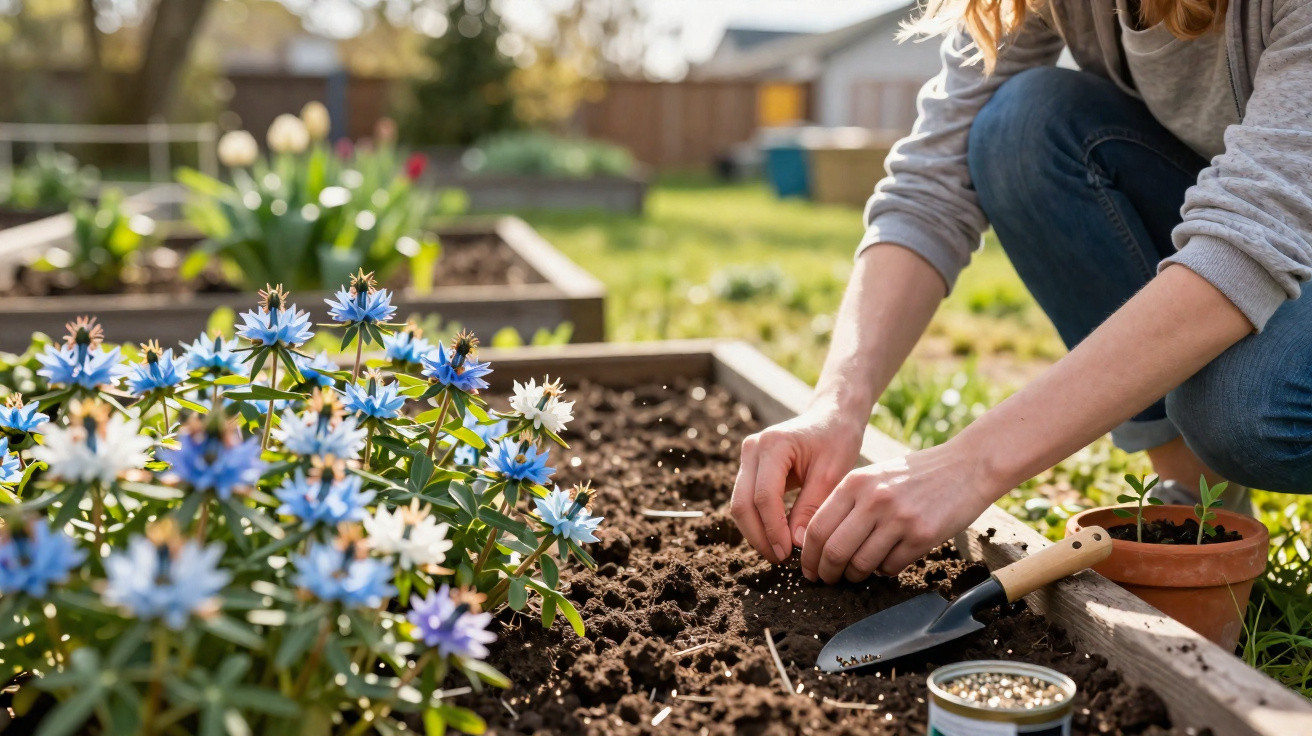
Many amateur gardeners look disheartened at bare beds in March. They are eager for colour, but often lack the time and energy for constant watering, feeding and picking over. This is where an astonishingly undemanding summer flower comes in: it does almost all the work itself and flowers continuously from June until late summer.
Nigella damascena: a summer flower that fills beds almost by itself
The flower in question is love-in-a-mist, botanically Nigella damascena. With very little effort, this delicate, slightly romantic-looking bloom creates a natural, gently wild style in the garden. Its fine, thread-like foliage forms a green veil from which star-shaped flowers shine out in blue, white or soft pink.
Growing to around 40 to 60 centimetres tall, the plants are ideal for perennial borders, cottage gardens, front gardens and larger pots on balconies or patios. Sow in March and you will usually be rewarded with the first flowers from mid-June, often enjoying them until the end of August and, in favourable weather, even into September.
“A simple sowing in March lays the foundation for a whole summer of flowers – without a daily care routine.”
This is precisely the sort of flower beginners appreciate. It establishes quickly, makes very few demands of the soil and forgives minor mistakes. Many gardeners report sowing only a small corner at first, then finding themselves surprised a few weeks later by a soft blue haze of blooms.
Why March is the ideal time
Love-in-a-mist is a tough annual summer flower. As soon as the ground is no longer frozen, it takes advantage of cooler spring temperatures to develop quickly. That is why early to mid-March is regarded as the best period in many areas.
- The soil is waking up: It is no longer ice-cold, so germination gets under way reliably.
- Less competition: Beds are still fairly empty, and weeds have not yet taken over.
- A longer flowering display: Sowing early extends the flowering season considerably.
In milder parts of the country, experienced gardeners can sometimes begin as early as late February, provided that severe frosts are no longer forecast. In more exposed locations prone to late frosts, it is better to wait until late March or even early April. Although the plants cope well with cool conditions, they do not appreciate sudden hard night frosts.
Step by step: sowing love-in-a-mist in March
Sowing love-in-a-mist is one of spring’s easiest gardening jobs. There is no need for seed trays, specialist compost or a greenhouse.
Choosing the right garden position
A sunny spot is best. The plant will tolerate a little partial shade during the day, but more light means more abundant flowering. The soil should be:
- loose and free-draining;
- never persistently waterlogged;
- lean to moderately fertile rather than overfed.
Improve heavy clay soils by working in sand, fine grit or well-rotted compost. For containers, a good-quality potting compost that is not excessively rich is enough.
Preparing the soil takes just a few minutes
Before sowing, a small amount of preparation is enough to improve your chances of success considerably:
- Remove weeds thoroughly from the area.
- Loosen the soil with a rake or hand trowel, breaking up large clods.
- Work in a little compost if the soil is very poor.
It does not need to be perfect: the important thing is a fine, crumbly surface so the small seeds can make contact with the soil.
Sowing and covering the seeds correctly
Next, scatter the seeds directly over the prepared area. You do not need a ruler or seed tape; simply avoid sowing them too densely.
Then:
- cover the seeds with no more than a few millimetres of loose soil or fine growing medium;
- firm the surface gently, using the palm of your hand or a board, for example;
- water with a fine spray, so that the seeds are not washed away.
In suitable conditions, the first seedlings often emerge after only one to two weeks.
Thinning correctly: the key to dense but not overgrown beds
One common mistake is scattering seeds far too generously. It may look promising at first, but later produces thin, drawn-out plants that compete with one another for light and nutrients.
“Once the seedlings have emerged, leave around 20 to 25 centimetres between plants – this produces sturdy stems and freely flowering clumps.”
As soon as the young plants have formed a few true leaves, proceed as follows:
- Carefully pull out overcrowded seedlings, or cut them off close to ground level with scissors.
- Retain only the strongest plants.
- In larger beds, do not be overly precise: a slightly irregular pattern looks more natural.
If you want especially large plants that stand out individually, increase the spacing to 30 centimetres. For a loosely filled “veil of flowers”, 20 centimetres is entirely sufficient.
Keeping love-in-a-mist looking good all summer
Once established, the plant needs very little attention. This is exactly what many gardeners value: the beds look full of life without creating another job every weekend.
Everyday watering and care
On ordinary days, rainfall alone is quite enough. Only during extended dry spells is it worth watering deeply. There is no need for continual light watering. The roots cope surprisingly well when they are allowed to dry out between waterings.
Feeding is generally unnecessary in beds, particularly if a little compost has been incorporated. Too many nutrients are more likely to result in lush, less sturdy plants with fewer flowers.
Removing faded blooms for continuous new buds
To prolong the flowering display, remove spent flower heads regularly. Pinch them off with your fingers or snip them away with small scissors; no more effort is required.
“The more consistently you remove faded blooms, the longer the plant will produce new buds – often until late summer.”
There is another welcome benefit: the bed immediately looks more cared for, even though the plant itself has the charm of a natural, slightly untamed garden.
Ideal for bouquets and self-seeding gardens
The delicate stems of love-in-a-mist work remarkably well in a vase. When freshly cut, they often last for up to ten days, especially in cooler rooms with the water changed regularly.
- For bouquets, cut them in the morning where possible.
- Put the stems straight into water.
- Combine them with other summer flowers such as cosmos, baby’s breath or sweet peas.
By late summer, things become particularly interesting: decorative, balloon-shaped seed pods develop from the flowers. They are also excellent when dried for arrangements and dried bouquets. Leave a few pods on the plant and you will benefit from perhaps this flower’s greatest advantage.
The ripe pods split open, allowing the seeds to fall and remain in the soil. The following spring, new seedlings suddenly appear, often in exactly the spots occupied by the parent plants. Over time, this creates a loose, self-renewing display of flowers.
Clever plant combinations – and what to avoid
Love-in-a-mist shows its strengths best in naturalistic planting schemes. Pair it with hardy perennials and other annuals to create a lively garden area that flowers for a long period.
Popular companions include:
- catmint and sage, for insects and rich colour;
- lavender, for fragrance and structure;
- cosmos and calendula, for an informal, colourful mix;
- ornamental grasses such as fountain grass, for movement in the wind.
Extremely shady, constantly damp corners and very cramped containers without a drainage layer are less suitable. In these conditions, the plant can easily suffer from root rot and is more likely to flop over.
Anyone with pets or young children should be aware that, like many ornamental plants, love-in-a-mist is not a plant for snacking on. Its decorative seed pods invite touching, but they are not intended to be eaten.
For anyone who does not want complicated watering schedules or costly specialist fertilisers, this flower is an ideal introduction to summer gardening. One afternoon in March and a few simple tasks can make the garden look, months later, as though a professional has lent a hand.






Comments
No comments yet. Be the first to comment!
Leave a Comment