
Many households want to cut their energy bills without giving up convenience. The dishwasher has long been an essential appliance in most kitchens, yet it quietly uses electricity every month. A simple household staple from the cupboard can noticeably reduce consumption and costs when used correctly.
Why the dishwasher quietly uses so much electricity
A modern dishwasher uses around 1 kWh for each cycle. In a typical family home, this can soon add up to 200 to 260 kWh a year. At roughly 18 cents per kWh, the dishwasher alone adds around €40 to €50 to the annual bill.
The real energy drain comes from a detail few people consider: heating the water. About 80 per cent of the electricity used is needed simply to make the water hot enough to remove grease and food residue.
“Even a thin layer of limescale on the appliance's heating element can increase electricity consumption by up to ten per cent.”
When limescale and grease build up on the heating element and inside the pipes, the dishwasher takes longer to reach the required temperature. This results in:
- a longer heating period for every wash cycle
- higher electricity use per cycle
- frequently poorer cleaning results
- a greater likelihood of running a second cycle
This is exactly where the cup trick comes in, using something that almost everyone already keeps in the kitchen cupboard.
The cup trick: how a splash of vinegar saves electricity
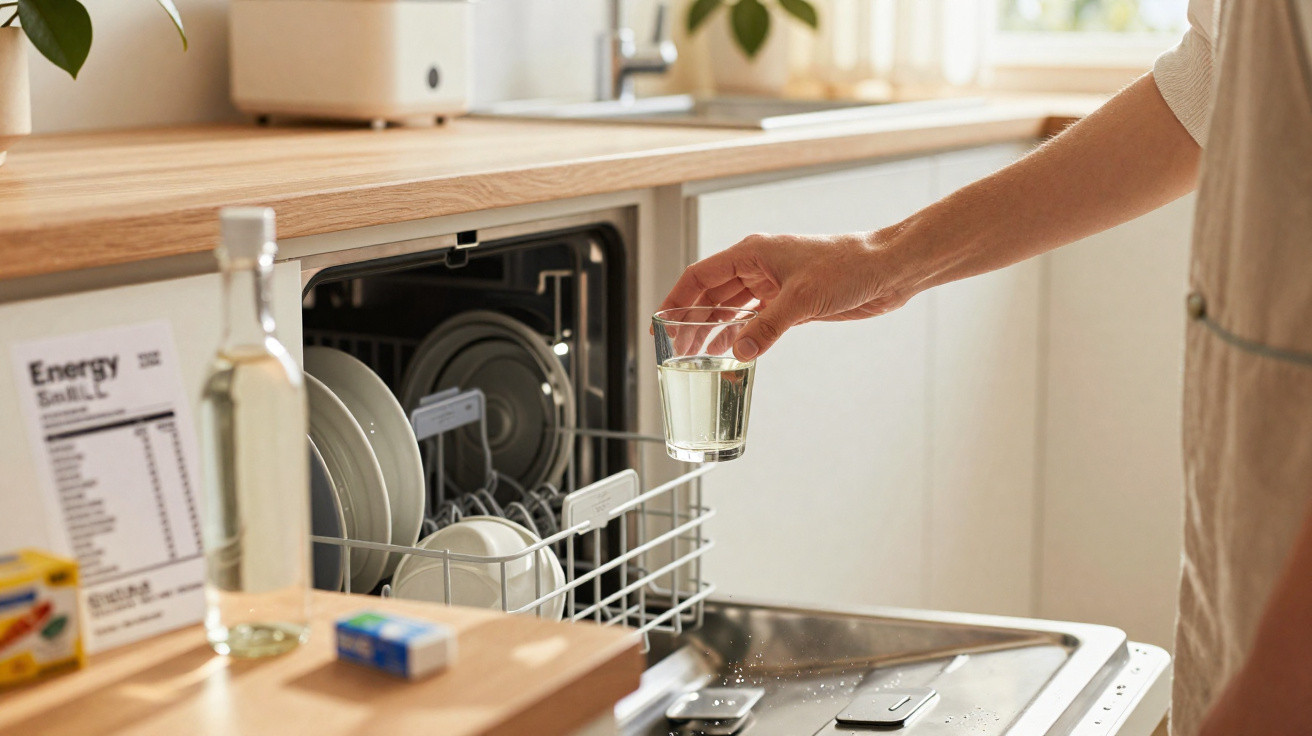
The method sounds almost too straightforward: place a heatproof cup or small bowl filled with plain household vinegar in an empty dishwasher, then run a hot programme. As the cycle runs, vinegar vapour and the wash solution circulate throughout the interior.
“The vinegar removes limescale, grease and deposits – making the appliance's heating element efficient again.”
The results of this cup-based cleaning cycle can be surprisingly clear:
- Deep cleaning for the dishwasher: vinegar, and optionally a little bicarbonate of soda, loosens grease and food residue from the base and pipes.
- Descaling the heating element: the thin limescale layer that acts as insulation is substantially reduced.
- Less electricity used per wash cycle: clean heating elements bring the water up to temperature more quickly.
- Better washing results: plates, glasses and cutlery will usually come out clean after the first cycle.
An example illustrates the difference: if an appliance uses around 260 kWh a year, an additional limescale layer can raise this to approximately 286 kWh. At an average electricity price, that amounts to about €5 extra per year solely because of deposits. Regular descaling helps keep consumption at the lower end of the range.
How to use the dishwasher cup trick correctly
No specialist cleaner or expensive tablets are needed to achieve this effect. Proceed as follows:
- Prepare a heatproof container, such as a cup or small bowl.
- Pour in around 150 to 200 ml of clear vinegar.
- Position the container securely in the upper basket so that it remains stable.
- Load the dishwasher with no dishes – it should be completely empty.
- Select a hot programme, ideally at around 65°C.
If desired, scatter a tablespoon of bicarbonate of soda inside the dishwasher or add a little lemon juice to the vinegar. This boosts the degreasing effect and leaves a fresher smell.
How often a vinegar cycle makes sense
The right frequency depends on the water supply and how the appliance is used. The following offers a general guide:
| Household situation | Water hardness / use | Recommended frequency |
|---|---|---|
| Small households | Soft to moderately hard water; appliance run a few times each week | Every 2–3 months |
| Family household | Normal water hardness; daily use | Around once a month |
| Very hard water | Heavy limescale; dishwasher used frequently | Every 3–4 weeks, with a conventional descaler as well if necessary |
Using the trick regularly not only keeps electricity costs down, but can also extend the dishwasher's service life. A limescale-covered heating element is one of the typical weak points in older appliances.
More ways to save: tricks to use alongside the cup
Cleaning the appliance alone is not enough. The savings become especially worthwhile when several measures are combined. One major factor is Eco mode. Many people avoid this programme because it appears to take forever, but its longer duration is precisely why it uses less energy.
“In the Eco programme, the dishwasher runs for longer but uses considerably less electricity because the water is heated less intensely.”
Depending on the model, this can save roughly 30 to 45 per cent of energy compared with an intensive short programme. Combined with a clean, descaled machine, the effects are noticeable:
- a dirty appliance using an intensive programme: high electricity use per wash cycle
- a cleaned appliance using an Eco programme: considerably fewer kWh per cycle
- with annual consumption of 260 kWh, use can be reduced to around 130 to 180 kWh
Using the same estimate of around 18 cents per kWh, the dishwasher's electricity costs fall from just under €47 to roughly €23 to €32 per year. At times of high energy prices, that difference can be significant for many households.
Other simple habits that save money
Alongside descaling and Eco mode, a few everyday routines can keep electricity bills lower over the long term:
- Only start the dishwasher when it is genuinely full, as half-empty loads use almost as much electricity.
- Remove larger food remnants with a spoon or kitchen paper beforehand instead of rinsing them under running water.
- Avoid prewash programmes unless the dishes are exceptionally dirty.
- Check the temperature of the standard programme: a medium setting is usually enough for normally soiled dishes.
- Clean the filter regularly so the pump does not have to work unnecessarily.
Many appliances can also be set to start later. Households using a cheaper overnight tariff can schedule the dishwasher to run during that lower-cost period.
How vinegar works in the dishwasher – and its limits
Vinegar contains acid that chemically dissolves limescale. Combined with hot water, the solution reaches almost every part of the interior: the heating element, spray arms, pipes and walls. This is why the cup trick is so effective at tackling deposits that would otherwise be difficult to reach.
However, some care is still advisable:
- Do not pour in litres of vinegar – one cup is sufficient.
- Do not use the trick every day, so seals and plastic components are not exposed to ongoing strain.
- Never pour vinegar directly onto delicate rubber parts; always place it in a cup in the basket.
Those living with very hard water will generally still need a conventional descaler in the long run. The vinegar cup remains a useful addition between more thorough cleaning sessions.
What many people overlook: clean technology means less everyday stress
A well-maintained dishwasher does more than reduce the electricity bill. It causes fewer faults, needs repairs less often and reliably produces clean plates and glasses. Not having to keep polishing glasses or rewashing plates saves both energy and time, as well as frustration.
In daily life, this works best with a simple routine: check the dishwasher once a month, rinse the filter, inspect the spray arms briefly and run the vinegar cup cycle. It takes only a few minutes, while the benefits apply to every wash cycle that month.
This shows that it is not the latest high-tech appliance that determines the electricity bill, but how existing appliances are used. A simple cup from the cupboard can become a small ally when it is regularly filled with vinegar and allowed to do its job in the dishwasher.






Comments
No comments yet. Be the first to comment!
Leave a Comment