
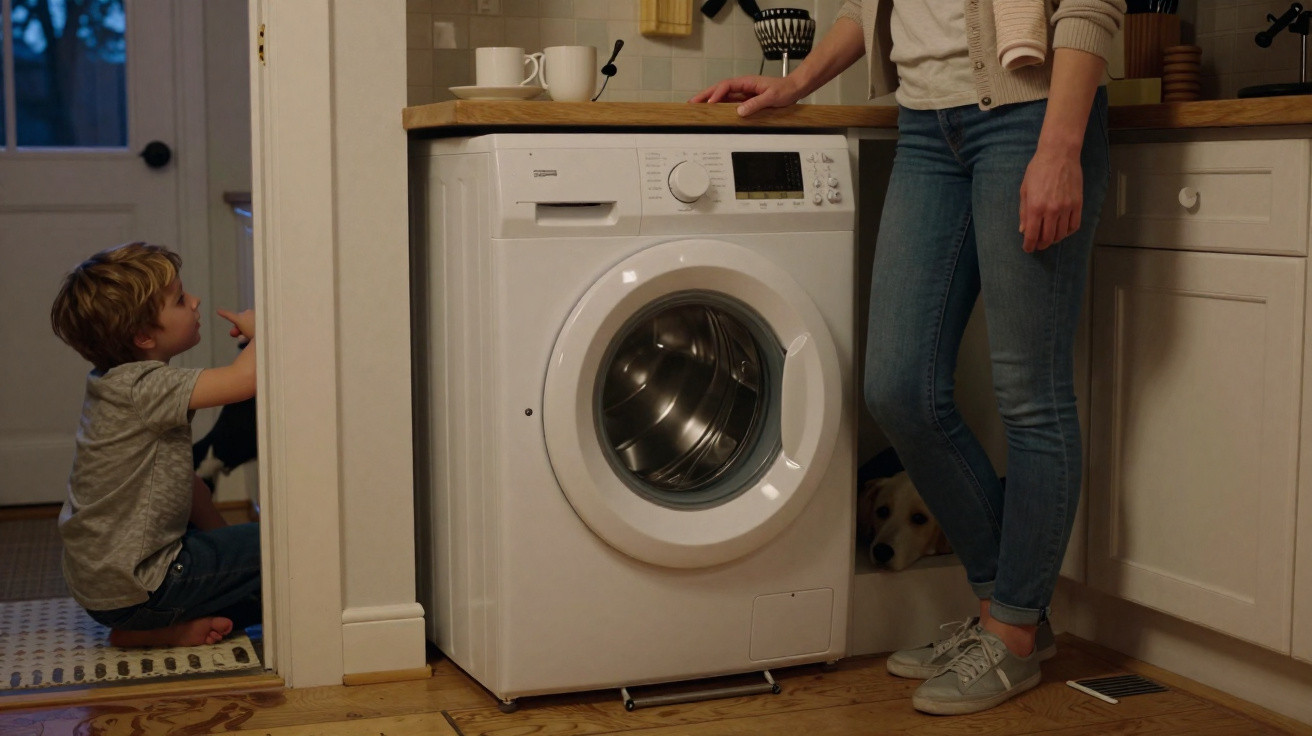
On Tuesday evening, my washing machine appeared determined to make a break for freedom.
That is certainly what it looked like as it juddered over the vinyl floor like an offended suitcase, with spoons rattling in the drawer and the spin cycle building to the roar of helicopter blades. I stood there, tea towel slung over one shoulder, acting as though I knew exactly what to do and as if the neighbours could not hear an entire percussion section through the party wall. The dog disappeared. My son yelled, “Mum, it’s moving!” Like most people, I stopped the programme and blamed the duvet first. I shifted the wet bundle about, hit Start again and watched the same hostile shuffle begin. Clearly, the load was not the only issue. The answer was neither a gadget, replacement flooring nor an engineer’s visit. It was one tiny levelling adjustment, so obvious that I wanted to congratulate the spirit of common sense.
This is how I got the peace and quiet back - and why it has lasted.
The night the washing machine tried to escape
Most of us have experienced the point at which an ordinary household sound becomes complete chaos. My washing machine had always been somewhat energetic: generally it hummed along nicely, then had a fit whenever I washed towels with jeans. This occasion was different. During the spin, the cupboard doors trembled. A mug on the worktop edged forwards as if it wanted a closer look. When I put both hands on top, I could feel a heavy, deep rocking movement, as though the drum were trying to run away.
My first thought was that the load had to be at fault, so I went through the usual routine: spread everything out, add a towel, take a towel away, and start again. Nothing changed apart from the volume. The flooring was not helping either. It is vinyl laid over floorboards, with a little spring in it and all the gentle movement of an ageing house. I imagined the thick concrete floor of a pristine showroom and briefly felt envious.
At that stage, I nearly disappeared down the rabbit hole of buying anti-vibration pads and a new utility-room mat marketed as a solution to everything. Yet, as I kept watching, a clear pattern emerged. The machine was not merely shaking; it was tipping on one corner before hopping forwards. It was a seesaw rather than an earthquake.
The myth of “it’s the floor”
We all enjoy having one neat culprit. The floor is an easy target: blame the questionable joist, the builder or the house’s accumulated history. Often, that is perfectly reasonable. A washing machine contains a weighty steel drum which attempts to spin itself out of the cabinet at full speed. Put it on something with the bounce of a trampoline and there will be trouble.
Still, even a springy floor can support a stable washing machine. What matters is how its weight reaches the ground. Many washers are delivered approximately level but not properly settled on all four feet. Two feet bear almost all the load, while the other two barely touch the surface. That allows rocking to begin, which the spin cycle then amplifies. That is the actual problem. And, honestly, it is not a check many of us think to make regularly.
When someone says, “I levelled it,” they often mean they adjusted the front feet until the top appeared straight. That is a useful beginning, but it is not the whole job. The vital part is removing diagonal movement and then securing the feet so they cannot gradually loosen themselves during repeated spins.
The small detail almost nobody levels correctly
Levelling is about more than making a machine sit level from side to side or front to back. It is also about the corners: the X-shaped relationship that determines whether a square object wobbles. Think of an uneven restaurant table. Place a napkin beneath the wrong corner and your glass still sloshes around; support the correct corner and the table becomes steady. Washing machines are rather like fancy restaurant tables, only with furious motors and very heavy drums.
I realised I needed to test opposite corners. This was not a gentle push on the front of the cabinet, but a firm press on each top corner in turn to identify which pair was moving. With the machine empty and unplugged, I pressed the front-left corner. It was solid. Then I pressed the front-right. It sank slightly before making a clack as a rear foot met the floor. There was the answer: a gap across the diagonal.
The cross-corner check
This is an easy way to investigate. First, empty the washing machine so the drum is not affecting the result. Put a small spirit level, or a levelling app on your phone, along the front edge where it is visible. You are not aiming for flawless precision - only a slight backwards lean with no rocking. Next, press down on every top corner one by one. If one corner moves while the opposite corner does not, that diagonal has one high and one low point.
To correct cross-corner rocking, adjust the feet on that diagonal. Lower the high corner and raise the opposite corner slightly, or in some cases bring both towards the middle. Very small movements can have a dramatic effect. A quarter-turn can transform what happens beneath the cabinet. I found a spanner, prepared to tighten the lock nut, and began with the front-right foot.
The fix: cross-corner levelling and a slight backwards tilt
My washing machine is wedged into a tight alcove, so I pulled it out only far enough to reach the rear and lean it back a little. Rear feet are not usually easy to alter by hand, but changing the front feet can still transfer more weight on to them. The objective was for all four feet to make firm contact, with a gentle backwards lean, much like somebody resting on their heels. That tilt helps the drum sit more securely in its cradle during the spin cycle.
I turned the front-right foot anticlockwise by a quarter-turn, checking the levelling app after every adjustment. Then I pressed each corner again. It had improved, but it was not quite right. I made a small adjustment to the rear-left relationship by shifting the cabinet and altering the opposite front foot. The right-hand rocking had gone, although there was still the faintest movement on the left. One further eighth-turn removed the wobble completely. The fix wasn’t magic; it was a level, three quarter-turns, and locking the nuts.
Then comes the unexciting but essential part: tighten the lock nuts firmly against the machine’s base. Tightening them by hand is insufficient. Over a month of spin cycles, the feet can work loose and leave you back where you started. Hold the nut with a spanner, steady the foot with pliers and bring metal firmly against metal. There should be no gap and no movement.
Locking it in
Once the washer seemed properly planted, I carried out the stomp test. It is hardly elegant: lean your weight on the top, press down and attempt to make the machine protest. Nothing shifted apart from the house’s faint natural bounce. I also slid a thin piece of card around every foot. There were no gaps. If paper can slide beneath one of the feet, that is the troublesome one. Keep adjusting until the paper will no longer go underneath.
Some modern washing machines have a “drum clean” or calibration spin setting. I ran an empty rinse and spin programme, keeping a close eye on the top of the cabinet. The initial climb to full speed is the crucial test. The drum gave itself a shake, found its balance, and then something wonderful happened: the noise settled into a consistent, low hum. I could hear the kettle. I could hear myself breathing.
The moment the room exhaled
After that, I ran a proper wash. Naturally, I chose towels because I enjoy a challenge. The machine built up speed, paused as though considering its options, redistributed the load internally and then committed to the spin. Every small item in the kitchen remained in place. No mug crept towards the edge, and the cupboards did not vibrate. There was only a contained whirr and the soft sound of water pipes humming through the wall.
The improvement was impossible to miss. It felt like removing heavy boots after standing all day. The tension simply left the room. That violent shudder vanished; the machine whispered instead of roared. My son came in, noticed the warm cotton scent drifting from the door seal, and asked whether I had bought another washer. It was the same appliance; it was simply meeting the floor in a different way.
Later, I saw the neighbour on the drive. “Whatever you did, keep doing it,” she laughed, pointing towards the shared wall. Peace had returned. I had not purchased anything or spent a penny. I had merely made four rubber feet share the workload.
If it still shakes, check these quick culprits
Occasionally, the feet are not responsible. Some washing machines are supplied with shipping bolts fitted at the back, and these must be removed. If they remain in place, the drum cannot move freely on its shock absorbers and may try to jump about. Checking the manual or looking for large bolts on the rear panel can prevent a great deal of swearing. Remove them, keep them safely in a bag for moving house, and relax.
The internal shocks and springs can also wear down after years of substantial loads. If your washer still thumps despite being level, and pressing the drum makes it bounce like a trampoline that never settles, the dampers may be worn. That could justify an engineer’s visit, or a Saturday spent following YouTube videos if you feel confident. Bearings can also produce a low metallic growl, and no amount of levelling will cure that sound.
Flooring does become important if it bends like a diving board. Where a washer stands on bouncy floorboards, a dense plywood board spanning the joists can make the surface more rigid. Do not use a thin off-cut; use a substantial, heavy piece that can be screwed into the joists, then place the machine on rubber pads. Pedestals may look attractive, but some behave like stilts. In most cases, keeping the washer lower to the floor is calmer.
The load itself still matters as well. Bedsheets have a habit of gathering into a dense knot, pulling the drum off balance and challenging your patience. Pause the programme, untangle them and try once more. Also remember the calibration spin if your model includes one. Washing machines are good at balancing themselves when given a reasonable chance.
Why the diagonal matters more than the spirit level
We often pursue a perfectly centred bubble because it feels like proof of success. However, a washer is not concerned with mathematical perfection. It needs contact and stability. Spinning creates circular forces. When only two feet are taking the strain, they behave like a hinge and the cabinet rocks around them. A diagonal creates the longest lever, so a tiny flaw turns into a major wobble.
Remove that diagonal rocking and you eliminate the hinge effect. All four feet press down, distributing the force across a wider area of floor and creating more friction. A subtle backwards tilt places the centre of mass further into the body of the machine, helping the drum settle sooner. You are not opposing physics; you are simply giving it a more suitable place to sit.
I have grown rather fond of the cross-corner press as a quick diagnostic. Press, feel, adjust, tighten. Those two minutes can determine whether the evening sounds like a small storm or an ordinary conversation. If your washer walks, this cross-corner leveling trick can stop it dead.
What I wish I’d known sooner
There is a particular satisfaction in fixing a noisy issue with almost no equipment: a small spanner, an inexpensive spirit level and five attentive minutes. The reward is a quieter home and a machine that is not battering itself every time laundry day comes around. I slept better that night, with the house still and the dog returned to his usual place.
Since then, whenever we move house or lay new flooring, I do the corner-press test. It is rather like inspecting the tyres before a long journey: not obsessive, simply sensible. And when life is full of gleaming new gadgets demanding attention, I find it reassuring that turning a foot by a quarter-turn can still feel like a modest triumph. At last, I could hear the kettle singing above the gentle hum of the spin.
We all find different ways to make peace with our appliances. Mine involved a spanner and a laugh at my own impatience. The washing machine did not need replacing or telling off. It needed a more secure handshake with the floor. That, dear reader, is the sort of quiet success that makes a home happier than any scented candle ever could.





Comments
No comments yet. Be the first to comment!
Leave a Comment