
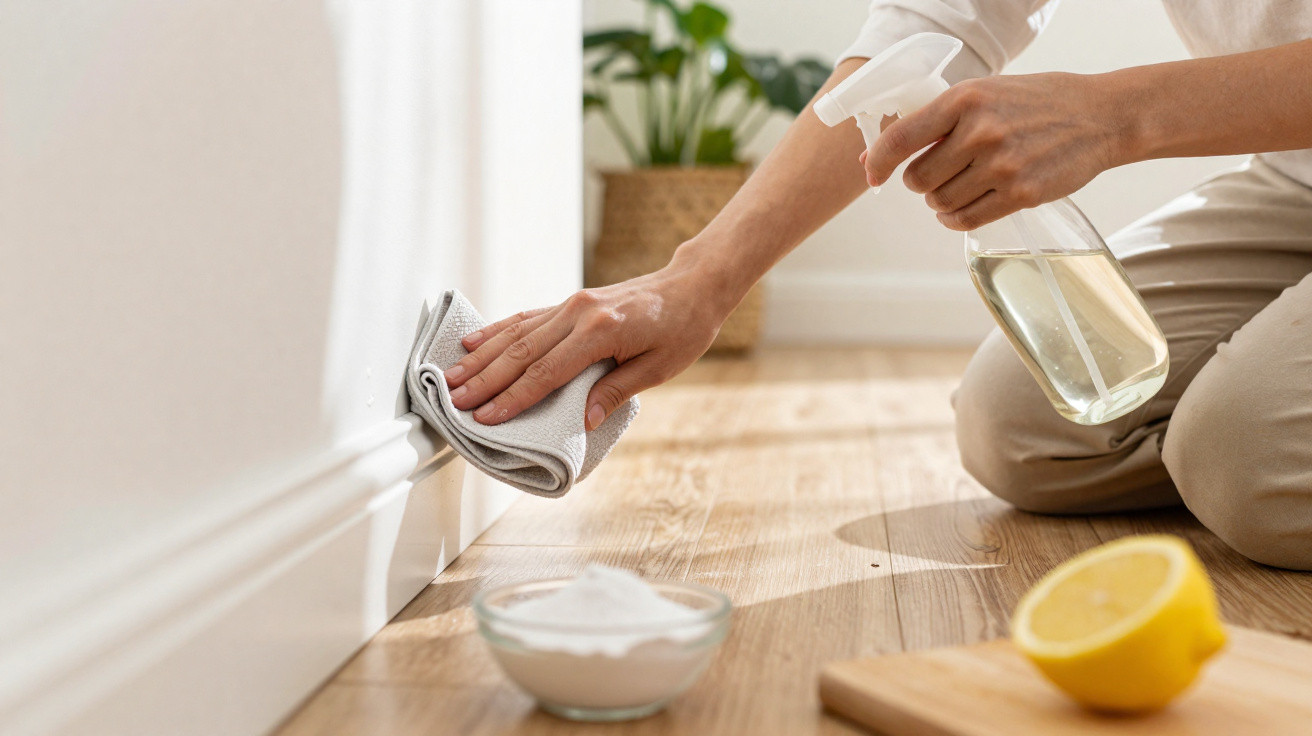
A simple item from the kitchen can completely change the situation.
Many households will know the problem: the floor has just been mopped, everything is shining – then daylight reveals a dusty line running along the skirting boards. If you are unlucky, you have to reach for a cloth or vacuum cleaner every few days. Yet a small adjustment to your cleaning routine is enough to keep the boards noticeably cleaner for longer.
Why skirting boards become dusty so quickly
Skirting boards are usually made from painted wood or plastic. This is precisely what makes the issue so persistent. Friction causes their surfaces to build up an electrical charge – much like a balloon rubbed against a jumper. That static charge attracts dust and hair as if by magic.
Whenever someone walks through the room, the heating is on or a window is opened, tiny particles are stirred into the air. Rather than simply settling on the floor, they stick to this charged surface – the skirting boards.
This grey dust line forms particularly fast in homes with:
- radiators beneath the windows;
- carpeted floors that shed lots of fibres;
- children, pets and plenty of movement.
Many people unknowingly make matters worse by wiping the boards with a dry cloth. Although this removes the dust, it also charges the surface again. The result is that everything looks greyed over after just one day.
The anti-static method: keeping skirting boards cleaner for much longer
The key is not the cleaning itself, but the treatment applied afterwards. When the static charge is reduced and the surface is lightly smoothed, far less dust can cling to it. This is where two useful tricks come in, using items that are already found in many homes:
- tumble dryer sheets from the laundry cupboard;
- a natural kitchen staple diluted in water and used as a spray or wiping solution.
“Anyone who thoroughly cleans skirting boards first and then treats them with an anti-static layer can often leave them alone for three weeks or longer.”
Tumble dryer sheets are intended to prevent static build-up in clothes in the tumble dryer and to keep fibres soft. The same effect works on painted skirting boards: an ultra-thin film settles on the surface and reduces its ability to attract dust.
The natural kitchen remedy: gentle, affordable and effective
Anyone wishing to avoid fragrances and added chemicals from laundry products can use a simple kitchen remedy instead. Lightly acidic, natural household solutions diluted with warm water are typical choices, creating a fine protective layer. This means dust does not adhere as easily and can be removed more readily during the next wipe-down.
According to user reports, these natural solutions can keep skirting boards relatively free of dust for two to four weeks, depending on how heavily a room is used and how much air circulates.
How to mix a simple natural solution
For a gentle, everyday household mixture, you will often only need:
- a bowl of lukewarm water;
- a dash of a natural kitchen ingredient, such as a little vinegar or a mild oil, depending on the surface;
- a soft cloth or a small spray bottle.
If you are unsure, test the mixture first in an inconspicuous spot, such as behind a piece of furniture. This lets you check whether the paint finish tolerates the treatment and whether it leaves any marks.
Step by step: clean and protect skirting boards
1. Vacuum away loose dirt
Before using any product, remove loose dirt. Fit the narrow attachment to your vacuum cleaner and slowly run it along the skirting boards once. Take particular care beneath radiators and in corners, as these areas collect the most dust.
2. Clean with a damp cloth
Next, carry out a standard wet clean:
- Fill a bucket with warm water.
- Add a squirt of washing-up liquid – this breaks down grease and everyday dirt.
- Wipe the boards with a microfibre cloth, including their edges and moulded sections.
If you prefer a stronger scent, you can add a small dash of liquid laundry detergent or fabric conditioner. This is purely a matter of preference; the cleaning result remains the same.
3. Allow the boards to dry
The cleaned surfaces must be fully dry before applying the protective layer. Either leave them to air-dry briefly or wipe them over with a dry cloth. Damp patches would dilute the protective film.
4. Apply the anti-static layer
Now for the actual trick:
- Using a tumble dryer sheet: Hold the sheet along its long edge and run it along the skirting board with gentle pressure – once across the top, once through the middle and once along the bottom. Go over corners a second time if needed.
- Using the kitchen solution: Pour the solution into a spray bottle, or soak a cloth in it and wring it out well. Then wipe a thin layer over the boards. A light touch is enough; the surface should not look wet or glossy.
“Anyone who repeats this treatment every three to four weeks will often find that, instead of a thick dust line, only a fine film develops that can be wiped away in seconds.”
How long do skirting boards really stay clean?
Practical tests in typical homes show that skirting boards which would otherwise start to look dull again after one or two days can often stay clean for up to three weeks with an anti-static treatment. The result depends on several factors:
- How often is the room used?
- Are there radiators directly above the boards?
- Are there pets in the household?
- Is there carpet that sheds fibres?
In busy hallways or children’s bedrooms, the effect will naturally last for less time. Even so, a quick wipe with some leftover solution or a fresh tumble dryer sheet is often enough – without needing to do a full deep clean.
Everyday safety and material advice
Although these tricks are simple, a few points are worth keeping in mind:
- Check the paint finish: With very old or delicate finishes, test first in a hidden area to make sure the surface does not discolour.
- Pets and children: In children’s bedrooms and places where toddlers crawl frequently or pets may chew, it is better to avoid heavily fragranced or strongly chemical products.
- Slip hazard: Wipe up any excess solution from the floor immediately so that nobody slips.
Anyone who is especially sensitive to fragrances or has allergies should choose a neutral kitchen remedy rather than strongly scented tumble dryer sheets. The anti-static effect matters more than the fragrance.
Improve the effect with a few extra tricks
If you are already updating your cleaning routine, a few straightforward measures can support the effect on the skirting boards:
- Vacuum beneath radiators regularly, as a great deal of dust builds up there.
- Beat rugs more often or clean them with a brush attachment, so fewer fibres remain airborne.
- Choose smooth skirting boards where possible: the more moulding and edges they have, the more places there are for dust to settle.
There is also an interesting side effect: people who get dust on their skirting boards under control often notice fewer dust deposits throughout their rooms. The boards act like small dust collectors along the walls – when they no longer do so, the dust has to settle on other surfaces and is removed more easily during normal cleaning.
This turns an annoying chore into a barely noticeable extra step in your usual cleaning routine: a few additional minutes, an everyday product from the kitchen or laundry cupboard, and skirting boards that look presentable not only on cleaning day but weeks later too.





Comments
No comments yet. Be the first to comment!
Leave a Comment