
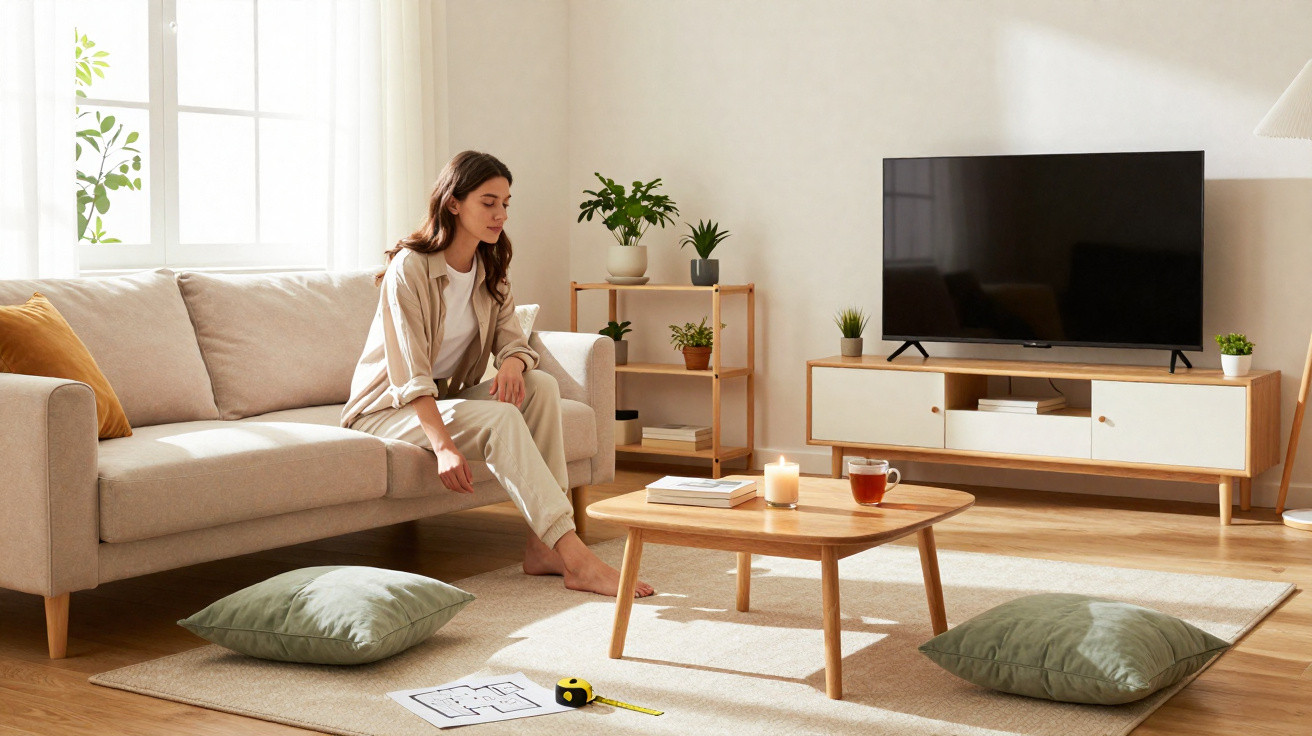
Many of us spend the evening on the sofa instead, phone in hand, eyes darting restlessly around the room while our minds refuse to quieten. Tomorrow’s to-do list, yesterday’s argument, the guilt of not having “properly” relaxed again. Somewhere in the middle sits that vague pressure that life is moving faster than we can keep up.
Some people try meditation apps. Others buy scented candles or a new television. But what if the real source of disruption is far more ordinary? What if the reason we cannot unwind internally lies in the way our sofa, coffee table and shelving are arranged?
That is where things become interesting.
When your living room is constantly shouting at you
When you never truly rest, you eventually start questioning yourself. Too little discipline, too much phone use, too much work: these are the usual suspects. We rarely look at what is literally right in front of us: the room itself. Your eyes continually scan your surroundings, even while you are “just quickly” scrolling. Every tangle of cables, unstable pile of books and chair blocking a walkway acts as a tiny alarm for the brain.
Many living rooms are packed with so much furniture and stuff that there is no clear focal point. Nowhere for your gaze to settle briefly and become calmer. As a result, the space feels frenetic even when nobody is talking. Sit down in a hectic room, and you carry that agitation inside with you.
A reader recently described her usual evening after work. She arrives home, drops her bag on the armchair that is never actually used, then collapses onto the sofa. In front of her is the television; beside it, shelving that is half decoration and half paperwork. Behind her sit the dining table, a home-working corner and a clothes airer. “I feel as though I’m sitting in the middle of an airport concourse,” she said. Rest? Not a chance.
We all know that moment when we try to relax but feel more as though we are standing in a queue. Her key sentence stayed with me: “I don’t even know where to put my eyes.” It is something interior designers hear repeatedly. And that gets to the heart of it: when a room continually fires stimuli at you, your nervous system cannot find an anchor.
Our brains evolved to assess spaces quickly: where are the dangers, the entrances and the escape routes? If you sit with your back to the door, your underlying tension rises. When you are also facing piles, cable clutter and furniture positioned at awkward angles, your mind is unconsciously working overtime. Furniture layout determines whether you feel protected or watched.
People need zones: one for activity, one for socialising and one for retreat. If a living room must accommodate everything at once - working, eating, playing, exercising and streaming - without furniture creating clear “islands”, it produces a permanent state of being “half here, half there”. It feels like inner restlessness, but it has a great deal to do with logic and sightlines.
How to arrange your living room so your mind finally becomes quieter
The first step is radically simple: look around your room as if you were visiting it for the first time. Where does your eye land first as you enter? Where would you instinctively sit if you did not know the person who lived there? Creating this little bit of distance from your own living room often makes the problems immediately obvious.
Then comes the most important point: where the sofa sits. Ideally, it should be positioned so you can see both the door and a calm focal point. That might be a window, a picture or simple shelving. It should not be an open kitchen with stacks of washing-up, or a work laptop on the dining table. Think of the sofa as the “main stage”, with everything else organised around it.
Many people automatically push the sofa against the longest wall and place the television opposite. Job done. But honestly, hardly anyone seriously asks how that arrangement feels to their nervous system. One man I visited for this research had placed his sofa in the middle of the room, directly in the route through it. Everyone heading to the kitchen passed right in front of him. No wonder he never felt properly “at rest” in the evening.
Together, we moved the sofa so its back touched the wall, while he could see the entrance and the window at the same time. We shifted the television slightly to one side and placed a calming picture directly in his line of sight. “It’s strange,” he said after a few days, “I suddenly lie down for longer without interruption.” No new sofa. Just a new relationship with the room.
Here is a useful decision-making trick: imagine drawing your living room from a bird’s-eye view. Where do people move through it? Where do routes cross, and where do they become congested? Walkways should stay open and obvious, without you having to weave around chairs. Seating feels more relaxing when it forms a “nest” - turned slightly towards one another rather than all rigidly lined up against the walls.
Sightlines matter just as much. Ask yourself: what do I see when I am sitting on the sofa doing nothing? A bundle of cables? The open door to a chaotic hallway? Or a calmer surface - perhaps a plant, a picture or a simple sideboard? The calmer the place your eyes naturally drift towards, the easier it is for your nervous system. Many people report reaching that “finally, the working day is over” feeling much more quickly after a straightforward furniture rearrangement.
Small adjustments that make your living room quieter
One practical measure you can begin immediately is to create a genuine calm zone in the living room. Not in theory, but in a way that feels physically tangible. This area needs a central seat, such as a sofa or armchair, a quiet backdrop and a clear boundary at the front, perhaps a plain coffee table or bench. The aim is to feel held by the space rather than exposed within it.
If your room allows it, try pulling the sofa slightly away from the wall rather than pressing it completely against it. A narrow console table or shelf behind the sofa can work like a protective barrier. Lighting also plays a part: choose a warm, low-level light source close to you, rather than a glaring ceiling light directly overhead. This creates an area clearly separated from work and dining zones.
A common mistake is wanting to “use” every available wall immediately. Full shelving, large television units and lots of ornaments quickly make a room feel more like a catalogue than a place to breathe. Many readers then describe a faintly rushed feeling without being able to name its cause. The reality is usually simple: there are too many visual tasks for the mind to process.
Try deliberately keeping one wall calmer, especially one visible from the sofa. A smooth surface, perhaps with one large and relatively simple picture, works like a pause button for the eyes. And: reduce mixed-use zones. If your living room is also an office, playroom, gym and drying area, each function needs a defined corner instead of being scattered across the space. Small baskets, boxes or a closed cupboard can make a remarkable difference.
“A living room that constantly signals ‘Do this as well, sort that out too’ is not a living room; it is an open browser window with 20 tabs,” says an interior designer I spoke to for this article. “The furniture arrangement is rather like the layout of that browser window.”
To make this more concrete, use this quick check, which takes hardly any time:
- Is your main seat positioned with its back exposed to the room? If possible, turn it towards a wall.
- Can you see the door from there? If not, consider a different position.
- Is there a clear, calm focal point within view? If not, create one - or clear an overcrowded area.
- Do main routes cut straight through your calm zone? Move furniture so people walk around it instead.
- Is work visible in the living room? Put it in closed furniture or baskets so you can make it “disappear” in the evening.
When your living room works with you rather than against you
Sometimes one small shift in a room can make the entire evening feel different. Suddenly, the sofa becomes somewhere you genuinely arrive, rather than a waiting room between work and sleep. A living room that does not constantly remind you of unpaid bills, untidy piles or people passing through makes room for different inner images: a book, a conversation, an empty gaze out of the window that does not feel like wasted time.
You may only notice after a few days that you are making fewer trips back and forth between the sofa, kitchen and desk. That you stay in one position longer, your body grows heavier and your thoughts slow down. Rooms are quiet participants in everyday life - and they speak even when we do not consciously hear them. Some readers say they start looking forward to the evening again after rearranging their space. Others find themselves putting their phones down more often without intending to.
This is not about creating the perfect Instagram living room. It is more about identifying the personal stress triggers hidden among furniture, corners and sightlines. Comfort is not only a soft sofa; it is also a room that does not continually demand action from you. Perhaps it is worth sitting the other way round on the sofa this evening, seeing the room afresh and noticing where your body quietly says: “I could stay here.”
| Key point | Detail | Benefit for the reader |
|---|---|---|
| Seating position and direction of view | Position the sofa so the door and a calm focal point are visible, ideally with its back against a wall | A greater subjective sense of safety and less underlying tension |
| Clearly defined zones | Separate the calm area clearly from work, dining and play zones, and direct routes around the calm zone | Switching off more quickly because the room does not send “multitasking signals” |
| Visual relief | Keep at least one wall surface calm, with fewer open shelves, cables and piles in the direct view from the sofa | Less sensory overload, allowing eyes and mind to enter a restful mode more quickly |
FAQ:
How can I tell whether my living room is stressing me? Ask yourself how you feel as soon as you sit down: do thoughts about work, tidying or things you “still need to do” immediately appear? Does your gaze roam restlessly around the room? These are typical signs that your furniture and belongings are activating rather than calming your nervous system.
Do I need to buy new furniture? In most cases, no. Simply repositioning existing pieces, clearing walkways and reducing what is on display is often enough. New furniture can be a bonus, but the fundamental effect comes from arrangement, not shopping.
What should I do if my living room is also my home office? Your work corner needs a clear boundary: a small rug, a room divider, shelving used as a partition or at least a box where your laptop and papers disappear in the evening. The goal is to ensure that, from the sofa, you are not looking directly at open work.
How should I approach a very small living room? In small spaces, lightness pays off: choose fewer but functional items, preferably furniture on legs rather than bulky blocks. Use walls vertically, but do not overload them. Pay particular attention to clear routes and ensure your main seat is not in a walkway.
Is there a quick way to create more calm? Yes: take 20 minutes to remove anything from your view from the sofa that suggests work, chaos or technology. Then, if possible, move your sofa so you can see the door and one calm element. Try this layout for a few evenings and notice whether your body finds it easier to settle.




Comments
No comments yet. Be the first to comment!
Leave a Comment