
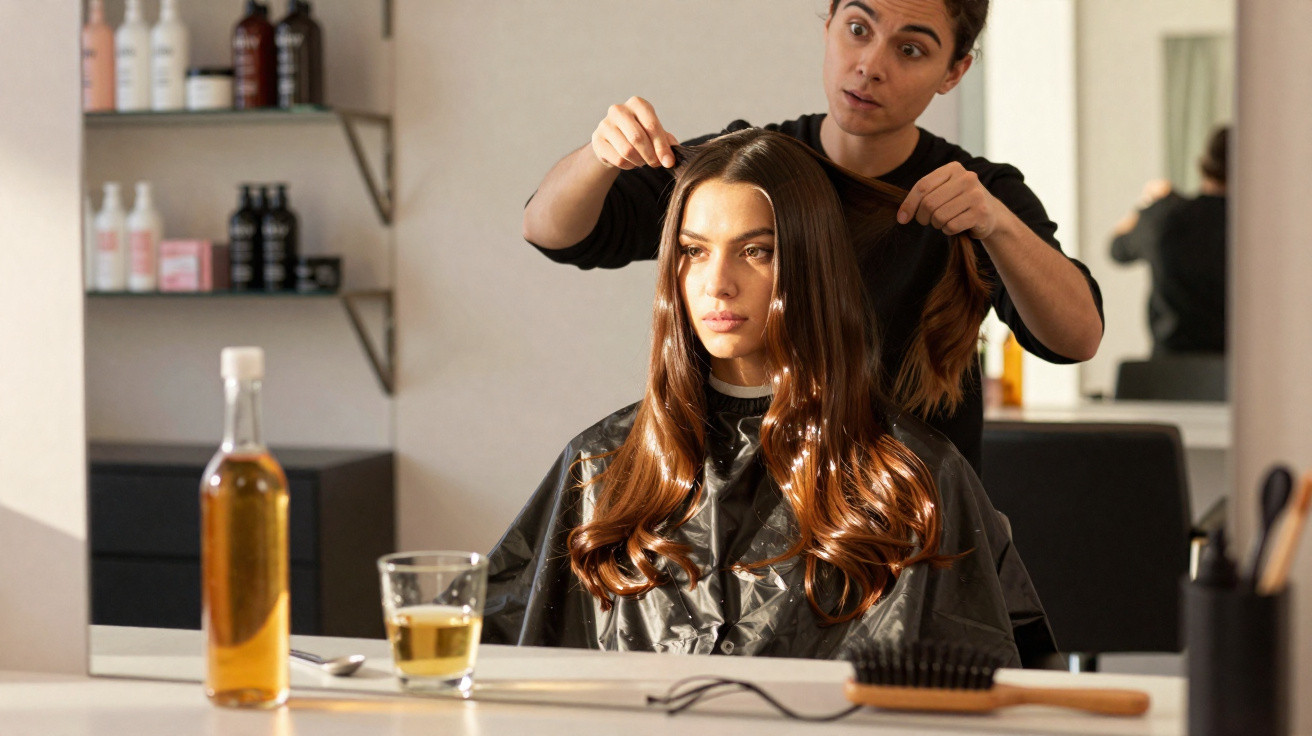
A simple kitchen staple, however, leaves the professional completely puzzled.
Rather than an expensive luxury product, the secret behind mirror-smooth, glossy hair is an age-old trick that many people will remember from their grandmother – and it is surprisingly effective. No conditioner, no high-end mask and no complicated 10-step routine required.
When the hairdresser asks about the luxury brand
The moment your head rests in the salon basin, you may already be expecting the familiar speech: dry ends, damaged lengths and a need for more care. This time, the reverse happens. The hairdresser runs their fingers through the hair, pauses halfway through – and looks baffled. The texture feels sleek, tangles come out effortlessly, and light bounces off the lengths as though they have just received a professional salon gloss treatment.
Their first assumption is an expensive professional brand, a specialist treatment or a keratin treatment. The reality is far less glamorous – and that is precisely what makes it so interesting: no conditioner, no mask, just shampoo and a homemade finishing rinse made with something normally kept in the kitchen cupboard.
“The key difference is not the product’s price, but how well it suits the biology of the hair.”
Many people assume that well-cared-for, shiny hair is only achievable with costly products. Yet hair is not a luxury handbag; it is a biological material with clear requirements: gentle cleansing, a balanced pH level and as few heavy residues as possible.
Why conventional conditioners can weigh down your lengths
It is a familiar post-wash feeling: hair is soft and smells lovely, but within a few hours it already seems heavy, flat or dull. Many high-street conditioners and masks rely on silicones and other film-forming ingredients. These coat every individual hair like a covering.
At first, the result seems excellent: the surface feels smooth and a brush glides through more easily. Over time, though, an invisible coating can form, often called “build-up”. This layer accumulates again and again, makes the hair feel more sluggish and prevents genuine conditioning ingredients or moisture from reaching the hair fibre.
- Hair feels heavy and drops flat more quickly.
- The lengths feel dull despite being “conditioned”.
- Shampoo is used more often because the roots become greasy faster.
- The ends dry out because they receive hardly any nourishment beneath the coating.
This creates a cycle: more products, more frequent washing and increasingly unruly hair. This is exactly where the grandmother’s trick comes in, with a radically simple approach: dissolve residue and smooth the surface without weighing the hair down.
Apple cider vinegar: the old kitchen classic replacing modern hair care
The “star” of this method is usually found alongside oil, mustard and spices: apple cider vinegar. It is an unassuming product that was regarded as a household remedy for decades and is now being rediscovered by many as an inexpensive, minimalist alternative for hair care.
Apple cider vinegar is produced by fermenting apples. This process creates, among other things, acids, minerals and trace elements that can have a surprisingly balancing effect on hair and the scalp. Unlike harsh clarifying shampoos, apple cider vinegar cleanses gently without drying out the lengths.
“Apple cider vinegar works like a gentle reset for hair and scalp – back to the starting point, without a silicone coating.”
Rather than being “filled” or “sealed”, the hair is freed from unnecessary residue. Its natural structure can then emerge – and, when treated correctly, this can look far shinier than many people expect.
The science behind the shine: limescale and pH level
Hard water: the hidden enemy of shine
In many areas, hard, limescale-rich water comes from the tap. When you wash your hair, tiny limescale particles settle on it. The result is a rougher surface, dull-feeling lengths and hair that is harder to style. Even the best shampoo can scarcely counteract this greyish film.
The acid in apple cider vinegar acts here like a mild descaler. It dissolves the deposits that have gradually built up on the hair’s surface. This clears the way for genuine shine, because light can only reflect from a surface that is as smooth and sealed as possible.
Why the correct pH level makes such a difference
Healthy hair is slightly acidic. Many shampoos and tap water temporarily shift this level towards the alkaline range. When that happens, the cuticle layers on the hair’s surface open, the structure becomes rough, strands catch more easily and hair breaks faster.
A mildly acidic apple cider vinegar rinse restores the pH level to balance. The cuticle lies flatter and the hair surface becomes smoother. It therefore reflects light more effectively – which is what appears as shine. The effect resembles a professional gloss treatment, but with substantially less chemistry and expense.
The easy routine: the kitchen “1-to-4” recipe
Getting the dilution right is crucial. Applied neat, apple cider vinegar can be too strong and may irritate the scalp. When diluted, however, it becomes a mild and highly effective rinse.
This ratio has proved successful:
- 1 part apple cider vinegar, ideally unfiltered and organic
- 4 parts cool tap water or still water
Use it as follows, step by step:
- Shampoo your hair as usual and rinse it thoroughly.
- Slowly pour the vinegar-and-water mixture over the scalp and lengths.
- Gently massage it in with your fingertips, especially around the roots.
- Leave it on for around two minutes.
- Finish by rinsing thoroughly with cool or cold water.
The final cold rinse provides an additional benefit: the hair surface contracts further, strands feel smoother and look shinier. The characteristic vinegar smell disappears completely as the hair dries.
“Used once a week, the rinse is enough for many people to almost completely stop using conventional conditioners.”
Better for your wallet and the environment: fewer bottles, more impact
Anyone who reaches for conditioner or a mask every other hair wash can quickly empty several plastic bottles in a year. One person uses an estimated five to six bottles annually just for “post-shampoo care”.
Apple cider vinegar is generally sold in glass bottles, sometimes even in returnable or packaging-free options. Since it is heavily diluted before use, one bottle lasts remarkably well. It also removes the need for extra specialist products, which are often considerably more expensive than straightforward vinegar from the supermarket or health-food shop.
For many people, this brings a double benefit:
- Less plastic waste in the bathroom
- Significantly lower annual hair-care costs
- More room on the bathroom shelf because several products become unnecessary
Who is an apple cider vinegar rinse suitable for – and what are its limits?
Apple cider vinegar rinses are particularly well suited to people with:
- fine hair that becomes weighed down quickly
- dull lengths caused by hard water
- greasy roots and dry ends
- scalp concerns such as mild dandruff or itching
Anyone with a very sensitive or irritated scalp should dilute the mixture further – for example, 1 part vinegar to 6 parts water – and test it on a small area first. Those with heavily bleached or extremely porous hair should start cautiously, perhaps every two weeks, to observe how the lengths respond.
Practical everyday tips and useful combinations
A few straightforward adjustments can help make the trick enjoyable in the long term. A softer towel, less rubbing and more gentle squeezing, together with heat styling at a moderate temperature, all enhance the effect of a smoother hair surface. A light, silicone-free oil applied to the ends can complement the routine, especially for longer hair.
If you prefer, pour the vinegar rinse into a small bottle with a pouring spout or an empty spray bottle. This allows the mixture to be applied precisely to the lengths or solely to the scalp. For travelling, a small concentrate that can be mixed with water at your destination is a useful option. The effect is particularly noticeable where water quality varies greatly, such as in hotels.
It is also interesting how quickly perceptions can shift: many people who use this method regularly report that, after a few weeks, they “need” far fewer products. Their hair feels lighter, becomes greasy more slowly, and even their hairdresser curiously asks what has changed in their routine. Sometimes all it takes is a look in the kitchen cupboard rather than reaching for the next expensive salon treatment.





Comments
No comments yet. Be the first to comment!
Leave a Comment