
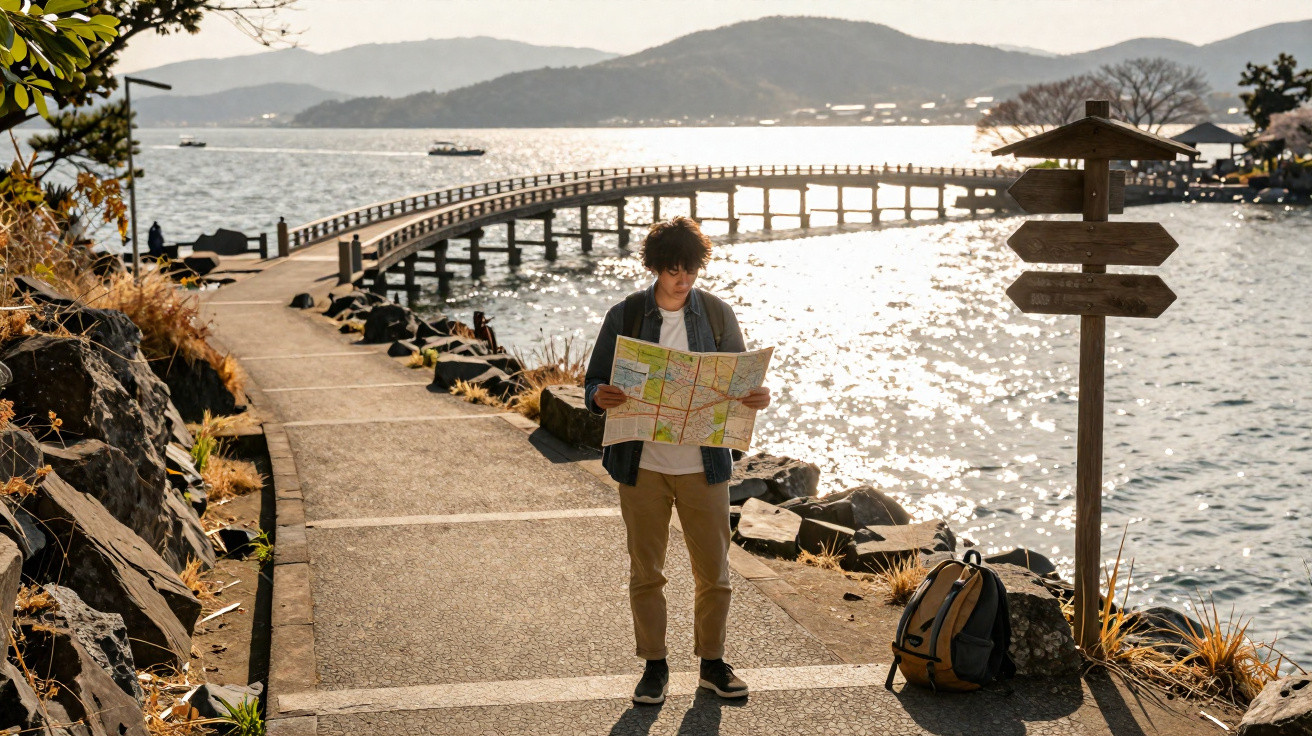
Isogaba maware (急がば回れ) is a Japanese proverb that advises caution over shortcuts when time is short. The phrase can be understood as “if you are in a hurry, take the longer way”: rather than choosing the option that appears quickest, it is wiser to follow a safe, dependable route. The expression arose from a real situation involving travellers, boats and Lake Biwa, in what is now Shiga Prefecture.
What does “Isogaba maware” mean in practice?
The proverb’s message is that the shortest route does not always result in the earliest arrival. If a shortcut brings risks, unexpected problems or a greater chance of mistakes, the longer route may ultimately save time. Isogaba maware expresses this principle as advice: the more urgent the situation, the more important it is to select a secure and reliable method.
- Do not sacrifice safety for a few minutes’ advantage.
- Avoid shortcuts that have a high likelihood of going wrong.
- Choose a predictable process when an error would cost even more time.
- Recognise that haste and speed do not necessarily mean efficiency.
How did a crossing of Lake Biwa give rise to the proverb?
The story is linked to an old route used by people travelling towards Kyoto. From Yabase, near the present-day city of Kusatsu, travellers could cross part of Lake Biwa by boat and shorten the journey considerably. However, there was also a longer land route through the Seta area and over the bridge now known as Seta no Karahashi.
For anyone running late, the boat seemed the obvious choice, yet the crossing could be disrupted by strong winds and hazardous conditions on the lake. Going around the water and using the bridge meant travelling further, but it provided a safer, more predictable journey. This apparent contradiction contained the lesson: the detour could bring a traveller to their destination sooner than the risky shortcut.
What is the connection between Seta no Karahashi and Isogaba maware?
Seta no Karahashi, historically also called Seta no Nagahashi or simply Seta Bridge, stood on the recommended overland route for travellers. The Shiga Prefectural Government itself connects the proverb with an old poem contrasting the fast Yabase boat with the longer route over the bridge, presenting the latter as the safer option and, ultimately, the faster one.
- Yabase represented the shortcut across the lake.
- Crossing by boat reduced the distance travelled.
- Strong winds made the journey less predictable.
- Seta no Karahashi formed part of the longer land route.
- The safety of the detour inspired the idea of “taking the longer way when you are in a hurry”.
A travel tip became a lesson for everyday decisions
Over time, Isogaba maware came to mean more than boats and roads. The same reasoning applies to work, study or any situation where trying to save a few minutes increases the chance of having to start again from the beginning. Checking a document before sending it, verifying a measurement before cutting material, or completing every stage of a procedure are modern examples of the same idea.
What is notable is that the proverb does not criticise speed itself. Instead, it challenges attempts to make a task faster by removing the very steps that make its result dependable. The traveller on Lake Biwa wanted to arrive quickly just like anyone else; the difference was recognising that the route which appeared slower could involve fewer obstacles along the way.
Why does this proverb still make sense centuries later?
The paradox remains familiar because shortcuts are still tempting when there is time pressure. In traffic, on a building site, at work or when making a financial decision, the shorter option may carry a greater risk of error, turning minutes saved into hours of rework. The old story of Lake Biwa gives this problem a tangible image: there was a fast boat, but speed without predictability did not guarantee arriving first.
For that reason, “if you are in a hurry, take the longer route” is not praise for slowness. It defends the path most likely to reach its destination without interruption. Seta no Karahashi and the old Yabase crossing turned a practical decision for Japanese travellers into an idea that has endured for centuries: when a shortcut increases the risk of failure too greatly, going the long way may be the fastest way to arrive.






Comments
No comments yet. Be the first to comment!
Leave a Comment