
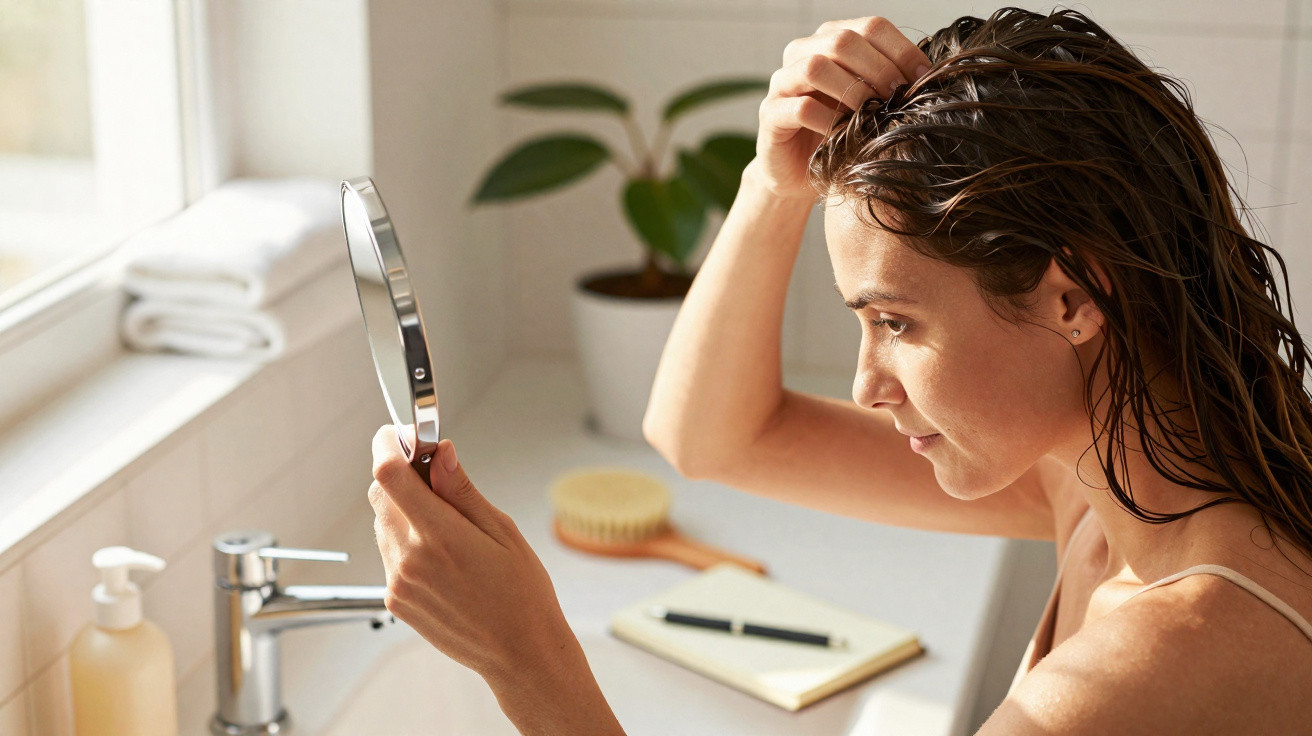
The woman standing before the mirror pauses, holding a bottle of shampoo.
It is Wednesday evening. Her roots are limp, while her ends feel dry. Instagram says “wash less,” her mum says “wash every day,” and her stylist says “only twice a week.” She exhales, looks despairingly at her reflection and searches online: “How often should I wash my hair, really?”
The results are chaotic: once weekly, every other day, daily if you live in a city, never with sulfates, or only with conditioner. Bewildered, she keeps scrolling, nearly ready to abandon the search and put her hair in another messy bun. Between advertising claims and TikTok tips, the actual science seems to disappear.
Then she finds a dermatologist explaining calmly that the answer is neither once weekly nor every other day, but something much more individual. Suddenly, the whole question looks different.
So… how often should we really wash our hair?
Few of us arrive at a washing routine through reasoned decision-making. We pick it up from a parent, a flatmate or a random YouTuber with flawless curls under studio lights. Then we carry on until our scalp starts itching, the lengths begin breaking, or a blow-dry lasts only six hours rather than three days.
That is often the point at which people visit a dermatologist with one familiar question: “Am I washing too much… or not enough?” According to dermatologists, the answer lies at the meeting point of your scalp and your lifestyle. It is not a tidy figure printed on a product bottle, nor a universal timetable.
This is exactly why “once a week” and “every other day” make appealing headlines but rarely work in actual bathrooms.
A New York dermatologist we spoke to notices the same trend every Monday: office workers with greasy roots and flaky scalps who shampoo twice a week “because TikTok said so”. There are committed gym-goers who wash after every session, then wonder why their hair has the texture of straw. There are also new mums who shift from daily washes to managing one wash every five days at most, only to worry when their hair begins shedding.
There is a less discussed group, too: people who wash only every 7–10 days. For some, that is perfectly manageable. For others, it leads to blocked follicles, seborrhoeic dermatitis and a sour “I wore a beanie for ten hours” odour that dry shampoo cannot genuinely conceal. The identical “rule” can affect a 16-year-old boy going through puberty very differently from a 48-year-old woman in perimenopause.
Dermatologists see these accounts across age groups, hormonal changes, cities and seasons. The same error keeps appearing: people adopt someone else’s timetable rather than responding to signs from their own scalp. Science suggests that your sebaceous glands, rather than your social media feed, ought to determine the frequency.
In practical terms, the scalp is skin from which hair grows. Like the skin on your face, it produces sebum for protection. Fine, thin strands become coated in that sebum quickly and therefore appear greasy sooner. With thick, curly hair, oil needs longer to move down the hair shaft, leaving the ends drier.
For that reason, many dermatologists use a straightforward guide. Oily or fine hair? Usually daily or every 2 days. Normal or slightly dry hair? Roughly 2–3 times weekly. Very curly, coily, or textured hair? Commonly once a week, occasionally every 10 days, with greater emphasis on caring for the scalp than scrubbing every length. They then tailor this according to perspiration, pollution and hormones.
Why reject the firm rule of once weekly or every other day? Those figures can easily turn into inflexible dogma. Your scalp does not operate according to a diary: it exists in real life, with heatwaves, stressful deadlines and three spin classes across four days.
The dermatologist’s rule: wash your scalp, not a schedule
This is the approach dermatologists regularly share with patients. Rather than asking, “Is it Wednesday, is it hair wash day?”, ask yourself, “What does my scalp look and feel like?” Before getting into the shower, part your hair under good light and inspect the roots. Are they glossy with oil? Are there tacky areas? Can you see powdery flakes gathered around the follicles?
Next, use touch. Run your fingertips over your scalp. Does it become slick within 24 hours of washing, or only after 72 hours? Is it itchy? When your scalp is oily, itchy or faintly sour-smelling, it is time to wash. If it feels comfortable, you can wait, even if your calendar disagrees. This ten-second assessment is more useful than any “every other day” instruction.
Dermatologists may also recommend a reset period. If you have not been washing often enough, raise the frequency slowly. If you have been washing too often, extend the interval in stages of 12–24 hours. The aim is to find a routine that leaves the scalp clean and comfortable while allowing the hair to feel like hair rather than straw.
There is an understated shame attached to washing either “too much” or “not enough”. Some people apologise to dermatologists for washing daily, saying they otherwise feel unclean. Others almost boast about lasting eight days on dry shampoo, treating it as a marker of cool-girl minimalism. In reality, the answer sits between those extremes and is highly personal.
For an oily scalp, a job that makes you sweat, or life in a humid city, washing every day with a mild shampoo can be entirely appropriate. Hair is not damaged by water itself, but by harsh surfactants combined with rough towel-drying and hot styling. Equally, once you delay washing until flakes, redness and an unpleasant odour appear, a “low-wash lifestyle” is no longer care; it becomes neglect.
Most of us know the experience of arriving for drinks, seeing our reflection and worrying that everyone can spot our flat, mildly greasy roots. It is seldom as noticeable as it feels, but that small social anxiety drives the ongoing argument. Dermatologists frequently provide as much emotional reassurance as clinical guidance.
“I tell my patients: your scalp doesn’t read beauty trends,” laughs Dr. Ana Campos, a board-certified dermatologist. “If you’re active, have an oily skin type, or live somewhere polluted, washing daily with the right formula is better than letting sweat, dirt, and product build up for days. Clean doesn’t mean stripped. It means balanced.”
To make the advice more practical, many specialists give patients a simple checklist for the bathroom mirror:
- Roots appear shiny, weighed down or divided into strands
- Your scalp has an unpleasant smell, even after dry shampoo
- Itchiness, tightness or a burning feeling
- Noticeable flakes at the hairline or along the parting
- Your scalp feels comfortable for only 24 hours after washing
When two or more apply, wash your hair. If none apply, it is fine to leave it-even when a magazine insists that you should “wash every other day.” Let us be honest: nobody follows that precisely, every day of the year.
Living with your real hair, not the internet’s version
The most candid advice a dermatologist can offer is that your ideal washing frequency will shift: with the seasons, your hormones and your stress levels. The routine that worked perfectly at 27 may no longer suit you at 37 after pregnancy, moving to a polluted city or changing to remote work with fewer commutes.
That is biology, not failure. If your roots once became greasy within 24 hours but now take three days, enjoy the extra time. If the opposite occurs and your scalp abruptly becomes an oil factory, consider changes in diet, medication or hormones before adapting your routine. Your hair story can have different chapters.
Once you accept that, the pressure eases. Rather than battling your scalp, you begin to pay attention to it. You become less attached to arbitrary numbers and more guided by comfort, health and how your hair genuinely feels when you wake on a Tuesday morning.
| Key point | Detail | Why it matters to the reader |
|---|---|---|
| Forget the “once a week” rule | Needs differ according to the scalp, hair type and lifestyle | Removes the pressure of doing it “right or wrong” |
| Watch the scalp, not the calendar | Look, touch and smell: oiliness, odour, itching and flakes | Makes it possible to adjust frequency from day to day |
| Aim for a clean, comfortable balance | Cleanse enough to prevent build-up without causing dryness | Helps maintain healthy hair and scalp in the long term |
FAQ:
- Is washing my hair every day bad? Not necessarily. If you have an oily scalp, live in a hot or polluted area, or exercise frequently, daily washing with a mild, sulfate-free or low-sulfate shampoo can be completely fine. The key is gentle formulas and gentle drying.
- Can washing only once a week damage my scalp? For some people, once a week works. For others, oil, sweat, and product build-up can trigger dandruff, itching, and irritation. If you notice smell, flakes, or discomfort before day 7, your scalp probably wants more frequent washing.
- Does not washing often make hair grow faster? No. Hair growth comes from the follicle inside the scalp. Letting oil and debris pile up can actually clog follicles and worsen issues, rather than “protecting” them. A clean, balanced scalp is a better environment for growth.
- How often should I wash curly or coily hair? Many dermatologists suggest about once a week, sometimes every 7–10 days, focusing on the scalp and using hydrating products. Some people alternate a full shampoo with a gentle co-wash, depending on how their scalp feels.
- Can I rely on dry shampoo instead of washing? Dry shampoo is useful for the occasional extra day, to absorb oil at the roots. It doesn’t actually clean the scalp. Used constantly in place of washing, it can contribute to build-up, itching, and dull hair.






Comments
No comments yet. Be the first to comment!
Leave a Comment