
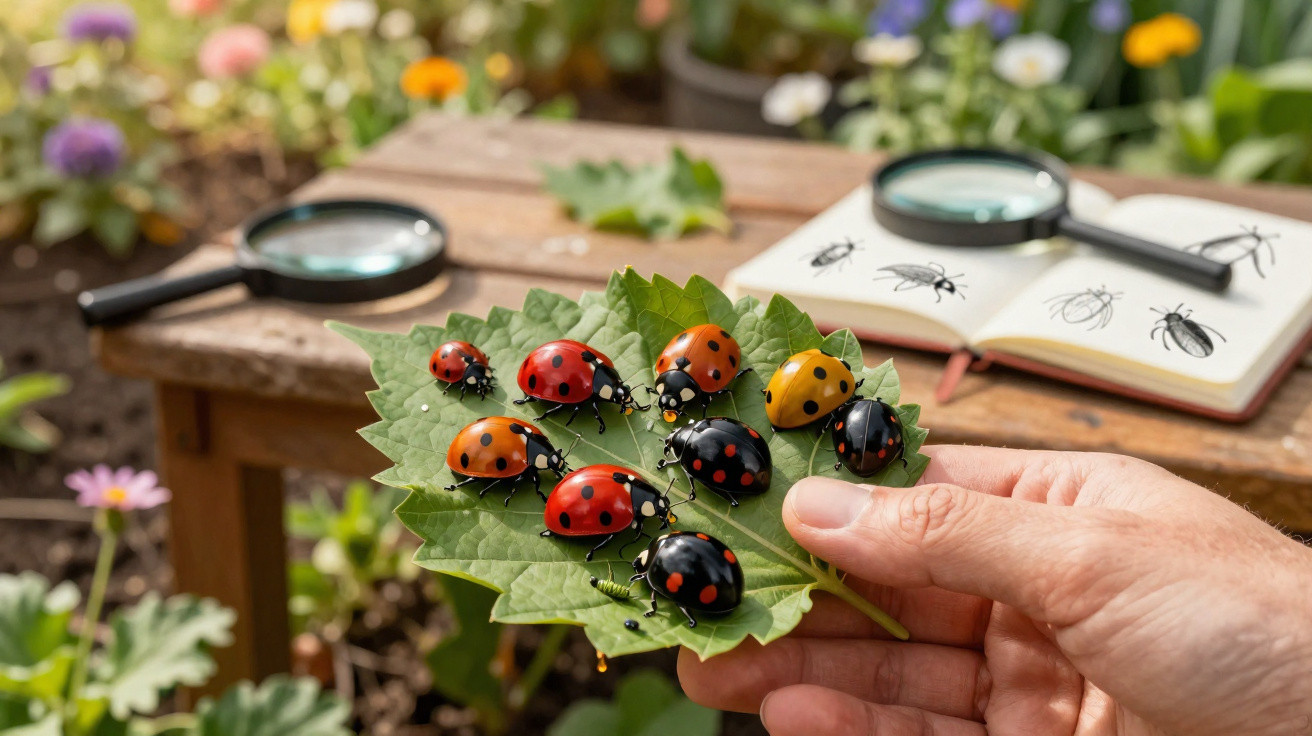
Ladybirds may look like harmless nursery-room motifs: round, colourful and friendly. In reality, they are highly specialised hunters, carriers of chemical weapons and subjects of scientific research. Many of their abilities sound more like science fiction than the idyllic image of a beetle on a balcony.
Colour spectrum: ladybirds are not just red with spots
The usual mental picture is a red back with black spots. In nature, however, the palette is far more varied. Ladybirds can be yellow, orange, black, whitish or even pink. Some species have large, distinct markings, while others have almost none.
A ladybird's colour is more than decoration – it signals, “Keep away, I taste poisonous”.
More than 5,000 species have been described worldwide. In Central Europe, commonly encountered examples include:
- Seven-spot ladybird: the classic red form with seven spots
- Two-spot ladybird: usually red with two spots, although black forms with red markings also exist
- Harlequin ladybird: extremely variable, ranging from entirely red without spots to almost fully black with numerous dots
This colourful diversity is no accident. Their striking colours form part of a warning system designed to deter predators. Birds and other hunters learn that a colourful beetle means an unpleasant experience.
Chemical defence: when a ladybird “bleeds”
When caught or threatened, a ladybird uses a rather drastic defence. It squeezes a yellowish droplet from its leg joints, a process specialists call “reflex bleeding”.
The fluid smells unpleasant, tastes bitter and contains toxic alkaloids. Many birds spit out the beetle again after the first bite. Spiders and small mammals are also sensitive to this cocktail.
The sweet little lucky ladybird is exceptionally well armed chemically – those that eat it usually learn that lesson only once.
The secretion is normally harmless to people, although it can irritate the skin of highly sensitive individuals. Children should therefore not spend minutes squeezing or licking ladybirds – something that does happen, especially in gardens during summer.
Miniature eating machines
Despite their friendly reputation, ladybirds are ruthless predators. Their larvae in particular eat whatever comes within reach of their mouthparts, with aphids being their preferred prey.
A single larva can consume well over 50 aphids each day. For gardeners and farmers, that is extremely valuable. Rather than spraying poisons, many growers rely on these natural pest controllers.
What ladybirds have on the menu
- Aphids
- Spider mites
- Mealybugs and scale insects
- Eggs of other insects
- Even members of their own species in emergencies
Ladybirds are deliberately released in greenhouses in particular. They help reduce the use of chemical pesticides, and therefore residues on fruit and vegetables as well.
Ladybirds on the move: surprisingly long-distance fliers
Some species travel distances that seem remarkable for such small creatures. The Asian species that also occurs here can migrate in swarms over many kilometres.
Falling temperatures or a lack of food trigger this behaviour. Thousands of beetles then gather together, are carried by the wind and look for shared winter shelters – often in rock crevices and woodland, but also on house façades or in lofts.
Anyone who suddenly finds an entire beetle-covered wall in their bedroom during autumn is probably witnessing a ladybird winter community.
Observations from North America show that such swarms can cover hundreds of kilometres across the landscape. For an animal weighing scarcely more than half a gram, this is an enormous achievement.
A secret language of scents
Ladybirds do not “talk” with sounds, but through chemistry. They release pheromones – scent compounds that transmit specific signals. These can attract mates, mark food sources or warn of danger.
Researchers are trying to decipher these scent patterns in detail. Their goal is to produce synthetic attractants. This could allow ladybirds to be “invited” to particular fields or greenhouses, where they could clear away pests.
Surprisingly long-lived for their size
Many insects survive for only a few weeks. Ladybirds manage considerably longer. On average, they live for around a year and, in protected favourable conditions, can survive for as long as three years.
One reason is what is known as diapause. During the cold season, ladybirds drastically slow their metabolism and remain motionless in winter shelters. This conserves energy and helps them survive periods of frost.
| Factor | Effect on lifespan |
|---|---|
| Food supply | Well-fed animals live longer and are more resilient |
| Temperature | Mild winters improve survival chances, while extreme heat weakens them |
| Shelters | Gaps in houses, sheds or tree bark provide protection from predators |
From the church to children's songs: the ladybird myth
In many languages, the religious connection matters, including in the German name Marienkäfer, meaning Mary's beetle. The name refers to the Virgin Mary. As early as the Middle Ages, farmers noticed that fields with many ladybirds suffered less from pests.
Because the beetles saved the harvest, they were considered gifts from heaven.
Numerous customs developed from this idea. Children blow ladybirds from their hands and make a wish. In some regions, the number of spots is said to reveal how many good months lie ahead in the year. Scientifically, this is of course nonsense, but culturally it shows how deeply this small beetle is rooted in everyday belief.
When the lucky charm eats its own relatives
As cute as they appear, ladybirds can become cannibalistic. Larvae in particular feed on unhatched eggs or weaker larvae when little other food is available.
This harsh mechanism ensures that at least part of the population survives. The strongest and best-adapted animals make it through – a classic selection process in miniature.
Colour changes throughout life
People watching newly emerged ladybirds are often surprised: many are initially pale, yellowish or brownish, with barely visible spots. Only after a few hours to days does the colour deepen and the characteristic pattern emerge.
As the beetle ages, it may darken again or fade slightly. Temperature, humidity and diet all play a role. In cooler regions, some individuals appear noticeably darker, an effect that helps them warm their bodies.
Ladybirds in the laboratory: small animals, major insights
Biologists have used ladybirds as model organisms for years. They are well suited to studying predator-prey relationships, genetic colour variations and chemical defence strategies.
Anyone researching ladybirds also learns a great deal about biodiversity, climate impacts and sustainable agriculture.
The invasive harlequin ladybird is particularly prominent in research. It is spreading rapidly and, in some cases, displacing native species. Researchers are examining why it is so successful and how balance can be restored.
What garden owners can do in practice
Anyone wishing to help ladybirds does not need to invest much. A few straightforward measures are enough:
- Leave some piles of autumn leaves and dead perennial stems in place, as overwintering beetles shelter there.
- Avoid broad-spectrum insecticides, especially in vegetable gardens and on balconies.
- Grow plants that attract aphids, such as roses or beans, as these provide food for ladybirds.
- Keep insect hotels or gaps in wood and stone as places of refuge.
Those who look closely will find a host of fascinating details among all the spots: larvae that resemble tiny crocodiles, pupae hanging motionless from leaves, and swarms passing over fields on warm days. For children in particular, ladybirds offer an ideal introduction to the insect world – visible to the naked eye and right on the doorstep.
At the same time, it is worth taking a critical view of introduced species. The harlequin ladybird, for example, is considered a problem in many regions because it displaces native species and gathers in large numbers inside homes. Specialists therefore advise respecting these insects while monitoring their populations carefully – that, too, is part of modern nature observation.




Comments
No comments yet. Be the first to comment!
Leave a Comment