
What should you do now?
Many homeowners are alarmed when they discover that a colony of bats has taken up residence in their property. Although these animals are strictly protected, may transmit diseases and can cause damage over time, panic and rushed DIY attempts are not the answer. By following a few basic rules, you can remove bats from your home humanely, legally and permanently.
Why bats choose your home
Bats are not monsters; from their perspective, they are simply practical tenants. They look for refuges that resemble their natural roosts: warm, dark, sheltered from predators and as undisturbed as possible.
Lofts, wall cavities, spaces behind cladding and disused chimneys offer ideal conditions. They enter through remarkably small gaps. Many species can squeeze through openings barely wider than half a centimetre. Even modern, well-built homes are therefore not automatically protected.
A building becomes especially appealing when suitable conditions are also available nearby:
- Water features such as ponds, rivers or ditches
- Gardens, traditional orchards, woodland or hedge networks
- High insect populations, for example around agricultural land
Bats consume huge quantities of mosquitoes and other insects every night. People living in this type of environment are statistically more likely to encounter them. Cities are no exception either: streetlights attract insects, followed by the bats that hunt them.
Typical signs of bats in the house
Acting early can prevent large colonies and costly repair work. Common warning signs include:
- Quiet squeaking or scratching shortly after sunset or before dawn
- Dark greasy marks around gaps, cracks and wall projections, caused by body oils
- Small piles of dark, crumbly droppings (guano) on floors, window ledges or roof timbers
- Direct sightings: bats repeatedly leave from the same opening in the evening
“If you regularly see bats entering and leaving at the same point, there is a high likelihood that your house contains a roost – and you should act promptly.”
Guano is more than just unpleasant. It may contain the fungus Histoplasma capsulatum, which can cause respiratory infections when inhaled. Cleaning it up without a protective mask and disposable clothing is therefore a poor idea.
Legal restrictions: why bats cannot simply be made to “go away”
Bats are subject to strict protection in Germany and many other countries. Numerous species are threatened, partly because of habitat loss and diseases such as White-Nose Syndrome.
Anyone who kills or captures bats, or destroys their roosts, risks substantial fines. In some cases, regulations such as the German Federal Nature Conservation Act or specific species-protection schemes also apply. Before taking major action, always seek advice from the local lower nature conservation authority, environmental office or a regional bat adviser.
The right time: when exclusion is permitted and sensible
The period in which female bats raise their young is particularly sensitive. At this stage, the pups remain unable to fly inside the roost. If the mothers are prevented from returning, the young die painfully, while the loft can become a health and odour problem.
| Season | Typical bat activity | Recommended action |
|---|---|---|
| Spring (March–April) | Active, before maternity colonies form | A good period for exclusion and sealing |
| Summer (May–August) | Young are born and raised | Do not exclude bats; leave the roost undisturbed |
| Autumn (September–October) | Colonies disperse and bats move on | A very favourable period for action |
| Winter (November–February) | Hibernation or migration to other regions | Leave them alone and avoid disturbance |
Some species may overwinter in a house, often deep within narrow gaps. Carrying out uncontrolled repairs at this time can wake them from hibernation and put their lives at risk, as their fat reserves may no longer last until spring.
How humane bat exclusion works in practice
The preferred approach is to use one-way exclusion devices. These let bats leave their roost during their evening flight but stop them from returning through the same entrance.
One-way bat exits: patience rather than force
Professional devices are available to buy, but with some practical skill they can also be made at home, for example as tubes or mesh tunnels fitted over the entry gap.
“The principle is simple: bats fly out, cannot find the original opening when they return and look for alternative roosts – ideally bat boxes provided in advance.”
Preparation is important:
- Watch for several evenings at dusk to establish exactly where the bats enter and leave.
- Record every entry point; there are often several, sometimes only a few centimetres apart.
- Install one-way devices in the late afternoon or early evening, while the bats are still in the roost but are due to emerge shortly.
Exclusion usually takes between three and seven nights. Afterwards, there should be no further visible or audible activity. If you are unsure, ask a specialist contractor or bat expert to confirm that the roost is genuinely empty.
Seal gaps afterwards: close weak points thoroughly
Only once you are certain that no bats remain in the house should you move to the second stage: sealing the openings. Otherwise, a new colony may arrive the following year, or another animal may use the gaps.
Suitable materials include:
- Foam insulation for fine cracks and joints
- Steel wool or copper mesh packed into medium-sized gaps before rendering
- Metal mesh for larger openings, vents and roof overhangs
- Door seals and specialist brush strips for loft doors
- Covers and caps for chimneys and ventilation pipes
Professional companies often guarantee that treated areas will remain free of bats. In many cases, they also remove guano properly, using respiratory protection, disposable coveralls and low-dust working methods.
Keeping your house free of bats without harming them
Anyone who has had bats before should remain more vigilant in future. A short inspection around the house before the spring “bat season” can make a major difference. Typical weak points include:
- Junctions between the roof and façade
- Loose or damaged roof tiles
- Soffits, eaves boards and fascia boards
- Transitions between different building materials, such as timber and render
A powerful torch is useful, as fine gaps are easier to spot when the façade is lit from the side. If you find more significant damage, try to arrange repairs outside the summer months.
Bat boxes: relocating rather than driving bats away
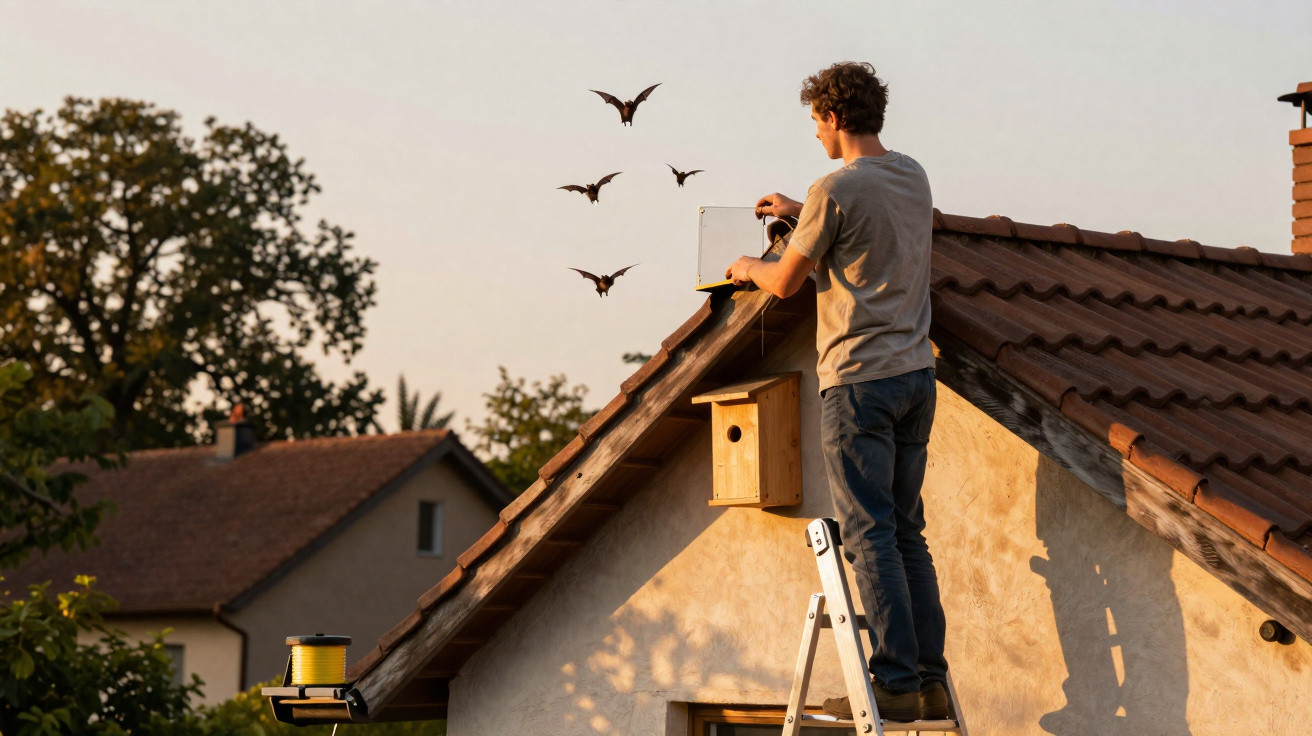
If you have sufficient space, you can offer the animals an alternative. Purpose-made bat boxes can be fixed to external walls or freestanding poles at a height of around 4 to 6 metres. Sunny, sheltered south-east or south-facing positions usually work well.
These boxes can house dozens of bats. They continue to provide natural mosquito control in the garden while reducing pressure on the loft and façade. There is no guarantee that bats will use them, but the likelihood rises where many bats already occur in the surrounding area.
What homeowners should also know
Many people fear bats, particularly because of rabies. In Europe, only very few animals are actually infected. The overall risk is low, but one rule still applies: never touch a bat with bare hands, especially if it is on the ground or appears lethargic. Instead, contact a wildlife rescue service, animal welfare organisation or bat expert.
If you are planning renovation or conversion work, such as turning a loft into living space, establish early on whether bats are present. Where construction work conflicts with species protection, specialists can usually find practical solutions, including replacement roosts, phased work schedules and adapted lighting.
The animals also benefit homeowners. A stable bat population can significantly reduce garden insect problems, mosquitoes around a pond and moths on the patio. Making parts of the building bat-proof while providing outdoor roosts offers the best long-term balance between protecting the house and supporting a threatened group of animals.





Comments
No comments yet. Be the first to comment!
Leave a Comment