
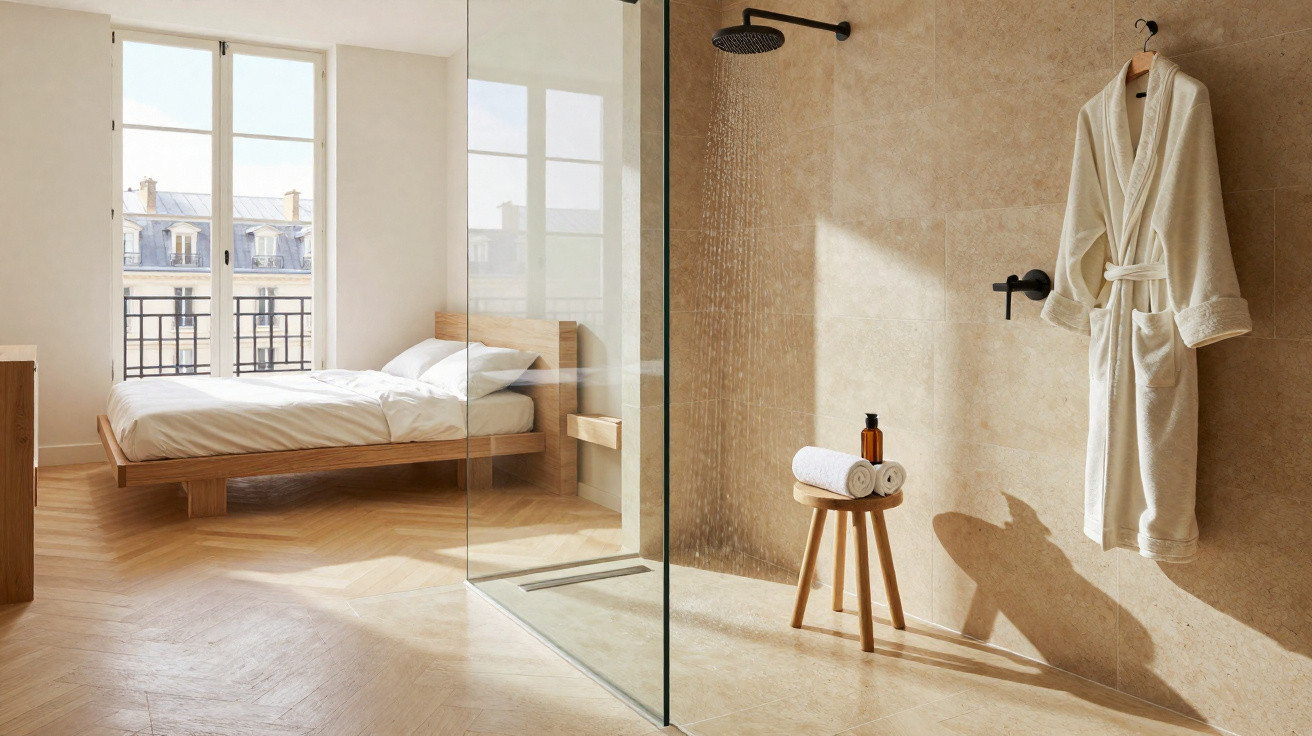
Walls are being removed, shower trays are vanishing, and France’s familiar bathroom format is undergoing a subtle transformation.
In both new homes and refurbishment projects, French households are moving beyond the traditional tiled enclosure with its sealed shower cubicle. In its place is a more open, spa-inspired approach: the wet room. Already established in Scandinavian houses and boutique hotels, this arrangement is now helping define what many architects call the 2026 “post-bathroom” age.
What a wet room means in 2026
A wet room is more than a walk-in shower behind an enlarged screen. The entire bathroom is treated as a waterproof shower space, with a gently angled floor directing water into an integrated drain and with permanent divisions kept to a minimum.
For French schemes, this is a striking departure. Baths are removed, shower trays are omitted, and tile or microcement extends continuously across walls and floors. The room’s practical purpose does not change, but both its use and appearance are transformed.
A wet room is a completely waterproof bathroom in which the full floor may get wet, with no trays, steps or bulky enclosures.
The principle is straightforward, but it changes the relationship between water and the space around it. Rather than occupying one corner, the shower effectively becomes the room itself.
Why France is moving beyond the traditional bathroom
More room with less clutter
In densely populated French cities, every square metre matters. Estate agents say prospective buyers increasingly focus on bathrooms, including in compact one-bedroom flats. A wet room removes the screens, doors and raised trays that break up a layout. A single unbroken surface can make even a 3 m² room appear more spacious.
Architects use large-format tiling, level-access drains and concealed controls to create an uninterrupted visual line. Technical components recede from view while the sense of openness increases. In small Paris flats, that visual expansion can separate a “cramped washing corner” from a “mini spa”.
From practical room to wellbeing space
The pandemic period changed the way Europeans occupied their homes. French owners began seeing bathrooms less as strictly functional spaces and more as places for a daily reset. Wet rooms fit naturally with that outlook.
Finishes previously associated with boutique hotels-textured stone, coloured glass and brushed metal-are now appearing in suburban homes and refurbished Haussmann flats. Soft lighting, recessed storage niches and frameless glass screens create a restrained hotel atmosphere without turning the room into a full luxury suite.
The wet room trend reflects a wider shift in France: transforming ordinary home spaces into modest, repeatable “wellbeing rituals”.
Accessibility without a clinical appearance
France’s population is ageing, while housing policy has encouraged more accessible home layouts. Conventional bathrooms for people with reduced mobility have often had an overly medical appearance. Wet rooms address part of this issue.
There is no step to negotiate and no tray edge to trip over: the floor remains level apart from its subtle fall towards the drain. This works well for older people, wheelchair users, young children and anyone dealing with wet feet and steamed-up mirrors at 7 a.m.
Rather than fitting large white grab rails, designers are incorporating black metal support bars, wall-mounted timber benches and wide doorways that integrate with the wider scheme. The practical function remains, while the stigma disappears.
Cleaning that will not take up your Sunday
French households are paying more attention to maintenance time and the expense of cleaning products. A wet room offers advantages here too. Fewer joints create fewer places for mould to develop. Without a shower tray edge, there is less scrubbing around silicone seals. Smooth, continuous finishes can be cleaned rapidly with a squeegee and microfibre cloth.
Some owners opt for large porcelain slabs or resin-based microcement, both widely used in France, to minimise grout lines. Limescale still develops, particularly in hard-water areas such as Île-de-France, but it tends to collect on fittings instead of difficult corners.
A refurbishment that may raise property value
Wet rooms have become a selling feature for estate agents across much of France. Property listings increasingly highlight an Italian-style shower or a spa-style shower room, particularly for city flats.
Although precise numbers differ, agents frequently report quicker sales for homes with a contemporary, high-quality bathroom. Buyers interpret this as evidence that the rest of the property has been maintained to a comparable standard, which lowers their expected refurbishment costs.
The technical side: where wet room projects fail
The result may appear minimalist, but its construction requires anything but a casual approach. Beneath the clean finish are waterproofing layers, carefully calculated gradients and rigorous ventilation planning. Missing any of these stages can turn an ideal wet room into a lasting problem.
Waterproofing: no room for shortcuts
In a standard bathroom, a problem around a shower tray can often remain contained in that spot. In a wet room, spray and standing water can reach the whole space, leaving far less tolerance for mistakes.
French building professionals generally create a complete waterproof barrier beneath the floor and behind the walls, using membranes, liquid-applied coatings or waterproof boards. Reinforced tapes are commonly used at corners, pipe openings and thresholds.
Once the tiles have been installed, fixing a waterproofing error can require breaking up the floor, walls and sometimes even the ceiling below.
This risk is why French insurers strongly favour certified contractors, especially in blocks of flats where a leak may affect multiple homes.
Drainage and gradients: measured in millimetres
A wet-room floor typically has a gradient of around 1–2%, sufficient to drain water while avoiding the feeling of standing on a ramp. Creating this slope while keeping the rest of the space level requires accurate planning of screeds, drain heights and tile depths.
Linear shower drains, now widely sold in France, make the arrangement easier. Positioned along a wall or at the entrance to the shower area, they allow water to run in one direction instead of towards a bowl-shaped centre. They also make large-format tiles simpler to cut and install.
Ventilation: controlling steam discreetly
As water can spread more widely, so can steam. Without effective extraction, condensation gathers on mirrors, ceilings and window surrounds. Eventually, paint starts to blister, joints turn black and timber expands.
Most newly built French homes now have mechanical extraction systems. In older properties, renovators commonly install a dedicated extractor fan connected to the light fitting or a humidity sensor. Positioning it near the wet area, while keeping noise under control, is part of the design process.
What French households actually spend
Prices differ considerably, but French renovation specialists generally place a complete wet-room project between a simple compact refresh and a full premium bathroom refurbishment.
| Project type | Example setting | Price range (France) |
|---|---|---|
| Entry-level wet room | Small city flat, standard tiles, basic fittings | €4,000 – €6,000 |
| Mid-range design | Family house, large tiles, concealed mixers | €6,000 – €9,000 |
| High-end finish | Stone or microcement, bespoke glass, designer brassware | €9,000 – €12,000+ |
These estimates normally cover demolition, waterproofing, tiling, drainage alterations and replacement fittings. Structural work, such as relocating walls or changing floor levels in older buildings, increases the overall cost.
Who the wet room trend is best for
The 2026 change in French bathrooms will not suit every household equally. Certain groups benefit more from a wet-room arrangement than others.
- Young urban professionals looking for a hotel-style atmosphere in a compact flat.
- Families seeking a hard-wearing shower area that is easy to clean each day.
- Older people adapting a home for later life without creating a “medical” environment.
- Landlords improving rental properties to stand out in competitive city markets.
Homes with only one bathroom require more consideration of household routines. Where several occupants still value baths or lengthy soaks, a hybrid arrangement-combining a wet room with a bath elsewhere in the home-may offer a better compromise.
Practical questions French homeowners are asking
What about cold floors and splashing water?
French critics of the wet-room trend often point to two concerns: cold feet and water travelling throughout the room. Both are influenced by design decisions. Underfloor heating, increasingly common in refurbishment work, tackles the first issue. The second depends on shower-head placement, screen dimensions and the strength of the shower system.
Designers now usually position shower heads away from the entrance and install partial glass screens to limit spray without sacrificing the open character. Bath mats and towel hooks are placed beyond the wet area to keep textiles dry.
Is it possible to retrofit a wet room in an older French property?
Yes, although there are restrictions. In mid-century blocks of flats, the available floor depth can limit the gradient that can be formed towards the drain. Plumbers may have to raise the finished floor slightly or fit ultra-flat drainage systems.
In old stone houses, uneven walls and floors make waterproofing more difficult. Contractors often create a lined interior using waterproof boards, effectively forming a “bathroom within a bathroom”. It costs more, but shields the original structure from damp.
Beyond the trend: what wet rooms reveal about French homes
France’s enthusiasm for wet rooms is tied to broader changes in domestic life. Urban homes are becoming smaller, so each room needs to perform more functions. As time pressures rise, upkeep must take less time. The bathroom is responding by becoming more open, adaptable and visually restful.
The change also connects with environmental concerns. Some French households are fitting digital thermostatic mixers and low-flow shower heads in wet rooms to manage water consumption. A thoughtfully planned open shower may encourage shorter, more efficient habits, though very large rainfall shower heads can still increase use if behaviour remains unchanged.
For people considering a refurbishment over the next two years, the wet room lies where design, comfort and ageing needs meet. A basic paper sketch showing where water will fall, air will circulate and future users will stand can already indicate whether the approach suits a particular home. Technical decisions can then follow-and the old enclosed bathroom begins to fade from view.

Comments
No comments yet. Be the first to comment!
Leave a Comment