

The wreck of the Dutch East India Company vessel Batavia, which went down off Western Australia in 1629, ranks among the region’s most notorious maritime disasters. Its notoriety stems chiefly from the mutiny and massacre perpetrated among those who survived.
A team of Australian and German researchers has now examined another part of the Batavia’s history: the precise contents of its cargo hold. Their findings appear in the Journal of Archaeological Science: Reports.
When the ship was lost, it was carrying prefabricated sandstone blocks, thousands of bricks and further construction supplies, alongside a valuable cache of silver coins and jewellery.
Batavia sandstone blocks reveal their origins
The researchers were especially interested in the source of the sandstone blocks. Their answer points to an unexpected strategic decision made by the Dutch East India Company four centuries ago.
"Historical records are incomplete, and after nearly 400 years underwater, these stones can look very similar, making them difficult to identify," says Anthony Clarke, a geochemist at Curtin University in Australia.
"We wanted to know if tiny mineral grains could give us a reliable fingerprint of where the stone formed, and help reveal how the Dutch East India Company sourced and transported materials across its global network."
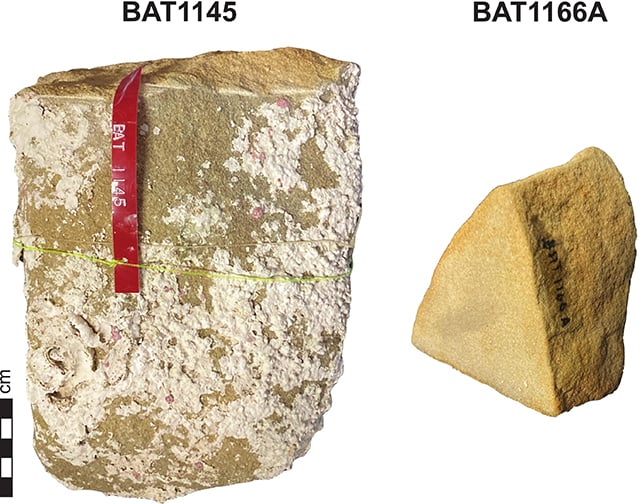
The two samples examined by the team. (Clarke et al., J. Archaeol. Sci. Rep. , 2026)
To identify features of the rock that conventional images and analyses could not reveal, the researchers used a method known as detrital zircon U-Pb dating.
In essence, this technique examines uranium enclosed within sandstone zircon to determine its age. Comparing the two sandstone-block samples showed that their patterns were not the same.
Yet the samples matched stone from present-day quarries. One block came from the Bentheim quarry in Germany, while the other originated at the Obernkirchen quarry, also in Germany. Both quarries are known to have supplied the Dutch East India Company.
"By analysing microscopic zircon minerals within the stone, we discovered that blocks which looked almost identical actually came from different quarry regions in what is now Germany," says Clarke.
"We found these stones were sourced from at least two different quarry areas, then brought together into a single shipment before being sent halfway around the world in a highly organized supply chain more than 400 years ago."
A Dutch East India Company supply chain
This matters because it indicates the company was not merely obtaining rock from the nearest available quarry. Rather, it operated a coordinated and carefully planned supply chain, drawing on quarries roughly 140 kilometres apart.

As one of the era’s largest trading organisations, the Dutch East India Company transported materials worldwide. These sandstone blocks were destined for the company’s Asian headquarters at Batavia, now Jakarta, from which the wrecked ship took its name.
"The research also highlights the logistical complexity behind the Dutch East India Company's expansion, including how building materials were sourced, consolidated and transported across vast distances to support colonial infrastructure," says Clarke.
The researchers suggest that the Batavia’s cargo might have been brought together at a central Amsterdam hub, though this remains an informed supposition.
They intend to apply the technique to additional sandstone and bricks recovered from the wreck. That work may uncover further details - and perhaps further secrets - about the logistics underpinning its operations. The same approach could also be applied to other stone-carrying shipwrecks.
Geochemical analysis and the past
The findings add to evidence that advances in geochemical analysis offer a clearer view of the past, whether examining workshop production, methods of warfare, or the movement of goods.
Related: 3,000-Year-Old Pottery Reveals Trade Networks in Australia Long Before Colonization
"Nearly 400 years after Batavia sank, the famous ship is still revealing new stories," says Corioli Souter, an archaeologist at the Western Australian Museum.
The study was published in the Journal of Archaeological Science: Reports.
This article was fact-checked and edited by Peter Dockrill. Although we take pride in our process, we are only human. If you notice an error, please let us know.


Comments
No comments yet. Be the first to comment!
Leave a Comment