
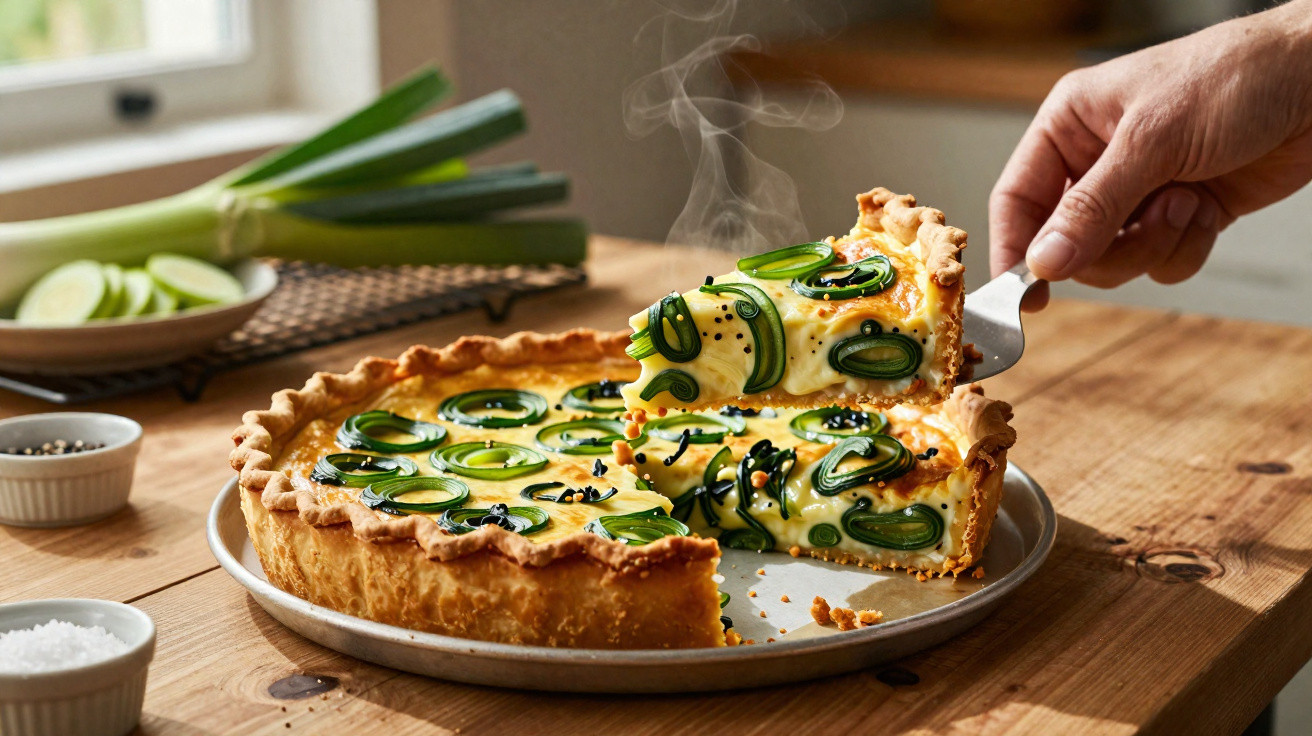
Almost everyone who enjoys making savoury quiches knows the frustrating outcome: attractive on the outside, soggy within. The encouraging news is that a wet, doughy base is rarely a major baking failure. It usually comes down to one specific preparation mistake, which can be corrected with a few deliberate steps.
Why the base of a leek quiche so often turns soggy
Leeks are a rewarding vegetable: affordable, locally grown, full of flavour and readily available throughout autumn and winter. That is precisely why they appear so often in quiches, tarts and gratins. However, leeks are made up of around 90 per cent water, and that water can cause problems in the oven.
As the vegetable cooks, its cells rupture and release moisture, which then finds a route out - usually straight into the pastry base. If raw pastry meets very moist leeks and a runny egg-and-cream mixture without any protective layer, several things happen:
- The starch in the pastry cannot bake properly.
- Moisture forms a film between the tin and the pastry.
- Bottom heat reaches the base less effectively.
The result is pastry that remains soft and claggy underneath, sticks to the knife and can seem almost raw, even when the quiche looks fully baked.
The main cause of a soggy quiche base is not the oven, but overly wet leeks placed directly on unprotected pastry.
The most common mistake: wet leeks on bare pastry
In many kitchens, the method follows the same pattern: soften leeks in a frying pan with butter, cook them briefly until tender, tip them straight onto the pastry, pour over the egg-and-cream mixture and put everything in the oven. It sounds simple, but it is exactly how a soggy base is created.
The first issue is that the leeks are still very hot. When hot vegetables touch cold pastry from the fridge, condensation forms. Much of this moisture settles directly on the base.
The second problem is that the leek mixture still holds plenty of liquid from both the vegetable and the butter. During baking, this moisture seeps downwards and interferes with the way the pastry cooks.
For anyone using a practical kitchen test as a guide, there is a simple benchmark: before topping the pastry, the liquid in the leek pan should be reduced noticeably - by at least a good third. If there is still visible liquid across the base of the pan, the leeks are too wet for a firm quiche.
Three-part protection: keeping the leek quiche base crisp
To keep the pastry dry and crisp, use a system of three “barriers”. It may sound technical, but it is very straightforward in practice.
Barrier 1: prepare the leeks properly
The first line of defence starts in the frying pan. Rather than merely sweating the leeks for a short time, it is worth taking a more patient approach:
- Gently cook the leeks in a little fat over a medium-low heat.
- Leave the pan uncovered so the steam can escape.
- Continue cooking until almost no liquid remains on the bottom of the pan.
Then transfer the leeks to a fine sieve, or a sieve lined with cloth, and leave them to drain for at least 15 minutes. If time allows, leave them for a few minutes longer so that more residual moisture can escape. The leeks do not need to be cold, but they should be only lukewarm. This avoids an extreme temperature difference when they meet the pastry.
Warm, thoroughly drained leeks are the best companion to a crisp pastry base.
Barrier 2: lightly thicken the egg-and-cream mixture
The second barrier is built into the filling itself. Add one small ingredient to the classic mixture of eggs and cream, or milk, and it makes an almost remarkable difference: a spoonful of flour or cornflour.
One possible mixture is:
- 3 eggs
- 200 ml cream or milk
- 1 tbsp flour or cornflour
- Salt, pepper and nutmeg
As it bakes, the starch binds some of the moisture released by the filling and helps the mixture set more quickly. It is important to whisk the flour or cornflour thoroughly into the eggs before adding the liquid, so that no lumps remain.
Barrier 3: create a protective layer on the pastry base
The third barrier protects the pastry directly. There are several easy options, and they can be combined effectively:
- Egg-white seal: Brush the unbaked pastry with beaten egg white, then bake it briefly until the egg white has just set. This creates a film that repels moisture.
- Parmesan layer: Scatter a thin layer of grated hard cheese, such as Parmesan or Grana Padano, over the pastry and bake briefly until it begins to brown. The cheese melts into a kind of protective coating.
- “Blotting-paper” trick: Sprinkle 1–2 tablespoons of fine semolina, breadcrumbs or ground almonds thinly over the unbaked pastry. These ingredients absorb escaping liquid like blotting paper.
Sealing the pastry and adding a little “blotting paper” delivers two benefits at once: flavour and bite.
The right order for filling and baking a leek quiche
Once the three barriers are in place, the sequence of steps also determines the result. This is one possible plan for a stable leek quiche:
- Preheat the oven to around 180°C, conventional top-and-bottom heat.
- Place the pastry in the tin and prick the base several times with a fork.
- Seal the pastry base with egg white or cheese, then pre-bake it for a few minutes.
- If desired, scatter a light layer of semolina, breadcrumbs or ground almonds over it.
- Spread the drained, lukewarm leeks evenly across the base.
- Pour over the egg-and-cream mixture containing flour or starch.
- Bake until the surface is golden brown and the centre no longer looks shiny and wobbly.
Most importantly, never place a steaming leek mixture straight from the pan onto ice-cold pastry. This familiar mistake reliably creates condensation and a limp base.
How to judge doneness and texture reliably
A quiche can look ready before the centre has fully set. A few signs make it easier to check:
- The top should be golden yellow to lightly browned.
- When the tin is gently shaken, the centre should barely move.
- The filling should no longer have a milky, glossy surface.
- A knife inserted into the middle should come out without any liquid mixture on it.
Many home cooks remove their quiche too soon because the aroma suggests it is done. Allowing it another five to ten minutes often produces a noticeably firmer base.
Practical ways to add flavour and reduce moisture
For an extra step towards a better result, focus on two factors: deeper flavour and lower water content. The two are closely connected.
- Brown the leeks: Allow some of the leeks to colour more deeply. This develops roasted flavours while also evaporating extra water.
- Use less fat: Usually, less butter or oil is needed than expected; otherwise, the leeks end up sitting in a mixture of fat and water.
- Add cheese thoughtfully: Firm cheeses such as Emmental help bind the filling and can absorb moisture too.
Those who prefer a more varied filling can also balance the water content with firmer ingredients. Fried bacon lardons, sautéed mushrooms - thoroughly drained - feta or finely diced ham add texture and flavour without contributing too much additional liquid.
Why leeks are especially tricky - and how the method applies elsewhere
Leeks are particularly water-rich, but the same principle applies to many vegetables. Spinach, courgettes, tomatoes and chard behave in similar ways. Anyone who adopts the method of draining, using a thickener and protecting the pastry will benefit when making these fillings too.
Spinach, for example, should be squeezed thoroughly after blanching. Courgettes need time to release their water in the pan before they are added to a tart. Tomatoes benefit from being partially dried in the oven or deseeded before they go onto the pastry.
At its heart, it is always about the same balance: water, starch and heat. Master these three elements and you will achieve not only a perfect leek quiche, but also firmer, more flavoursome tarts in general - with bases that can be sliced without the knife sticking in the pastry.


Comments
No comments yet. Be the first to comment!
Leave a Comment