
Can a car genuinely qualify as a work of art? There is compelling precedent. In a landmark 2019 case brought by Ferrari against coachbuilder Ares, an Italian court ruled that the 250 GTO was precisely that: a work of art that could not be copied or recreated. Valued at more than $50m, it sits alongside some of humanity’s greatest artistic accomplishments, at least if price is the measure that matters to you.
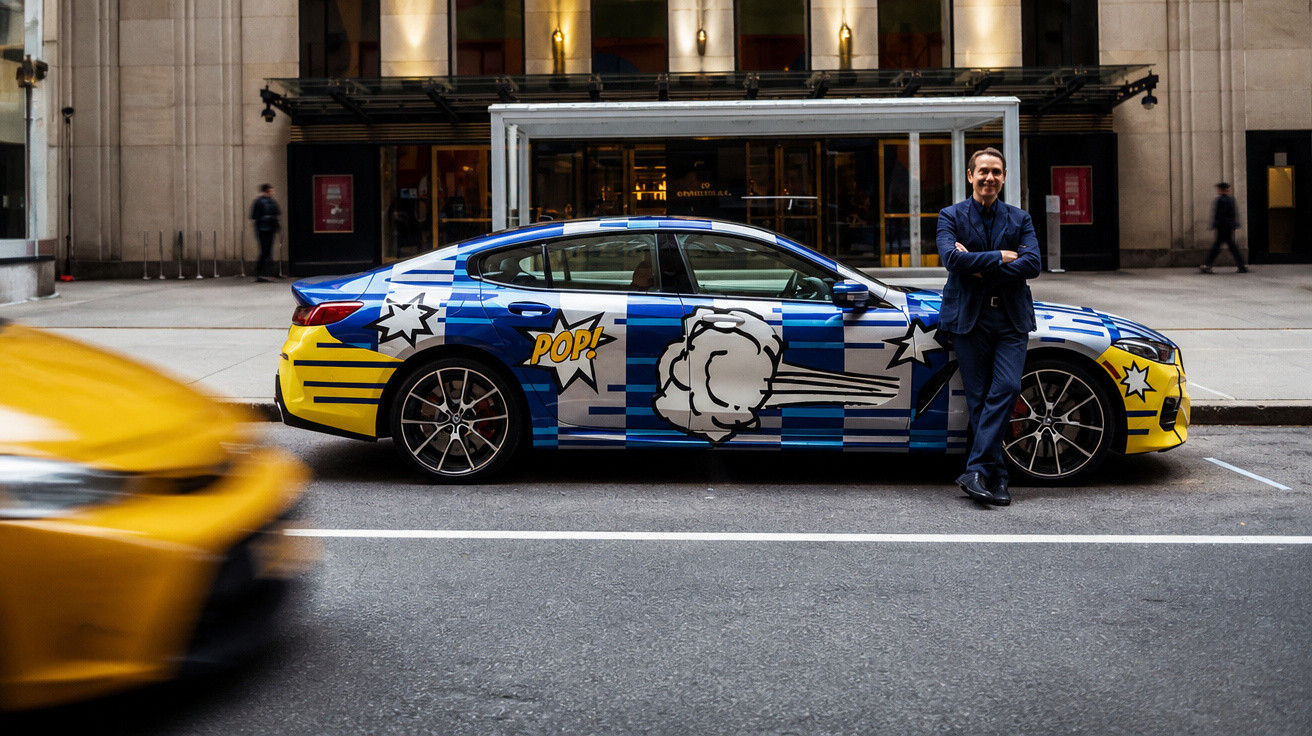
That is the car as art. But what about the art car? The car pictured here, the 8 X Jeff Koons BMW, puts that notion to the test. Limited to 99 examples, it carries the instantly recognisable, playfully provocative stamp of one of the world’s foremost artists. And self-publicists.
[themed carousel]
**Images:* Enes Kucevic*
BMW has history in this field. Its 19 art cars began when American artist Alexander Calder turned a 3.0 CSL into a travelling canvas in 1975; BMW then raced it at Le Mans that same year. “The public loved the idea. It was easy to understand, and it looked rather like a kid’s drawing, with very bright colours. It was like a moving sculpture,” Hervé Poulain, the French racing driver and auctioneer who conceived the idea, told me several years ago.
The initiative has since become increasingly prestigious, drawing in superstars including Roy Lichtenstein, Frank Stella, David Hockney, Jenny Holzer and Andy Warhol. “I adore the car,” Warhol observed. “It’s much better than a work of art.” Instead of first working on a scale model and then transferring the design, Warhol attacked a BMW M1 using hefty decorating brushes and tins of paint. The job took 20 minutes. That car, too, competed at Le Mans in 1979, where it achieved a remarkable sixth-place finish. It was extraordinary then, and even more so today, given that experts widely consider it the world’s most valuable car. “Effectively priceless,” one told me. More than $100m, if a number is required.
Modern art has long been subject to the mischievous influence of high finance, and Jeff Koons has undoubtedly profited from it. In 2019, one of his works - a gleaming stainless-steel rabbit - sold at Christie’s for $91m, surpassing the record he already held as the most expensive living artist. Once an enfant terrible, he is now firmly embedded in the art establishment, though plenty of critics still decline to regard him seriously.
Much of that stems from the difficulty of deciding whether he means it. He studied painting and worshipped Salvador Dali, before later becoming a Wall Street commodities broker to support himself. Some see an uncomfortably suspicious connection. For 1985’s ‘One Ball Total Equilibrium’, he suspended a basketball in a water tank, commenting on “an ultimately desirable but ultimately unattainable state”. It is brilliant. His most infamous piece, ‘Made In Heaven’, arrived in 1989 and showed the artist and his muse, soon to become his wife - porn star turned Italian politician Ilone Staller, also known as Cicciolina - involved in various energetic acts of erotic congress. His output since has been formidable, encompassing a vast topiary puppy, the balloon dog and Hulk Elvis. His latest undertaking, Jeff Koons: Moon Phases, marks his first move into NFTs; physical works will also be dispatched to the moon and deposited on its surface by a robotic lunar rover. The man is a genius.
Jeff Koons and BMW’s art-car legacy
But the cars are why we are here. In 2010, Koons created BMW’s 17th art car: a blazing reimagining of an M3 GT2 that also raced at Le Mans. “Art is all about a narrative,” he told me when the car was unveiled. “The narrative I enjoy and trust the most is the one that connects us all – life. This car is about life energy, it’s that millisecond before life comes into being. This car is striving to get where it needs to go, to beat all the obstacles in its path. So it’s a metaphor for our lives, and a reminder that we’re all winners. Because if we’re here at all then we’ve won, and we should embrace all the possibilities that exist.”
Sadly, the M3’s potential was curtailed by gearbox gremlins and a fuelling issue. Now comes a kind of follow-up: a fresh Koons work based on the BMW M850i xDrive Gran Coupe. It is emphatically not an official addition to the art-car roster, but this is the 8 X Jeff Koons. A Neo-Pop fantasy that combines 11 colours, it features explosions, clouds of smoke and comic-book speech bubbles that proclaim the Pop Art influence with a simple ‘Pop!’. It also takes a cheeky run at the BMW badge. Inside, Koons’ signature has been laser-engraved into the cupholder panel, while vivid red and blue leather fills the cabin. He will not appreciate the analogy, but it looks as though Spider-Man has melted into the seats.
In the US, each example is priced at $350,995, and the full allocation sold out at once. One was retained, however, and is scheduled to be auctioned by Christie’s in New York in support of the International Centre for Missing & Exploited Children. Today, TG will share driving duties with Jeff Koons himself on the journey to the auction house near Rockefeller Plaza.
Putting this together has not been straightforward. BMW’s American operation is deeply protective of the car, particularly because it will spend several days in a glass box outside the auction house before the main event. Manhattan’s roads are worse than London’s, both for their surface condition and for the frenzied unpredictability of the traffic. Covid may have knocked the city sideways for a time, but New York’s famously forthright attitude has returned at full volume.
Driving the 8 X Jeff Koons BMW through Manhattan
This will not, then, be an exhaustive road test, although we know the 850i’s silky drivetrain, properly effortless pace and the location of its horn - essential kit today. We set off from Hunters Point on Long Island, once a desolate industrial district but now being rapidly redeveloped, with a staggeringly expensive view across to Midtown Manhattan. Koons arrives in a chauffeur-driven 7-Series, greeting the crew and three influencers gathered to maximise social engagement. Victoria Brito, Wisdom Kaye and Evan Mock - who have 5m Instagram followers between them, pah - strike poses and appear youthful, stylish and influential. “I love your jacket,” Koons says to Mock. “My eldest son is very interested in fashion.”
He is friendly, almost avuncular. He appears younger than his 67 years, and it would be easy to picture him as a successful estate agent or perhaps a boutique publisher. Yet this is arguably the most influential and disruptive artist of the last 40 years. Having met him several times, I know too that his thoughts are curated with exceptional care. Put more politely, he does not relish answering certain questions.
He explains that he and BMW had been talking about a second collaboration for a while, but that the moment had not felt right until now. He had hoped to incorporate a lenticular effect into the original art car, but the weight consequences were clearly less than ideal for a racing machine. The ideas therefore continued to simmer. Every car requires nearly 300 hours of painting, and the execution is faultless. Koons is renowned in art circles for his meticulousness, although he rejects the suggestion that he is obsessive.
“I don’t believe in perfectionism, but I believe in using detail to communicate to people that you care about them. I always wanted this kind of ‘swoosh’ on the side, that vapour, for that sense of energy,” he says. “I have lines on there going from the front to the back that increase in size to create a sense of acceleration. There are pop symbols, too.
This is the car I always wanted for myself
“I know that people will mention Lichtenstein, and Roy was a friend of mine. I love his work. But it also comes from the pop vocabulary, from comic books, and from packaging. There’s a red roof inside, and red and blue leather. But there’s a minimalism too, to create a moment for self-reflection.”
His voice has the cadence of a meditation app. Even when he is fully animated by a subject, there is something oddly calming about Koons. He also plainly feels an affinity with popular culture. I ask how he handles a world becoming ever more overstimulated and overwhelming.
“I enjoy popular culture because I enjoy being stimulated,” he replies. “It connects you to a larger community. It’s a beautiful, fertile ground for things to grow out of. People need to understand their potential, and stimulation is the foundation of ideas. I wanted to create something exhilarating and thrilling but that had meaning.”
The BMW gets its potential from a 4.4-litre twin-turbo V8. It is among BMW’s finest engines, though today its capabilities are being restrained. Is Koons a car enthusiast?
“I always loved cars. I had road racing sets as a kid. I have a very fond memory of seeing a Corvette Stingray for the first time, in 1963, I was with my dad when he was trying to find a new truck. It moved me. I had sports cars when I was younger, but not now.”
We are proceeding with great care, but we are driving it. That prompts another question: if none of the 99 8 X Jeff Koons cars ever rotates a wheel, does that diminish or enhance its meaning?
“How do you define a work of art? It’s something made out of freedom, and you strive to embed within it aspects of life experience,” Koons says. “I tried to do that with the car, so I do think of it as art. I see no difference between creating the car and creating a new piece of work. It’s an opportunity to have a conversation about feelings, sensations, about the permanency of certain things and the fragility of others. I’m looking forward to driving mine, but if one person out of the 99 preserves it, that would be nice. If that’s what excites them.
“I have eight children. I enjoy being in a car with people, yet I wanted to feel the thrill and acceleration of a sports car. This is the car I always wanted for myself. But I would never want to take away that sense of power from the other occupants. Somebody sitting in the back has as much power as the driver. It’s an opportunity to connect with people, as the car goes by, too. We’re celebrating art, we’re celebrating a great automobile, but we’re also celebrating each other.”
A crowd is assembling outside Christie’s. A space is cleared, and we draw up at the kerb. It must be a singular occasion: an artwork being driven to an auction house by the artist responsible for creating it.
I watch as Koons is filmed walking into the building. “Who’s that?” asks a woman. I give her the abbreviated version of his story, inevitably mentioning the stainless-steel rabbit and the auction record. “Wow! Art, right?”




Comments
No comments yet. Be the first to comment!
Leave a Comment