
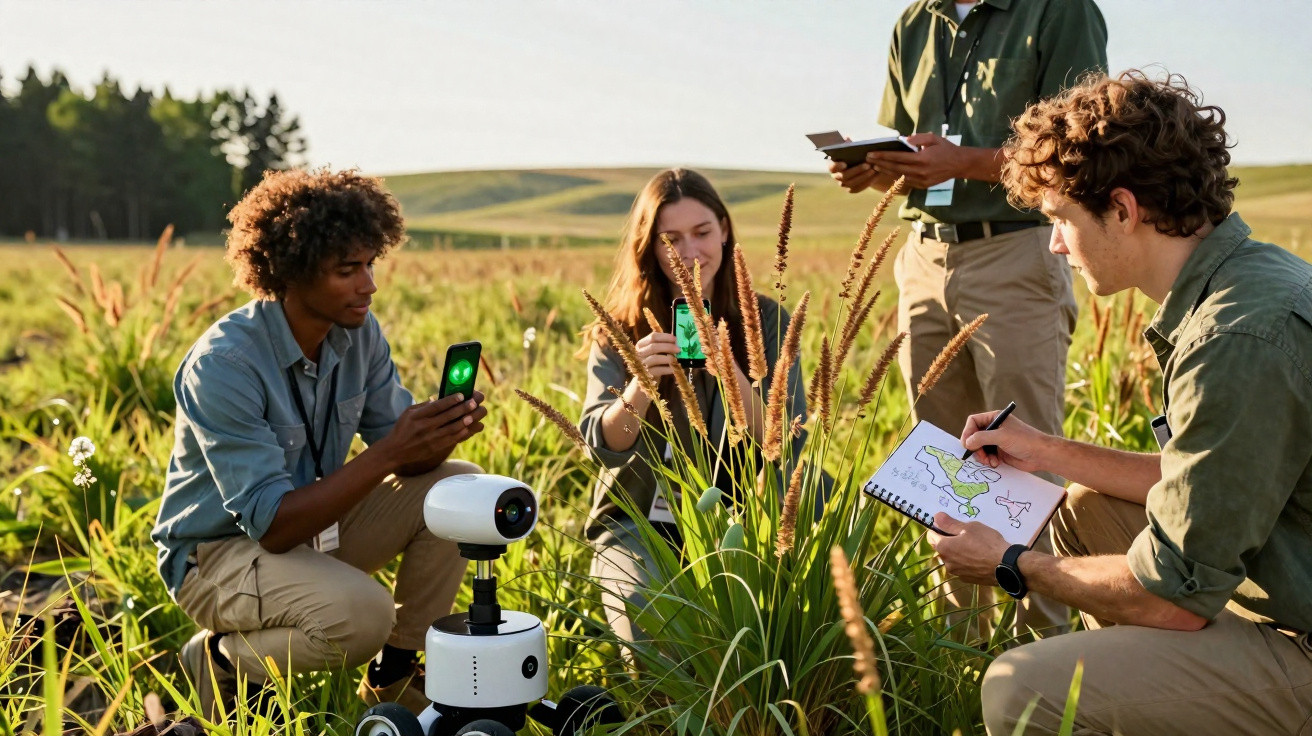
Every summer, millions of people photograph wildflowers and share the images on nature apps without giving it much thought. Those seemingly casual pictures, however, can support substantial scientific research.
A recent study used almost 44,000 crowd-sourced photographs to show how plants persist across an entire continent.
The research group, partly led by Professor Jianming Yu of Iowa State University, brought together the photo archive, controlled field trials and genetic analysis.
They aimed to tackle a longstanding ecological question: why can one plant species behave so differently according to the place where it grows?
“With this study, we have connected our quantitative genetic and genomic research with ecology, evolution and adaptation over a large-scale landscape,” said Yu.
“The beauty is we’re bridging them together so we can see the whole picture.”
A robot that spots flowers
The scientists examined four widespread North American prairie grasses: switchgrass, big bluestem, Indiangrass and little bluestem.
These species occur from Texas to the Canadian border, and monitoring their flowering times across such a vast area would ordinarily require years of work by field teams.
The researchers instead created an AI system named FLORIST and used it to process a huge online image collection from GBIF, the Global Biodiversity Information Facility, which is largely supplied by iNaturalist contributors.
Citizen science reveals flowering patterns
FLORIST examined every photograph for evidence that a plant was actively flowering.
From almost 44,000 images, it detected roughly 5,000 records showing plants in bloom, with each record carrying GPS location data and a date.
The resulting trend was obvious. For all four species, plants at more northerly locations flowered earlier in the year. On the face of it, this was unsurprising.
Northern summers are brief and winter arrives quickly, so plants must complete flowering before the cold sets in.
The experiment showed otherwise
The findings became more intriguing because the same group had already spent two years cultivating switchgrass at ten research locations throughout the Midwest and Gulf regions.
These controlled trials grew hundreds of genetically different plants beside one another in the same conditions.
Yet the experimental pattern was entirely reversed. Plants originating farther north flowered later than those from southern origins, by approximately 2.3 days for every degree of latitude northwards.
“We had to wrap our minds around that,” said Yu.
The two datasets, both concerning the same plant, appeared to tell wholly different stories. Instead of accepting one source and rejecting the other, the researchers worked to establish how both results could be correct.
The answer was in the genes
Genetic evidence resolved the apparent conflict. After studying the DNA of hundreds of switchgrass plants throughout their native distribution, the team found three crucial genes governing when the species flowers.
Known as GI, Hd1 and FTL1, these genes work as a biological clock, interpreting environmental cues and determining when to bloom.
The genes occur in different forms. Gulf-region plants possess one set of variants, known as H1, while Midwest plants carry another set, H2.
These two forms react differently to environmental conditions. H2 plants respond strongly to spring temperatures, flowering rapidly when April and early May are warm.
By contrast, H1 plants bloom much later even when spring is warm, and their timing changes far less in response to shifts in temperature.
Switchgrass plants adapted for survival
This distinction is not accidental; it demonstrates adaptation at work. In northern areas, early flowering is essential for survival.
As winters arrive severely and swiftly, H2 plants must reproduce before cold weather brings activity to a halt.
The team observed this first-hand during the harsh winter of 2018. At northern garden sites, H1 plants experienced devastating losses, whereas H2 plants emerged largely unharmed.
Further south, the threat is reversed. Switchgrass pollen is exceptionally vulnerable to heat and survives for under ten minutes at 32 degrees Celsius (89.6 degrees Fahrenheit).
H1 plants postpone flowering until late summer, once the most intense heat has passed. If H2 plants were grown in the south, they would flower during the height of summer and, in effect, ruin their own pollen.
“In their native conditions, both haplotypes are doing the things that they need to do to survive and thrive,” Yu said.
“In the north, they flower earlier because winter is coming. But in the south, there’s no rush because summer is so hot and the fall is mild.”
Two datasets, one true picture
The contradiction disappeared after the researchers considered both the gene form carried by each plant and the temperatures it encountered.
The citizen science photographs documented real plants that already possessed the gene version appropriate to their setting.
Meanwhile, the field trials placed every gene version into every environment, exposing the underlying genetic baseline rather than the outcome that occurs in the wild.
Neither source of evidence was incorrect. Each revealed a separate part of the same overall picture.
“Our study highlights the power of combining citizen science observations with designed experiments to uncover mechanisms of adaptation across spatiotemporal scales,” noted the researchers.
“It was the collective effort by scientists across a wide range of disciplines and institutions that gathered all the evidence to assemble the puzzle. We hope it inspires other studies,” Yu added.
Anyone can contribute to science
Photo databases created by people using smartphones outdoors can provide robust scientific evidence when they are combined with suitable experiments.
“You can’t say, ‘No, the experiment is true,’ and just ignore citizen science,” Yu said. “You’ve got to put them together.”
The next time you take a picture of a wildflower and upload it to iNaturalist, or to a similar app such as EarthSnap, you could be helping to enable precisely this sort of finding.
Evidence of how life adapts is visible all around us, and members of the public have been gathering it throughout this time.






Comments
No comments yet. Be the first to comment!
Leave a Comment