
You may assume that telling someone why the sky is blue is fairly straightforward. Yet even a short account involves quite a bit of science. The colours of all the things around you arise through different processes. Physics accounts for some colours, while others fall within my own discipline of chemistry.
The nitrogen and oxygen you are breathing at this moment consist of extremely small particles known as molecules. A nitrogen or oxygen molecule is incredibly tiny: each one measures only about 0.4 nanometres, or 16 billionths of an inch. Around 250,000 nitrogen molecules placed side by side would be as wide as a single human hair. You can imagine these molecules as minuscule balls, continually bouncing about.
As sunlight moves through the atmosphere, it travels among vast numbers of these tiny nitrogen and oxygen molecules. Every so often, a beam of light collides with one.
Put simply, the sky appears blue because the blue part of sunlight is far more likely than the other colours of light to bounce off molecules in the atmosphere.
How Rayleigh scattering makes the sky blue
Tennis balls and marbles
Imagine, then, that nitrogen and oxygen molecules are tennis balls, while light comes in piles of marbles.
When a light marble strikes a nitrogen or oxygen tennis ball, the ball "eats" the marble before almost immediately spitting it out in a random direction. Physicists refer to this process as scattering.
At around 1870, British physicist John William Strutt, more commonly known as Lord Rayleigh, first identified the reason the sky is blue: blue sunlight is scattered more than any other colour as it travels through the atmosphere. This finding is the reason the scientific name for the phenomenon is Rayleigh scattering.
Other atmospheric gases can matter greatly in other respects, including the influence of carbon dioxide and methane on the global climate. However, they affect the colour of the sky only very slightly.
Without scattering, the sky would be dark, as it is on the Moon, which has no atmosphere.
Sunlight, the visible spectrum and blue light
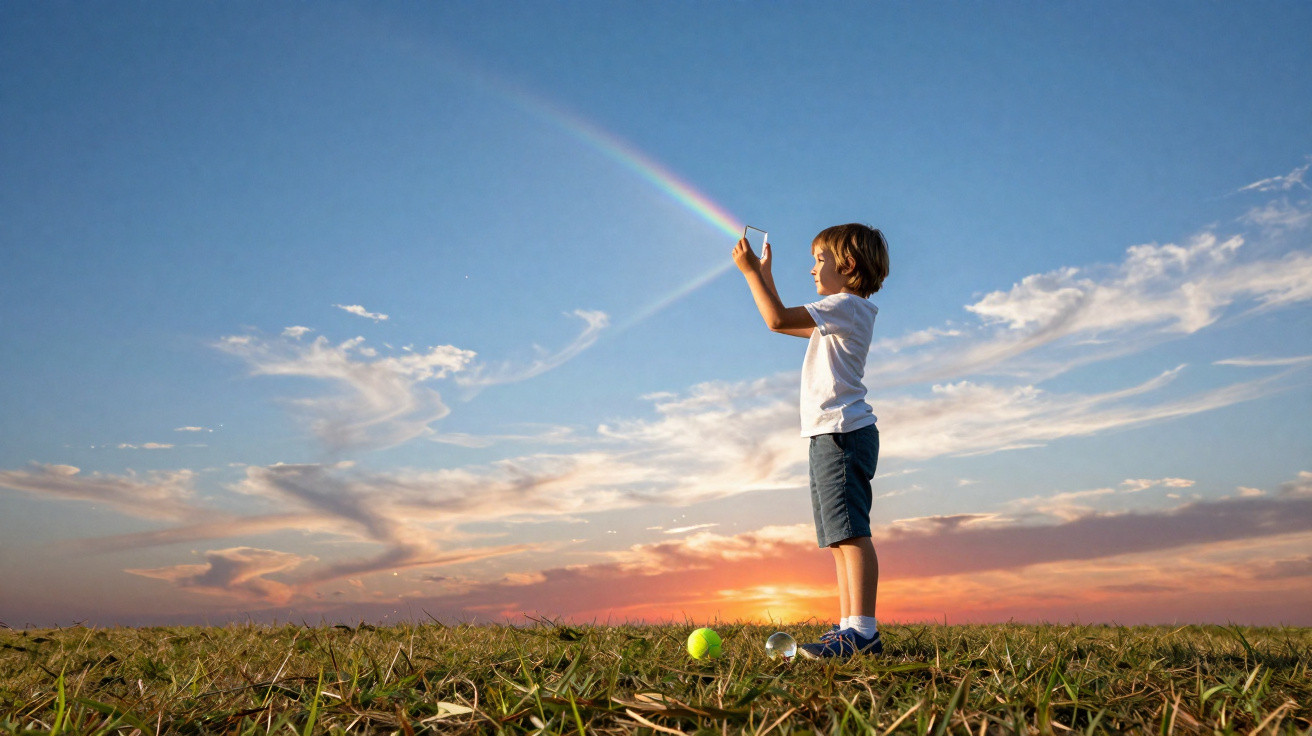
A rainbow shows every separate component of sunlight. When this light passes through water droplets hanging in the air, it separates into its constituent colours, known as the visible spectrum: red, orange, yellow, green, blue, indigo and violet. These are more easily recalled as ROY G. BIV.
Light from the blue end of a rainbow scatters more effectively than the other colours. It is rather like tennis balls being highly selective about the marbles they eat, choosing blue ones in preference to those of other colours.
Consequently, blue light is scattered throughout the sky, which is why blue is visible in every direction on sunny days. Most of the other colours pass largely straight through the atmosphere.
Why the sky is redder at sunrise and sunset
Naturally, the sky is not blue all the time.
Rayleigh scattering also accounts for the sky's tendency to look reddish when the Sun is low on the horizon, during sunrise and sunset.
With the Sun close to the horizon, its light must travel through much more atmosphere to reach the Earth's surface than it does when the Sun is directly above. Blue and green light scatter so effectively that they are scarcely visible. Red and orange light colour the sky instead.
Colours matter to us in countless ways. Both understanding the science of colour and using colour to express ourselves through art have mattered to people throughout recorded history. It is worth remembering that when you choose the colour of shirt to wear tomorrow morning.
Daniel Freedman, Dean of the College of Science, Technology, Engineering, Mathematics & Management, University of Wisconsin-Stout
This article is republished from The Conversation under a Creative Commons licence. Read the original article.





Comments
No comments yet. Be the first to comment!
Leave a Comment