
Bottles fall over, a stray razor skids towards the sink, and somewhere in this mess is the one cream you actually wanted. You know its scent perfectly, yet you have not spotted it since last winter. Morning light is already unforgiving, your coffee is going cold on the counter’s edge, and you are crouched on the bathroom floor wondering how such a small space can consume so much stuff.
We have all had that moment when we put a product down “just for now”, promising ourselves we will tidy it later. Later never arrives. The cabinet turns into an archaeological site filled with partly used serums, hotel miniatures and out-of-date painkillers. Beginning or ending the day confronted by that visual clutter is quietly draining. It seeps into your mood like a faint background buzz that you cannot switch off.
Still, that narrow space behind the mirror has more to offer than it first appears. A handful of remarkably straightforward hacks can turn it from a dumping ground for face products into a calm, almost ritualised station. The real shift, though, is not simply about storage. It is about deciding what has earned a place within reach of your reflection.
Treating the bathroom cabinet as valuable space, not a dumping ground
Open most bathroom cabinets and the clutter tells you plenty about someone’s life. Old prescriptions sit beside high-end skincare, alongside three partly squeezed tubes of toothpaste and a thicket of travel-size shampoos from hotels you hardly remember. It resembles a record of habits begun and then left behind. This space is far from neutral: it holds small stories about who you once hoped to become.
Organisation experts estimate that the average household keeps at least 20 to 30 personal-care products per person in the bathroom. Yet a standard medicine cabinet is scarcely wider than your shoulders. It is hardly surprising that everything gets packed from front to back, until the items at the rear may as well exist in another dimension. I once saw a friend take out five different sun creams, all at least two summers old, and laugh in disbelief. “I didn’t even know I owned these,” she said, with a flash of guilt visible on her face.
That concealed guilt is why the mess feels more burdensome than it appears. An overflowing bathroom cabinet can quietly suggest that you are failing to be “put together.” The pattern is straightforward: the more you cram inside, the less likely you are to use each item. Out of sight really does become out of mind. Start by viewing this compact space as prime city-centre real estate. At eye level, keep only what serves the person you are today; everything else can live somewhere less prominent and less valuable.
Micro-zones, vertical storage and small routines that last
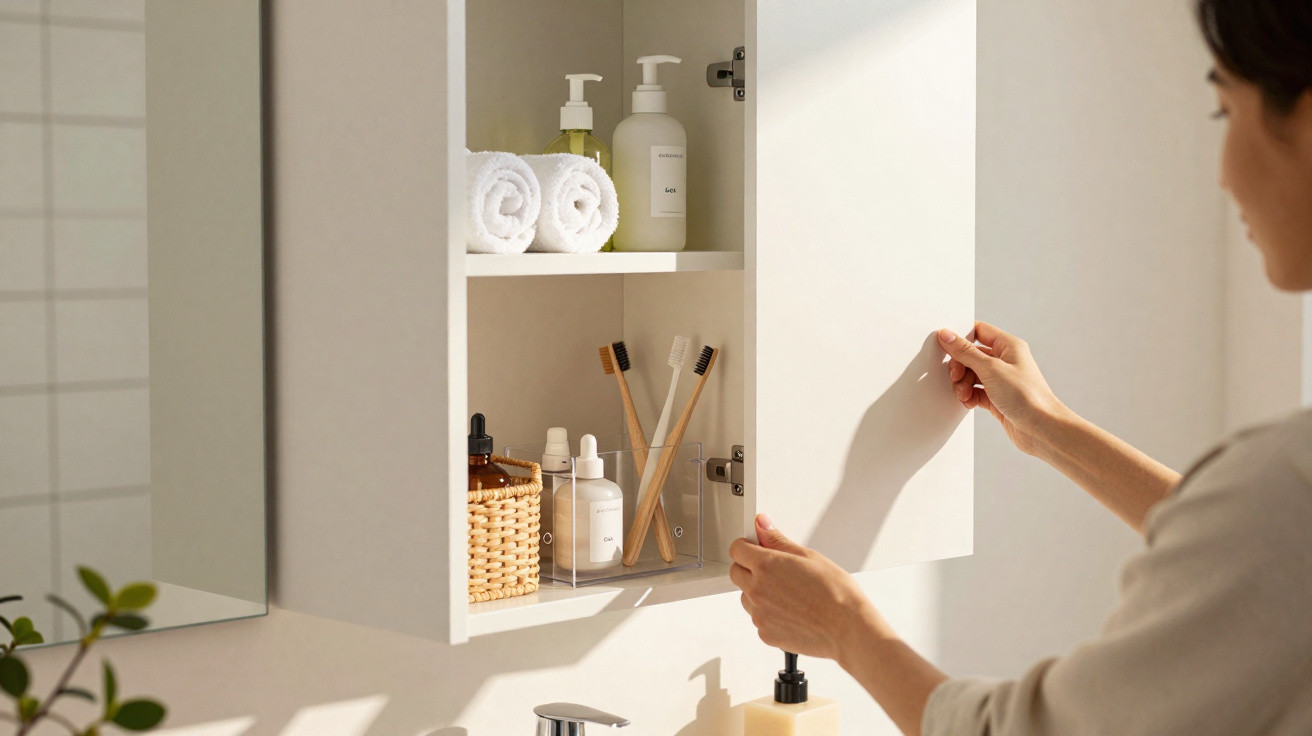
The best bathroom cabinet hacks do not begin with buying containers. First, divide the available room into micro-zones. Consider strips and layers instead of shelves. Reserve the top shelf for “rare but essential” items, such as prescriptions, allergy medicine and emergency eye drops. Use the middle for your “daily face”: cleanser, moisturiser, SPF and a dependable serum. Make the bottom shelf “teeth and quick fixes”, holding toothpaste, floss, lip balm, spot patches and deodorant. Each area teaches your hands where to reach without needing to think.
Once those zones are established, vertical solutions do most of the work. Narrow acrylic risers add a second layer at the back, preventing small pots from disappearing behind taller bottles. Magnetic strips fixed to the inside of the door can hold tweezers, nail clippers and small scissors. Adhesive pods or slim spice racks on the door convert unused air into practical storage for face mists, toners and cotton pads. The same cabinet suddenly accommodates more while appearing calmer, because every item has a visible “front-row seat”.
The most overlooked trick is creating one small routine around the new arrangement. Try a five-minute “Sunday reset”: discard empties, wipe down one shelf and remove anything that has expired. Let us be honest: nobody really does this every day. A weekly mini-ritual, however, is achievable. It keeps the system going long after your first rush of motivation disappears, while reinforcing that your bathroom cabinet is an active space rather than a product graveyard.
Smart containers, unobtrusive labels and emotional clutter
Clear containers with flat bases are among the most useful additions to a bathroom cabinet. Short, open-topped bins stop bottles toppling and create easy grab-and-go groups, such as “morning face”, “night face”, “SOS” and “guests”. Lazy Susans suit the area beneath the sink, but waste precious depth inside a shallow cabinet; slim rectangular trays are more effective. Set shelf heights so that your tallest everyday bottle only just fits, rather than leaving a large gap above it. That single adjustment can create an extra horizontal layer of usable room.
A frequent mistake is adding too many unattractive, overly bold labels that you do not enjoy seeing. Labels should be discreet and useful, not resemble office stationery that has wandered into the bathroom. A fine waterproof marker on transparent tape, or small neutral labels along the lower edge of bins, keeps the look restrained. Be gentle with yourself about excess stock, too. If you own too many hair products, make a single “back-up stock” box outside the cabinet. Shop from that box only when an item runs out. You get the pleasure of “shopping your own stash”, along with relief from some of the mental clutter.
There is emotional clutter as well: the costly cream that caused a breakout, the fragrance that reminds you of an ex, or the lipstick colour you wish suited you. A professional organiser I once interviewed told me,
“The most powerful organizing tool in any bathroom is your permission to let go of the ‘maybe someday’ products.”
Keeping these items front and centre will not make you more disciplined; it simply leaves you feeling faintly guilty every morning.
- Keep one shelf as a “trial zone” for products you are genuinely testing this month.
- Put anything that is clearly not for you into a donation or disposal bag that same day.
- Give emotionally charged products a choice: use them this week or let them go.
Making a small bathroom cabinet a calm, honest part of your day
You notice a functional bathroom cabinet within the first three minutes of waking up. Your hand reaches directly for the same three or four essentials, without any searching. The shelf becomes almost a checklist for basic self-respect: brush, cleanse, moisturise, protect. The visual calm - fewer labels, clear categories and less colour overload - has a subtle effect on your nervous system. You begin the day with one part of your life that is not demanding your attention.
This is also where being honest with yourself helps. Perhaps you do not need a seven-step skincare routine; perhaps you only need what you will genuinely use while half-asleep before work. Perhaps your children can only reach the lowest shelf, so that shelf becomes their area, containing sturdy, non-breakable items and a small bin bearing their name. Perhaps your partner will never return items in neat rows, so you give them one wide bin labelled “his stuff” and leave it at that. Organisation that overlooks real habits does not last.
A small cabinet cannot solve tired eyes or a demanding job. It can, however, provide a pocket of clear decisions in a place you visit at least twice daily. Every bottle you retain is a quiet vote for who you are now, rather than the person you thought you “should” become when you bought that third exfoliating toner. When friends instinctively open your mirror - because we all do - they see more than your products. They see the story you have chosen to keep.
| Key point | Details | Why it matters to readers |
|---|---|---|
| Create vertical layers | Place slim risers or stackable trays at the rear of every shelf so short jars stand above taller bottles. Set shelf height so that there is only a narrow gap above your tallest item. | This makes every item visible at a glance, reduces forgotten products and turns “dead air” into storage without packing more onto one flat surface. |
| Use the door as a storage wall | Fit magnetic strips for tweezers, nail clippers and small scissors, as well as adhesive pods or narrow racks for toners, mists and cotton pads on the inside of the door. | It releases shelf depth for larger items, stops tiny tools from disappearing and turns an often wasted surface into useful storage. |
| Build daily and weekly routines | Keep “daily reach” products together in a front bin, then set aside five minutes every Sunday to throw away empties, wipe one shelf and rotate anything from your back-up box. | This makes the system sustainable, eases decision fatigue on hectic mornings and prevents the gradual return of chaos. |
FAQ
- How often should I declutter my bathroom cabinet? A quick monthly review works well for most people, with a more thorough sort every six months. Use the five-minute monthly check only to discard empties, expired medicines and products you genuinely dislike using, rather than making it into a major task.
- What should never live in a bathroom cabinet? Anything especially sensitive to heat or humidity, including some vitamins, certain prescription creams and spare razor blades in cardboard packaging, is better kept in a cool, dry drawer elsewhere. Store only products you genuinely use in that steamy setting.
- How can I share a tiny cabinet with a partner or flatmate? Assign each person a clearly defined area or bin, preferably on separate shelves, then agree on one shared space for products such as toothpaste, painkillers and cotton pads. Firm boundaries reduce disagreements and make it clear when someone’s supply is overflowing.
- Are clear containers really better than opaque ones? In most bathroom cabinets, yes. Transparent bins make categories immediately visible, so you are more likely to use what you already have instead of buying the same product again “just in case”. Opaque boxes are better for visual clutter that you seldom need to access.
- What’s a realistic number of products to keep in a cabinet? There is no ideal number, but many organisers recommend one active product for each step: one cleanser, one day cream, one SPF, one night treatment and a small “rotation” of two or three extras. What matters is that every item on the shelf has been used within the past 30 days.


Comments
No comments yet. Be the first to comment!
Leave a Comment