
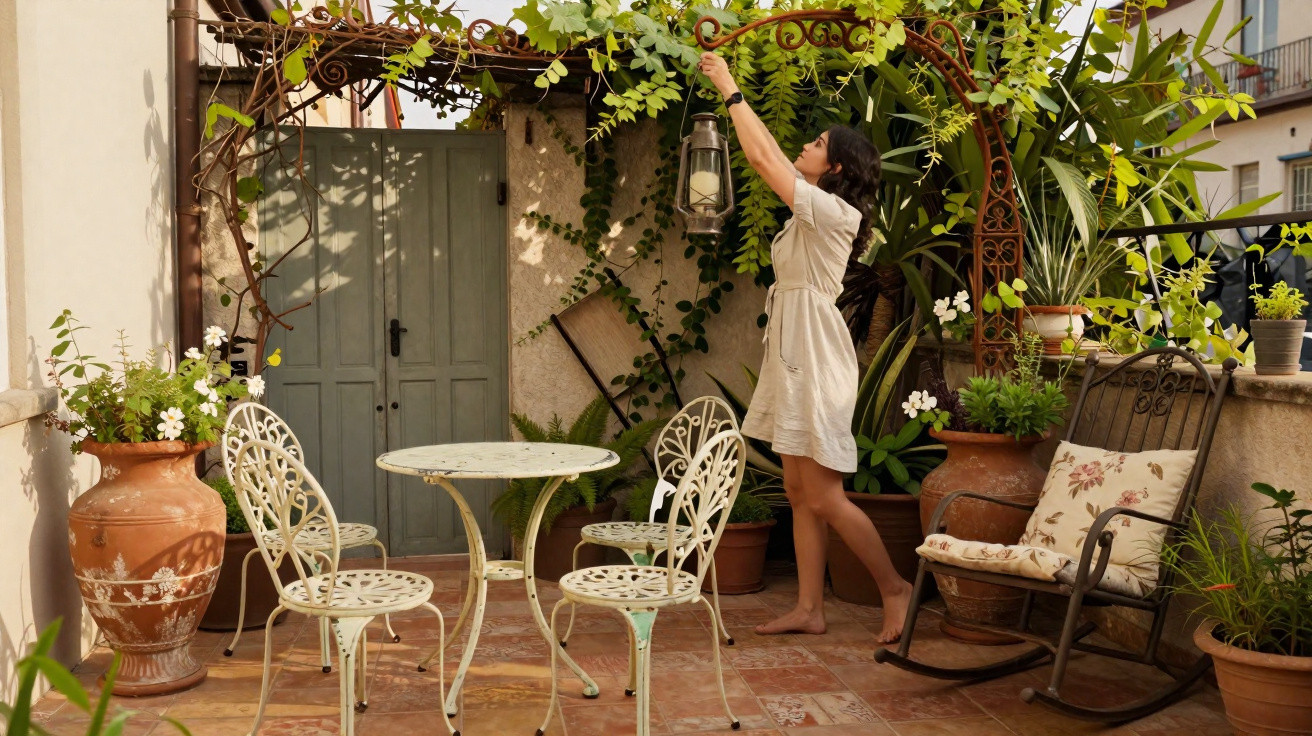
People redesigning a balcony, courtyard or garden today are increasingly turning away from sterile-looking complete sets from DIY shops. The clear trend is towards the Brocante look: pre-owned individual pieces, visible signs of use and durable materials that have already lasted for decades – which is precisely why they work so well. Outdoor spaces should no longer resemble furniture catalogues, but extensions of the living room with a history of their own.
Why Brocante is currently so popular in the garden
For a long time, furnishing efforts centred on interiors. Now, however, many people treat the patio as an extra room. This has raised expectations around style, quality and individuality. Mass-produced furniture can quickly feel interchangeable, whereas finds from flea markets and classified ads are one of a kind.
Patina becomes an ornament in the garden: marks left by weather, time and use give objects the very charm that new furniture often lacks.
At the same time, awareness of sustainability is increasing. Saving well-made furniture or accessories from the 1950s, 1960s or 1970s conserves resources and preserves craftsmanship that is rarely found in much of today's mass-produced furniture.
1. Old outdoor lights: from unwanted item to focal point
Atmospheric lighting often determines whether people want to stay outdoors in the evening or head inside quickly. The move is clearly away from uniform strings of lights and towards individual lamps with real character.
Particularly sought-after options include:
- Brass or copper lanterns from the 1960s
- Pendant lights with frosted glass and visible patina
- Wall lights with slightly flaking paint
These lights regularly appear at flea markets, Brocante shops and classified-ad platforms. When searching, pay attention to two things: the wiring and the stability. Some surface rust on the metal is acceptable, but the lamp holder must be capable of safe replacement.
A practical tip: old casings can often be paired with new outdoor-rated electrical fittings. This retains the historic appearance while ensuring the technology meets current safety standards.
2. Terracotta pots and urns with a past
Terracotta never looks artificial in a garden, particularly when its surface bears moss, limescale marks and fine hairline cracks. These pots are more than planters: they organise an area and draw the eye.
The older and more “used” a terracotta pot appears, the more naturally it settles into the garden.
Interior designers and garden designers often use oversized pots and urns as sculptural elements, placing them, for instance, at the end of a path or beside a bench. The key is to choose a few large pieces rather than scattering many smaller ones around.
It is worth inspecting these carefully before buying:
- Does the pot sound solid and substantial, rather than dull and fragile, when tapped?
- Are any cracks merely on the surface, or do they extend into the interior?
- Can the vessel still be lifted and moved safely?
If in doubt, very old or cracked pieces can be used solely for decoration – left empty, partly buried, or used as the base for a small dry bed of succulents.
3. Wrought iron: arches, pergolas and old garden gates
Wrought-iron features are making a noticeable return to outdoor settings. This includes not only seating, but architectural structures such as arches, pergolas and garden gates.
Their major advantage is that historic pieces are often made from thicker materials with carefully finished joints. They can withstand decades outdoors, be repainted when needed and tend to become more attractive, rather than less so, over time.
One iron arch with climbing roses is enough to add depth and romance to an otherwise flat-looking garden.
Anyone finding a second-hand gate or old pergola should check for pockets of rust in load-bearing areas. Light surface rust is not a concern, whereas deep corrosion around joints is more problematic. Minor damage can be treated effectively using a wire brush, rust-inhibiting primer and paint.
How to care for Brocante iron in the garden
- Remove loose layers of rust with a metal brush.
- Wipe away dust thoroughly or blow it off with compressed air.
- Apply rust-inhibiting primer, especially to cut edges and welded seams.
- Paint with a matt or satin finish – black, dark green or blue-grey look especially timeless.
Those wishing to retain the appeal of ageing can paint only selected areas, deliberately leaving some rust marks as patina.
4. Vintage wrought-iron garden furniture
Nostalgic iron seating sets often turn up when old houses, inns or villas are being cleared. Their distinctive features include ornate backrests, lattice or trailing-vine patterns, and sturdy constructions that are often surprisingly heavy.
Many designers favour these sets because they bring together several benefits:
- Extremely durable frames, usually far longer-lasting than modern aluminium sets
- A delicate appearance that takes up little visual space and works well on small balconies
- Individual patina instead of an immaculate paint finish that soon becomes scratched
Names such as John Salterini increase prices, but unbranded pieces can be equally worthwhile. Patient buyers can often find complete ensembles for considerably less than the price of new retail furniture.
Restoring them often takes no more than an afternoon:
- Tighten the screws and inspect the seating surfaces
- Sand or brush away loose paint
- Add fresh seat cushions or pads – perhaps in bold stripes or muted natural shades
Important: on patios with delicate tiles, use felt pads or protective feet to prevent rust marks transferring to the surface.
5. Vintage armchairs, rocking chairs and loungers
Seating is arguably the most personal part of any patio. It is where people read, make calls and doze. This is exactly why vintage pieces have such impact: their scratches, fabric patterns and shapes tell stories of summers gone by.
Especially popular are:
- Wooden rocking chairs with curved runners
- Rattan armchairs from the 1960s and 1970s
- Deckchairs with wooden frames and retro striped fabric panels
A single old rocking chair on the balcony can create more cosiness than an entirely new lounge set.
At flea markets, these seats are often set aside at the edges, sometimes with faded covers or a slight wobble. That can put buyers off, but unfairly so. Fabrics can be replaced, screws tightened and weak rattan sections reinforced. Those without much DIY confidence can find upholsterers specialising in vintage furniture.
What to check when buying second-hand seating
| Criterion | What to look for |
|---|---|
| Stability | It should not creak or wobble significantly when someone sits on it. |
| Material | Avoid soft, rotten wood and broken rattan strands in load-bearing areas. |
| Screws | Rusty screws that can still be gripped are fine; it is best to avoid those that are completely rounded off. |
| Upholstery | Stains are not a problem, but odours and mould are – in that case, reupholstering is the better option. |
How to create a cohesive scheme from Brocante finds
The greatest skill lies not in buying but in combining pieces. Collecting every bargain at random can quickly result in cluttered bric-a-brac chaos. A broad stylistic framework helps: Mediterranean rustic, urban courtyard, country house or mid-century.
One possible approach is to:
- Keep metal to one or two shades, such as black and dark green.
- Choose woods in similar tones – very dark woods with dark metal, and pale woods with lighter shades.
- Link textiles through patterns and colours, for example stripes in recurring colour combinations.
A clearly defined layout of zones is also useful: one area for dining, a quiet reading chair in partial shade, and a decorative corner with pots and urns.
Benefits, risks and low-maintenance strategies
Brocante in the garden has several tangible advantages: high-quality materials, an individual look, a smaller environmental footprint and usually better value for money. There are also potential pitfalls.
Possible risks include:
- Rusting metal furniture on sensitive surfaces
- Unsafe wiring in old outdoor lights
- Wood deteriorating too quickly outdoors without protection
Keeping these points in mind makes it possible to enjoy such finds for years. A useful rule of thumb is this: everything you sit on or touch should be sturdy and smooth. Patina is welcome; splinters and sharp edges are not.
It is practical to combine Brocante pieces with simple new essentials: a plain weatherproof table with old chairs, new cushions on a historic frame, or modern LED bulbs in old casings. The result is a garden made for use rather than merely decoration – and one that becomes more interesting with every flea-market find.



Comments
No comments yet. Be the first to comment!
Leave a Comment