
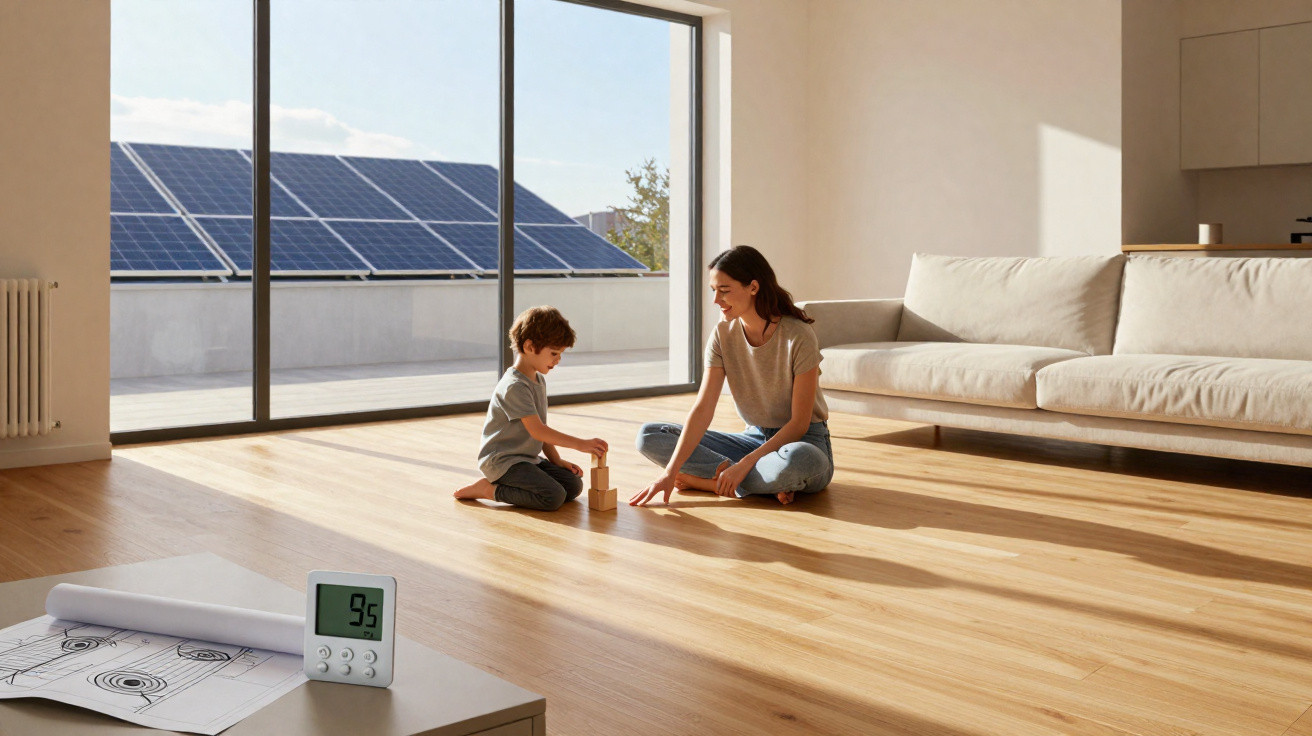
Anyone living through recent winters in Central Europe will recognise the issue: homes are becoming noticeably colder, conventional radiators are working at full capacity, yet bills continue to rise. The energy crisis, pressure to cut CO₂, and ageing gas boilers are making many people uneasy. At the same time, an approach is emerging that feels like a quiet, small-scale revolution: heating with solar electricity, delivered directly through the floor and without conventional radiators.
Heating without radiators – what does it involve?
The underlying idea is almost deceptively straightforward: electricity generated by photovoltaic panels on a roof or façade powers a heating system that needs no visible radiators. In most cases, warmth is delivered through the floor, either by electric heating mats or by a water-based system operated with a heat pump.
Rather than heating a room in isolated spots using individual radiators, the warmth is spread across a wide area. The floor becomes the effective heating surface, while the role of the photovoltaic system is to supply as much of the required energy as possible.
“Combining photovoltaics with surface heating turns the sun into a direct supplier of heat – with almost no ongoing costs.”
At its heart, this approach shifts reliance away from fossil fuels such as gas and oil towards self-generated green electricity. Those with enough roof space and a well-insulated flat or house can cover a substantial proportion of their heating needs using their own system.
How “heating with the sun” works day to day
Photovoltaic modules convert sunlight into electricity. That electricity can be used in three ways:
- directly to run electric underfloor heating or infrared panels;
- to power a heat pump that heats water for a surface heating system;
- or alongside a battery, which stores energy for the evening and overnight.
Heat pumps are particularly important in this setup. They use solar electricity to raise ambient heat from the air, ground or groundwater to a usable temperature. In ideal conditions, one unit of electricity can generate three to four units of heat.
Why the floor becomes the centre of the heating system
Floor-based surface heating is a key component of these newer heating concepts. The physics is simple: warm air rises. When heat is supplied from below and distributed over a large area, a room can often feel comfortable even at a lower air temperature.
This allows lower flow temperatures, meaning less energy is needed to achieve the same level of comfort. It also removes intrusive radiators from the walls, something architects and interior designers welcome.
“Underfloor heating uses large surfaces at low temperatures, making it an ideal match for renewable energy sources such as solar electricity and heat pumps.”
Advantages: where solar heating outperforms conventional radiators
Switching to this type of system can deliver benefits in several areas. Its principal advantages include:
- Significantly lower energy costs: Once the installation has paid for itself, ongoing costs are low. A large share of the heat is supplied “free” by the sun.
- Independence from gas and oil: There are no price shocks on gas markets, less dependence on imports, and no more oil deliveries.
- No local emissions: Neither soot nor exhaust gases are produced inside the building. This improves air quality in homes and cities.
- A more pleasant indoor climate: Underfloor heating provides even, gentle warmth. Cold corners and overheated areas occur less frequently.
- Less circulating dust: Without hot radiators creating air currents, less dust is moved around rooms – a benefit for allergy sufferers.
Many users say that rooms with underfloor heating already feel cosy at 20 to 21 degrees, whereas conventional radiator systems are often set to 22 or 23 degrees. That small difference reduces energy use without sacrificing comfort.
What does it cost, and when does it pay for itself?
The main obstacle comes at the outset: purchase and installation costs. A photovoltaic system, inverter, potentially a battery, heat pump and underfloor heating can quickly amount to a five-figure sum. Renovating an older property may also require floors to be opened up and insulation to be improved.
At the same time, solar technology has become cheaper for years. In many areas, government support schemes and low-interest loans cover part of the investment. Example calculations show that, with a well-designed installation, heating and electricity demand can be reduced enough for the system to pay for itself after several years.
| Aspect | Conventional heating (gas/oil) | Solar-powered surface heating |
|---|---|---|
| Running costs | high, dependent on world market prices | low, mainly maintenance |
| CO₂ emissions during operation | significant | close to zero with green electricity |
| Visible radiators | yes | no |
| Comfort | localised warmth | even radiant heat |
Who can genuinely benefit from switching?
The technology is not equally suitable for every building. Several requirements should be met for the system to make economic and technical sense:
- sufficient roof or façade area with good sun exposure;
- the best possible insulation to the façade, roof and windows;
- low flow temperatures, usually provided by underfloor or wall heating;
- electrical infrastructure designed to handle higher loads.
In poorly insulated older buildings with outdated windows and numerous thermal bridges, it is difficult to create an efficient system even with solar power and a heat pump. In such cases, major refurbishment is often unavoidable before changing the heating system becomes worthwhile.
Technical complications and potential pitfalls
Although the concept may sound highly future-proof, it does not run itself. Those who plan too tightly can face unpleasant surprises in the depths of winter. Common problems include:
- an undersized photovoltaic array;
- no battery storage, or storage that is too small;
- a poorly specified heat pump that relies solely on an electric immersion heater during freezing weather;
- inadequate control between power generation, heating and storage.
The essential factor is an integrated overall plan. Energy advisers and specialist installers now often design the entire property as one system, bringing together insulation, heating technology, solar capacity, storage and user behaviour. The better these elements work together, the closer homeowners come to heating largely with their own solar energy.
Everyday examples of solar electricity and underfloor heating
In many new housing developments, it is now common to see homes with photovoltaic panels covering almost their entire roofs. A heat pump hums away in the utility room, while heating pipes are laid in the screed on the ground floor. During the day, the system generates more electricity than the home currently needs; the surplus charges the battery or is exported to the grid.
At night, the battery takes over part of the supply. If that is insufficient, the electricity grid provides the remainder. Even so, annual electricity bills are often surprisingly low in well-planned projects, because high summer surpluses improve the overall balance.
“Those who consider heating, insulation and solar electricity together can operate their home with self-generated energy for almost the entire year.”
Key terms explained briefly
Photovoltaics (PV): Technology that converts sunlight directly into electrical power. It is based on solar cells made from semiconductor materials, usually silicon.
Heat pump: A device that raises ambient heat to a higher temperature, much like a refrigerator working in reverse. One unit of electricity can produce several units of heat.
Surface heating: A heating system in which large areas, such as floors or walls, are warmed instead of small radiators. As a result, the heating surface can operate at a lower temperature.
How the trend could develop further
Photovoltaic modules are becoming slightly more efficient and less expensive every year. At the same time, many countries are accelerating their move away from fossil-fuel heating systems. For homeowners, this creates pressure but also an opportunity: anyone already planning modernisation can take the step towards a heating system that creates far fewer long-term dependencies.
Further combinations are also promising: solar thermal systems for direct hot-water production, photovoltaics for heat pumps and household electricity, and intelligent controls that incorporate weather data. The aim is a home that ideally produces much of its own energy – and where radiators truly become unnecessary.






Comments
No comments yet. Be the first to comment!
Leave a Comment